


Has your personal data been recently exposed?
Check if information like your Social Security number, email, and passwords is exposed on the dark web.


You have reached the maximum number of scans allowed. Please come back after 24 hours.

Scanning the dark web...
Scanning public databases...
Scanning millions of records...
Narrowing down the search...
We need more information
Please enter a few more details to ensure we show you the right information.
You’re at high risk
We found your personal information on the dark web and on data broker sites.
 Up to $3M Reimbursement for identity theft, with up to $1M for Stolen Funds†††
$10K Scam Reimbursement7
Scam Support
Credit, Checking and Savings Activity Alerts: Unlimited Accounts
Credit & Payday Loan Lock2
Credit Monitoring:
3 Bureau1
Automatic Data Broker Removal8
Dark Web Monitoring
Priority 24/7 Customer Phone Support
LifeLock Total

No one can prevent all cybercrime or prevent all identity theft.
- Price valid for introductory term. After that, your price will renew at the standard price.
- Your subscription begins immediately after your transaction is complete. A payment method is required at sign-up for trials, and you will be charged at the end of your trial, unless canceled first.
- Prices are subject to change and may be charged up to 35 days prior to renewal. Cancel here or contact Member Services.
- Restrictions apply. Automatically renewing subscription required. If you're a victim of identity theft and not satisfied with our resolution, you may receive a refund for the current term of your subscription. See lifelock.norton.com/guarantee for complete details.
††† Up to $1 million coverage for Lawyers and Experts included with all plans. Reimbursement and expense compensation vary according to plan. Insurance benefits are issued by third parties. See lifelock.norton.com/legal for policy info.
1 Bureau Monitoring and Monthly Credit Report and Score / 3 Bureau Monitoring and Monthly Credit Report and Score.
2 Credit Lock cannot prevent all account takeovers, unauthorized account openings, or credit file inquiries. Deactivates if you downgrade or cancel your subscription.
7 Scam protection coverage as part of identity theft benefits is currently available to all customers residing in the United States, including U.S. territories and the District of Columbia, with the exception of residents of New York. Gen Digital is not a licensed insurance producer. Benefits under the Master Policy are issued and covered by HSB Specialty Insurance Company. You can find further details and exclusions in the summary of benefits.
8 After setup, automatic data broker removal service scans and requests removal every 90 days.
You’re at medium risk
We found your personal information on data broker sites.
Up to $1.2M Reimbursement for identity theft, with up to $100K for Stolen Funds†††
$5K Scam Reimbursement7
Scam Support
Credit, Checking and Savings Activity Alerts:
5 Accounts
Credit & Payday Loan Lock2
Credit Monitoring:
3 Bureau1
Automatic Data Broker Removal8
Dark Web Monitoring
Priority 24/7 Customer Phone Support
LifeLock Advanced
No one can prevent all cybercrime or prevent all identity theft.
- Price valid for introductory term. After that, your price will renew at the standard price.
- Your subscription begins immediately after your transaction is complete. A payment method is required at sign-up for trials, and you will be charged at the end of your trial, unless canceled first.
- Prices are subject to change and may be charged up to 35 days prior to renewal. Cancel here or contact Member Services.
- Restrictions apply. Automatically renewing subscription required. If you're a victim of identity theft and not satisfied with our resolution, you may receive a refund for the current term of your subscription. See lifelock.norton.com/guarantee for complete details.
††† Up to $1 million coverage for Lawyers and Experts included with all plans. Reimbursement and expense compensation vary according to plan. Insurance benefits are issued by third parties. See lifelock.norton.com/legal for policy info.
1 Bureau Monitoring and Monthly Credit Report and Score / 3 Bureau Monitoring and Monthly Credit Report and Score.
2 Credit Lock cannot prevent all account takeovers, unauthorized account openings, or credit file inquiries. Deactivates if you downgrade or cancel your subscription.
7 Scam protection coverage as part of identity theft benefits is currently available to all customers residing in the United States, including U.S. territories and the District of Columbia, with the exception of residents of New York. Gen Digital is not a licensed insurance producer. Benefits under the Master Policy are issued and covered by HSB Specialty Insurance Company. You can find further details and exclusions in the summary of benefits.
8 After setup, automatic data broker removal service scans and requests removal every 90 days.
Good news!
We didn’t find your personal information across millions of records or on public data sources.
Up to $1.05M Reimbursement for identity theft, with up to $25K for Stolen Funds†††
Identity Restoration Specialists
Credit, Checking and Savings Activity Alerts:
2 Accounts
Credit & Payday Loan Lock2
Credit Monitoring:
2 Bureau1
Automatic Data Broker Removal8
Dark Web Monitoring
Breach Alerts
24/7 Customer Phone Support
Lifelock Core
No one can prevent all cybercrime or prevent all identity theft.
- Price valid for introductory term. After that, your price will renew at the standard price.
- Your subscription begins immediately after your transaction is complete. A payment method is required at sign-up for trials, and you will be charged at the end of your trial, unless canceled first.
- Prices are subject to change and may be charged up to 35 days prior to renewal. Cancel here or contact Member Services.
- Restrictions apply. Automatically renewing subscription required. If you're a victim of identity theft and not satisfied with our resolution, you may receive a refund for the current term of your subscription. See lifelock.norton.com/guarantee for complete details.
††† Up to $1 million coverage for Lawyers and Experts included with all plans. Reimbursement and expense compensation vary according to plan. Insurance benefits are issued by third parties. See lifelock.norton.com/legal for policy info.
1 Credit features require successful setup, identity verification, and sufficient credit history by the appropriate credit bureau. Credit monitoring features may take several days to activate after enrollment.
2 Identity Lock cannot prevent all account takeovers, unauthorized account openings, or credit file inquiries. Deactivates if you downgrade or cancel your subscription.
8 After setup, automatic data broker removal service scans and requests removal every 90 days.

 Why do we ask?
Finding your match...

10 cents
If your information is exposed or stolen in a data breach, it can end up on the dark web where it can be sold for as little as 10 cents.
100M+
LifeLock monitors hundreds of millions of data points a second.
- Up to $1.05M Reimbursement for identity theft, with up to $25K for Stolen Funds†††
- Up to $1.2M Reimbursement for identity theft, with up to $100K for Stolen Funds†††
- Up to $3M Reimbursement for identity theft, with up to $1M for Stolen Funds†††
- Up to $1.05M Reimbursement for identity theft, with up to $25K for Stolen Funds††† for each adult
- Up to $1.2M Reimbursement for identity theft, with up to $100K for Stolen Funds††† for each adult
- Up to $3M Reimbursement for identity theft, with up to $1M for Stolen Funds††† for each adult
- Up to $1.05M Reimbursement for identity theft, with up to $25K for Stolen Funds††† for each adult
- Up to $1.2M Reimbursement for identity theft, with up to $100K for Stolen Funds††† for each adult
- Up to $3M Reimbursement for identity theft, with up to $1M for Stolen Funds††† for each adult
- Credit Monitoring Coverage1
- Credit Monitoring1 each adult
- Credit Monitoring1 for family
- Credit, Checking & Savings Account Activity Alerts
- Credit, Checking and Savings Activity Alerts for each adult
- Credit, Checking and Savings Activity Alerts for family
- 401K & Investment Account Activity Alerts
- 401K/Investment Account Alerts for each adult
- 401K/Investment Account Alerts for family
- Recurring and Unusual Charge Alerts
- Unexpected & Suspicious Charge Alerts for each adult
- Unexpected & Suspicious Charge Alerts for family
- Stolen Funds Reimbursement†††
- Stolen Funds Reimbursement††† for each adult
- Stolen Funds Reimbursement††† for family
- Lawyers and Experts†††
- Lawyers & Experts††† for each adult
- Lawyers & Experts††† for family
- Automatic Data Broker Removal8
- Automatic Data Broker Removal8 for each adult
- Automatic Data Broker Removal8 for family
- Scam Reimbursement7
- Scam Reimbursement7 for each adult
- Scam Reimbursement7 for family
- Credit Reports & Scores1
- Credit Report & Score for each adult
- Credit Report & Score for family
- Social Media Monitoring
- Social Media Monitoring for each adult
- Social Media Monitoring for family


††† Up to $1 million coverage for Lawyers and Experts included with all plans. Reimbursement and expense compensation vary according to plan. Insurance benefits are issued by third parties. See LifeLock.Norton.com/legal for policy info.
1 Credit features require successful setup, identity verification and sufficient credit history by the appropriate credit bureau. Credit monitoring features may take several days to activate after enrollment.
7 Scam protection coverage as part of identity theft benefits is currently available to all customers residing in the United States, including U.S. territories and the District of Columbia, with the exception of residents of New York. Gen Digital is not a licensed insurance producer. Benefits under the Master Policy are issued and covered by HSB Specialty Insurance Company. You can find further details and exclusions in the Summary of Benefits.
8 After setup, automatic data broker removal service scans and requests removal every 90 days.
Why do we ask?
Identifying your concerns gives us the ability to recommend the right plan for your needs.
Why do we ask?
Knowing this number helps us recommend coverage that fits your needs.
Why do we ask?
Providing your email address makes you eligible for notifications of potential identity threats.
Do the police investigate credit card theft?
Police may investigate credit card theft depending on the nature and severity of the crime committed. Find out what to do if your credit card is stolen, and how LifeLock Advanced can help you spot fraudulent activity with three-bureau credit monitoring, credit account alerts, and stolen wallet protection.





To criminals, stolen credit cards can seem like an “infinite free money” hack, which helps explain why credit card fraud is so prevalent. In 2024 alone, the FTC received more than 449,000 reports of credit card fraud, an 8% increase from 2023, making it the most common type of identity theft.
The scale of the problem shows up in fraud detection data too: the Gen Q3 2025 Threat Report found that suspicious credit card activity triggered alerts for 20% of alerted users, second only to suspicious bank account activity.
If you fall victim to credit card theft or card-not-present fraud, you’ll likely feel overwhelmed and have a few questions. Once you’ve canceled your compromised card, you’ll probably wonder whether you should file a police report for credit card theft.
Continue reading to learn about who handles credit card theft investigations, when to get the police involved, and how identity theft protection from LifeLock can amplify your protection and help lock down your personal information.
Who handles credit card theft investigations?
Financial institutions, the police, and federal agencies typically handle credit card theft investigations.
- Financial institutions: When you notice a fraudulent charge on your account or that your card is stolen, you should first contact your bank. They’ll help you protect your account and cancel your compromised card. Then they’ll review your case, look for suspicious patterns in your transaction history, and reimburse you if they confirm theft.
- Police: The police are more likely to investigate credit card theft if it’s tied to wider criminal activity or involves a significant monetary value. They will also intervene if the theft is connected to acts of violence.
- Federal agencies: Large-scale, interstate credit card fraud may be investigated by the FBI, including reports made through its Internet Crime Complaint Center (IC3). Consumer fraud and identity theft should also be reported to the FTC. Which federal agencies become involved depends on the nature, scale, and circumstances of the crime.
Should you contact the police about credit card theft?
Yes, you should report credit card fraud to the police — even if they won’t investigate — because filing a report is vital for creating an official record that helps support your case if complications arise with your bank or a credit agency.
For example, there may be instances where the issuing bank refuses to reimburse you, or a credit bureau erroneously lowers your credit score after the fraud.
Many times, the only thing that can reverse the bank’s or bureau’s decision is a police report.
Some banks may even request a police report as part of their internal investigation. Filing a report with law enforcement also helps investigators detect larger patterns of criminal activity.
When do police investigate credit card theft?
Police are more likely to investigate credit card theft when the financial loss is significant, the theft is part of another crime, or it’s part of an identity theft or hacking ring.
Here’s when your police report may trigger an active investigation:
- The financial loss is significant: This is because bigger losses may cross the state’s felony threshold, and could indicate the fraud is part of a larger scheme.
- The theft is part of another crime: This could include a home break-in or carjacking. These crimes are violent or invasive, going beyond simple financial fraud.
- The fraud is part of an identity theft or hacking ring: This can affect the bank accounts, tax records, and credit scores of thousands of citizens, and signals a large-scale security issue.
- There’s available evidence in the form of suspects or leads: This could be security footage, point-of-sale records, or transaction IP addresses.
What happens when you report credit card theft?
When your credit card is stolen, or your card details fall into the wrong hands, acting quickly can help limit unauthorized charges, protect your account, and begin the dispute or investigation process sooner. Here’s what happens when you report credit card theft.
1. Your credit card is frozen
When you contact your credit card issuer, they’ll cancel your card to prevent further losses. You’ll need to provide details of the fraud to help them start their investigation.
2. The credit card issuer investigates the fraud
Your financial institution’s internal fraud department will review your account. They’ll scan for suspicious patterns and review your spending history. This process may also involve gathering data from national fraud databases or flagging the merchant.
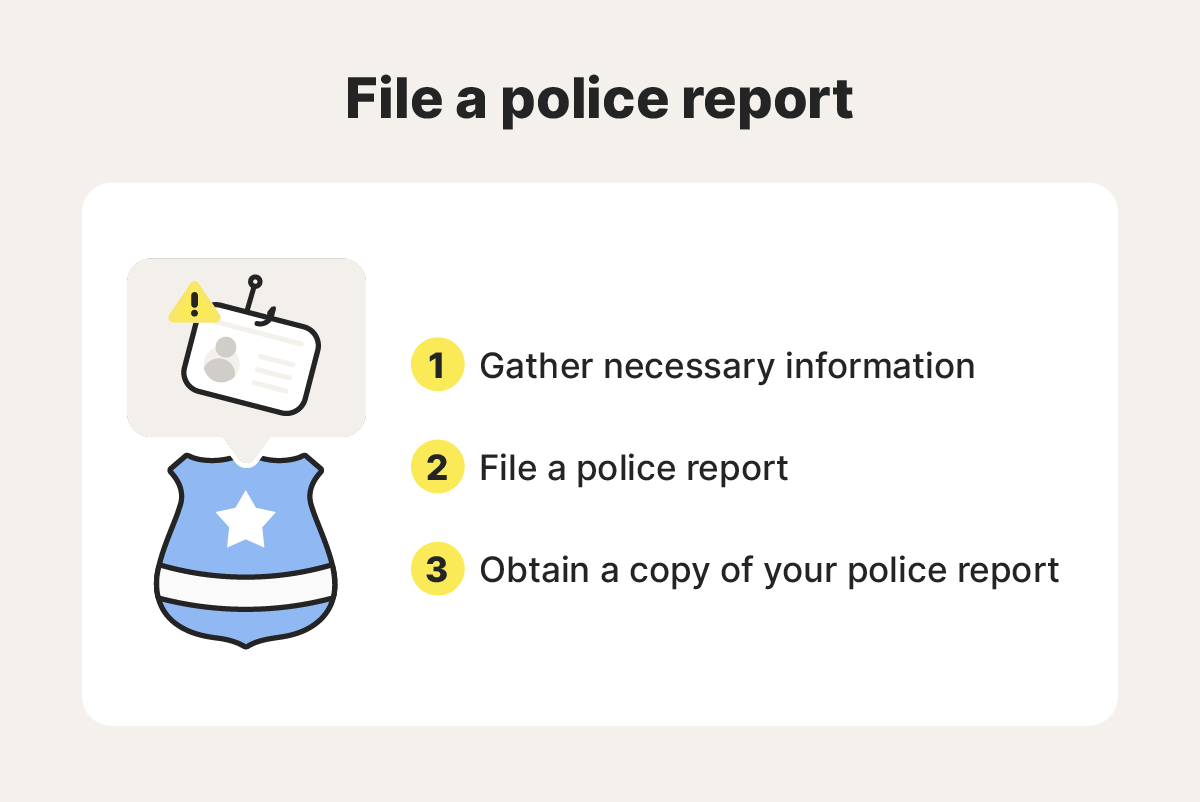
3. You file a police report
Filing a police report is a crucial step in protecting yourself because it creates an official record of the crime. This documentation strengthens your case with banks, and they may even request this before they start investigating.
When filing, include as many details as possible, such as:
- Bank statements showing unauthorized or unfamiliar transactions.
- Transaction details, including dates, amounts, and merchant names.
- A timeline of your movements around the time of the suspected fraud.
- Screenshots of unauthorized transactions or unfamiliar merchant charges.
- Phishing emails or SMS messages received around the time of the fraud.
- Correspondence with the merchant, card issuer, or payment processor, if applicable.
It’s also worth filing a report with the FTC at ReportFraud.ftc.gov. Your report is added to the Consumer Sentinel Network, a database that helps law enforcement agencies identify patterns and connect related cases.
4. Police may investigate the fraud
Filing a police report creates an important official record of credit card fraud, but it doesn’t guarantee a full investigation. Individual cases may not receive extensive law enforcement resources, particularly when losses are relatively small or there are few investigative leads. With nearly 449,000 reports in 2024 alone, according to recent credit card fraud statistics, authorities must prioritize cases based on factors such as severity, evidence, and scale.
So, don’t be surprised if the police refer your case back to the bank’s fraud department. Even if your case doesn’t land on a detective’s desk, it’s still important to file a report.
5. The credit issuer makes a decision based on its investigation
If your credit issuer determines there was fraud involved, they’ll refund you part or all of the amount. Under the Fair Credit Billing Act:
- Your maximum liability is $50 if your credit card is used fraudulently.
- If you report the card stolen before it’s used, you have zero liability.
- If the card number (but not the physical card) is stolen, you’re not liable for any charges.
Some card issuers also voluntarily offer zero-liability protection, meaning you may not have to pay anything for unauthorized charges. This is not a blanket federal legal right, and coverage varies by issuer, card type, and circumstances. Check your card’s terms to understand the protections that apply.
How to protect yourself from credit card theft
You need to keep your physical card safe, be wary of scams, and protect your personal information online to help prevent credit card theft.
Here’s how to help protect yourself from credit card theft:
- Set up fraud alert notifications: Enable fraud alert notifications with financial institutions and review bank statements regularly for unauthorized charges.
- Enable 2-factor authentication (2FA): Use 2FA on all of your financial accounts. This requires a second verification step when logging in, making it harder for a cybercriminal to steal your card details or make fraudulent transactions via your account.
- Choose contactless payments: Tap your card or use your smartphone instead of inserting your card into a reader. This can be more secure and help you avoid credit card skimming devices that allow criminals to clone your card.
- Avoid clicking suspicious links: Email or SMS phishing attacks rely on social engineering tactics to trick you into clicking malicious links to steal sensitive info like your credit card number.
- Be wary of scams: Stay up to date with other scams that could put your credit card details at risk. For example, an unsolicited call from your “card issuer” could be a scammer trying to steal your card number.
- Run a dark web scan: Dark web monitoring services scan the dark web and notify you if sensitive info like your credit card number is found. This lets you take action to secure your card and accounts, possibly before fraud occurs.
- Get identity theft protection: Consider getting identity theft protection from a trusted brand like LifeLock. This also includes credit monitoring, which will notify you if suspected fraud is detected.
Help protect your credit card with LifeLock
Even if you take all the right precautions to secure your credit card and identity, it’s not always enough. Get LifeLock Advanced to monitor your credit card and bank accounts with activity alerts, helping you spot suspicious transactions early. Plus, with three-bureau credit monitoring, stolen wallet protection, and other identity theft protection features baked in, you can help protect your wealth and future with total confidence.
FAQs
What should you do if your credit card issuer won’t refund fraudulent charges?
If the bank won’t refund your money after a fraudulent charge is made, you can file a complaint with the Consumer Financial Protection Bureau (CFPB).
Is credit card fraud a felony?
It can be classified as a felony or a misdemeanor. This usually depends on the amount stolen, whether identity theft or hacking was involved, whether it was part of organized crime, or if the fraud crossed state or national borders.
Can credit card theft be traced?
Physical credit card theft and fraud can sometimes be traced using surveillance footage. Card-not-present fraud — where your card number is used without the physical card, often for online purchases — may leave a digital trail of merchant transaction logs, payment processor records, and other technical data that helps investigators identify where and how the card information was used.
How can I improve the chances of the police investigating my credit card theft?
File a detailed police report detailing the financial loss involved, timelines for when the fraud occurred, bank statements, and anything else that could help the police.
Do police investigate credit card theft under $500?
Police don’t have infinite resources, so they can’t investigate every case of credit card theft. However, they’re more likely to investigate if a wider crime syndicate is implicated, if violence was involved, if there’s solid evidence, or if it crosses the relevant state’s felony threshold.
Editors’ note: Our articles provide educational information about identity theft, scams, financial fraud, and other topics that can put your identity or personal accounts at risk. LifeLock offerings may not cover or protect against every type of crime, fraud, scam, or threat we write about. For more details about how we write, review, and update our articles, see our Editorial Policy.
This article contains
Related articles