


Has your personal data been recently exposed?
Check if information like your Social Security number, email, and passwords is exposed on the dark web.


You have reached the maximum number of scans allowed. Please come back after 24 hours.

Scanning the dark web...
Scanning public databases...
Scanning millions of records...
Narrowing down the search...
We need more information
Please enter a few more details to ensure we show you the right information.
You’re at high risk
We found your personal information on the dark web and on data broker sites.
 Up to $3M Reimbursement for identity theft, with up to $1M for Stolen Funds†††
$10K Scam Reimbursement7
Scam Support
Credit, Checking and Savings Activity Alerts: Unlimited Accounts
Credit & Payday Loan Lock2
Credit Monitoring:
3 Bureau1
Automatic Data Broker Removal8
Dark Web Monitoring
Priority 24/7 Customer Phone Support
Up to $3M Reimbursement for identity theft, with up to $1M for Stolen Funds†††
$10K Scam Reimbursement7
Scam Support
Credit, Checking and Savings Activity Alerts: Unlimited Accounts
Credit & Payday Loan Lock2
Credit Monitoring:
3 Bureau1
Automatic Data Broker Removal8
Dark Web Monitoring
Priority 24/7 Customer Phone Support
LifeLock Total

No one can prevent all cybercrime or prevent all identity theft.
- Price valid for introductory term. After that, your price will renew at the standard price.
- Your subscription begins immediately after your transaction is complete. A payment method is required at sign-up for trials, and you will be charged at the end of your trial, unless canceled first.
- Prices are subject to change and may be charged up to 35 days prior to renewal. Cancel here or contact Member Services.
- Restrictions apply. Automatically renewing subscription required. If you're a victim of identity theft and not satisfied with our resolution, you may receive a refund for the current term of your subscription. See lifelock.norton.com/guarantee for complete details.
††† Up to $1 million coverage for Lawyers and Experts included with all plans. Reimbursement and expense compensation vary according to plan. Insurance benefits are issued by third parties. See lifelock.norton.com/legal for policy info.
1 Bureau Monitoring and Monthly Credit Report and Score / 3 Bureau Monitoring and Monthly Credit Report and Score.
2 Credit Lock cannot prevent all account takeovers, unauthorized account openings, or credit file inquiries. Deactivates if you downgrade or cancel your subscription.
7 Scam protection coverage as part of identity theft benefits is currently available to all customers residing in the United States, including U.S. territories and the District of Columbia, with the exception of residents of New York. Gen Digital is not a licensed insurance producer. Benefits under the Master Policy are issued and covered by HSB Specialty Insurance Company. You can find further details and exclusions in the summary of benefits.
8 After setup, automatic data broker removal service scans and requests removal every 90 days.
You’re at medium risk
We found your personal information on data broker sites.
Up to $1.2M Reimbursement for identity theft, with up to $100K for Stolen Funds†††
$5K Scam Reimbursement7
Scam Support
Credit, Checking and Savings Activity Alerts:
5 Accounts
Credit & Payday Loan Lock2
Credit Monitoring:
3 Bureau1
Automatic Data Broker Removal8
Dark Web Monitoring
Priority 24/7 Customer Phone Support
LifeLock Advanced
No one can prevent all cybercrime or prevent all identity theft.
- Price valid for introductory term. After that, your price will renew at the standard price.
- Your subscription begins immediately after your transaction is complete. A payment method is required at sign-up for trials, and you will be charged at the end of your trial, unless canceled first.
- Prices are subject to change and may be charged up to 35 days prior to renewal. Cancel here or contact Member Services.
- Restrictions apply. Automatically renewing subscription required. If you're a victim of identity theft and not satisfied with our resolution, you may receive a refund for the current term of your subscription. See lifelock.norton.com/guarantee for complete details.
††† Up to $1 million coverage for Lawyers and Experts included with all plans. Reimbursement and expense compensation vary according to plan. Insurance benefits are issued by third parties. See lifelock.norton.com/legal for policy info.
1 Bureau Monitoring and Monthly Credit Report and Score / 3 Bureau Monitoring and Monthly Credit Report and Score.
2 Credit Lock cannot prevent all account takeovers, unauthorized account openings, or credit file inquiries. Deactivates if you downgrade or cancel your subscription.
7 Scam protection coverage as part of identity theft benefits is currently available to all customers residing in the United States, including U.S. territories and the District of Columbia, with the exception of residents of New York. Gen Digital is not a licensed insurance producer. Benefits under the Master Policy are issued and covered by HSB Specialty Insurance Company. You can find further details and exclusions in the summary of benefits.
8 After setup, automatic data broker removal service scans and requests removal every 90 days.
Good news!
We didn’t find your personal information across millions of records or on public data sources.
Up to $1.05M Reimbursement for identity theft, with up to $25K for Stolen Funds†††
Identity Restoration Specialists
Credit, Checking and Savings Activity Alerts:
2 Accounts
Credit & Payday Loan Lock2
Credit Monitoring:
2 Bureau1
Automatic Data Broker Removal8
Dark Web Monitoring
Breach Alerts
24/7 Customer Phone Support
Lifelock Core
No one can prevent all cybercrime or prevent all identity theft.
- Price valid for introductory term. After that, your price will renew at the standard price.
- Your subscription begins immediately after your transaction is complete. A payment method is required at sign-up for trials, and you will be charged at the end of your trial, unless canceled first.
- Prices are subject to change and may be charged up to 35 days prior to renewal. Cancel here or contact Member Services.
- Restrictions apply. Automatically renewing subscription required. If you're a victim of identity theft and not satisfied with our resolution, you may receive a refund for the current term of your subscription. See lifelock.norton.com/guarantee for complete details.
††† Up to $1 million coverage for Lawyers and Experts included with all plans. Reimbursement and expense compensation vary according to plan. Insurance benefits are issued by third parties. See lifelock.norton.com/legal for policy info.
1 Credit features require successful setup, identity verification, and sufficient credit history by the appropriate credit bureau. Credit monitoring features may take several days to activate after enrollment.
2 Identity Lock cannot prevent all account takeovers, unauthorized account openings, or credit file inquiries. Deactivates if you downgrade or cancel your subscription.
8 After setup, automatic data broker removal service scans and requests removal every 90 days.

 Why do we ask?
Finding your match...

10 cents
If your information is exposed or stolen in a data breach, it can end up on the dark web where it can be sold for as little as 10 cents.
100M+
LifeLock monitors hundreds of millions of data points a second.
- Up to $1.05M Reimbursement for identity theft, with up to $25K for Stolen Funds†††
- Up to $1.2M Reimbursement for identity theft, with up to $100K for Stolen Funds†††
- Up to $3M Reimbursement for identity theft, with up to $1M for Stolen Funds†††
- Up to $1.05M Reimbursement for identity theft, with up to $25K for Stolen Funds††† for each adult
- Up to $1.2M Reimbursement for identity theft, with up to $100K for Stolen Funds††† for each adult
- Up to $3M Reimbursement for identity theft, with up to $1M for Stolen Funds††† for each adult
- Up to $1.05M Reimbursement for identity theft, with up to $25K for Stolen Funds††† for each adult
- Up to $1.2M Reimbursement for identity theft, with up to $100K for Stolen Funds††† for each adult
- Up to $3M Reimbursement for identity theft, with up to $1M for Stolen Funds††† for each adult
- Credit Monitoring Coverage1
- Credit Monitoring1 each adult
- Credit Monitoring1 for family
- Credit, Checking & Savings Account Activity Alerts
- Credit, Checking and Savings Activity Alerts for each adult
- Credit, Checking and Savings Activity Alerts for family
- 401K & Investment Account Activity Alerts
- 401K/Investment Account Alerts for each adult
- 401K/Investment Account Alerts for family
- Recurring and Unusual Charge Alerts
- Unexpected & Suspicious Charge Alerts for each adult
- Unexpected & Suspicious Charge Alerts for family
- Stolen Funds Reimbursement†††
- Stolen Funds Reimbursement††† for each adult
- Stolen Funds Reimbursement††† for family
- Lawyers and Experts†††
- Lawyers & Experts††† for each adult
- Lawyers & Experts††† for family
- Automatic Data Broker Removal8
- Automatic Data Broker Removal8 for each adult
- Automatic Data Broker Removal8 for family
- Scam Reimbursement7
- Scam Reimbursement7 for each adult
- Scam Reimbursement7 for family
- Credit Reports & Scores1
- Credit Report & Score for each adult
- Credit Report & Score for family
- Social Media Monitoring
- Social Media Monitoring for each adult
- Social Media Monitoring for family


††† Up to $1 million coverage for Lawyers and Experts included with all plans. Reimbursement and expense compensation vary according to plan. Insurance benefits are issued by third parties. See LifeLock.Norton.com/legal for policy info.
1 Credit features require successful setup, identity verification and sufficient credit history by the appropriate credit bureau. Credit monitoring features may take several days to activate after enrollment.
7 Scam protection coverage as part of identity theft benefits is currently available to all customers residing in the United States, including U.S. territories and the District of Columbia, with the exception of residents of New York. Gen Digital is not a licensed insurance producer. Benefits under the Master Policy are issued and covered by HSB Specialty Insurance Company. You can find further details and exclusions in the Summary of Benefits.
8 After setup, automatic data broker removal service scans and requests removal every 90 days.
Why do we ask?
Identifying your concerns gives us the ability to recommend the right plan for your needs.
Why do we ask?
Knowing this number helps us recommend coverage that fits your needs.
Why do we ask?
Providing your email address makes you eligible for notifications of potential identity threats.
What is tax identity theft and how does it occur?
Between filing deadlines, understanding complex deductions, and owing money to the IRS, tax season is stressful enough. The last thing you need is an uphill battle against identity theft because someone has already filed in your name. Learn how tax identity theft occurs and how LifeLock can help protect your identity from being misused.





In the 2025 tax filing season alone, The Internal Revenue Service (IRS) flagged 2.1 million returns for potential identity theft. And, while some of those cases may be the result of oversensitive filters erring on the side of caution, many are likely to be real cases of tax identity theft.
Unpicking the web of identity theft and its fallout isn’t a quick job. In fact, refund delays for theft victims in 2025 took around 20 months to resolve on average. And, in the meantime, you’re unlikely to receive a tax refund that you might be owed, leaving you out of pocket when you least expected it.
Learn more about how tax identity theft occurs so you understand what you can do to protect against it, and discover the key steps to take if someone does file in your name.
What is tax identity theft?
Tax identity theft is when someone uses your personal information to file a fraudulent tax return in your name. Typically, they do this to steal your tax refund or claim taxes withheld while they worked under your stolen identity.
Another less common form of tax identity theft involves the thief fraudulently claiming your child or another dependent on their tax return to steal the tax benefit. But, regardless of the specifics, you probably won’t realize you’re a victim of tax identity theft until you try to file your tax return and it’s rejected automatically.
How tax identity theft typically happens
A typical case of tax identity theft involves a fraudster stealing your personal information and filing a fake return in your name to claim your refund. They’ll aim to file as early as possible in the tax season to get there before you get a chance.
All they need to get started is your SSN and name. However, any other data they have access to, like your birth date, address, W-2 details, or prior-year tax information, can make the fraudulent filing look more legitimate. They steal this information through phishing attacks, data breaches, or mail theft.
Here’s a summary of how a tax identity theft incident might go:
- Your sensitive information is stolen: Identity thieves need to get access to sensitive information required in a tax return, like your SSN. To get it, they might steal your mail, exploit security flaws in payroll software, trick you with social engineering tactics, leverage a data breach, or buy data on dark web marketplaces.
- A fraudulent tax return is filed in your name: Using your SSN and other personal information, the identity thief will file a tax return in your name early on in the tax season, before you get a chance to do your own. They’ll make up fake income and deductions to maximize the return.
- Your return is directed to the fraudster: The identity thief enters their own bank account information for the tax return to be deposited in, giving them access to cash that should be yours.
- You can’t file your own return: When you finally get around to submitting your tax return, you’ll get a message from the IRS system claiming that one has already been filed under your name. At this point, you’ll need to prove your identity to the IRS before the issue can be investigated.
Warning signs of tax identity theft
Tax identity theft often goes unnoticed until you try to file and receive an auto-rejection, or you get mail from the IRS about unreported income, account changes, or a previously filed return. However, there are some other potential warning signs to watch out for, including:
- Unfamiliar income: If you receive a W-2 or 1099 from an employer you don’t recognize, someone may have used your identity to apply for and get approved for a job, creating income records the IRS now associates with you.
- Missing mail: Ahead of tax season, be vigilant for any missing mail, particularly if you’re expecting sensitive documents like W-2s, 1099s, bank statements, or insurance notices. If mail you expect doesn’t arrive, it may have been stolen for tax identity theft.
- Delayed refund: The IRS’ Where’s My Refund? tool may show unusual delays or status changes if the IRS flags your return for identity verification after receiving a fraudulent filing.
- Unexplained credit activity: Unauthorized accounts or credit inquiries may appear on your credit report if your stolen identity has been used in credit fraud. This means you’re also at increased risk of tax identity theft.
An identity theft protection service can help you monitor for common signs that your sensitive data is being misused, with credit monitoring, financial account alerts, identity alerts, and more. Plus, if you do fall victim to identity theft, you’ll get expert restoration support helping guide you through the recovery process.
How to protect against tax identity theft
There’s no foolproof way to prevent tax identity theft, but you can help protect yourself by taking proactive measures such as filing early, securely storing documents containing sensitive information, and limiting access to your accounts and SSN.
Here’s a summary of some of the best proactive steps you can take to defend against tax identity theft:
- File early: Submit your return as soon as possible after your tax documents are ready (employers must send them out by Jan. 31st). This shortens the window for identity thieves to file in your name.
- Maximize account security: Lock down the accounts most likely to be used in tax fraud — like tax filing software, IRS and Social Security accounts, and bank accounts. Set strong passwords, store them in a secure password manager, and enable two-factor authentication to help prevent account takeovers that could expose tax documents or redirect refunds.
- Monitor your credit: An identity thief who plans to commit tax fraud using your information may already be using your SSN and other data to get credit in your name. Monitoring your credit manually or with an identity theft protection service can help you catch signs of fraud.
- Shred sensitive documents correctly: Use a cross-cut or micro-cut shredder for old tax returns, W-2s, 1099s, bank statements, and insurance paperwork. Determined identity thieves can often reconstruct documents blacked out with a marker or torn by hand.
- Go paperless: Opt into electronic delivery for tax documents, bank statements, tax refunds, and government notices to reduce the risk of mail theft and time spent shredding. For extra security, store sensitive PDFs in password-protected folders or digital vaults.
- Keep your SSN private: Insurance, utility and healthcare providers, employers, and financial services may need your SSN to verify your identity. Even so, you should always verify why they need it and how they’ll store it. If you deem it necessary, provide your SSN through a secure portal or in person, never via email or a phone call.
- Know how and why the IRS would get in contact: The IRS usually initiates contact with a mailed letter, not texts or emails. In some cases, the IRS may call after sending an official letter, but they won’t demand immediate payment, threaten arrest, or ask for payment by gift cards, wire transfer, or cryptocurrency.
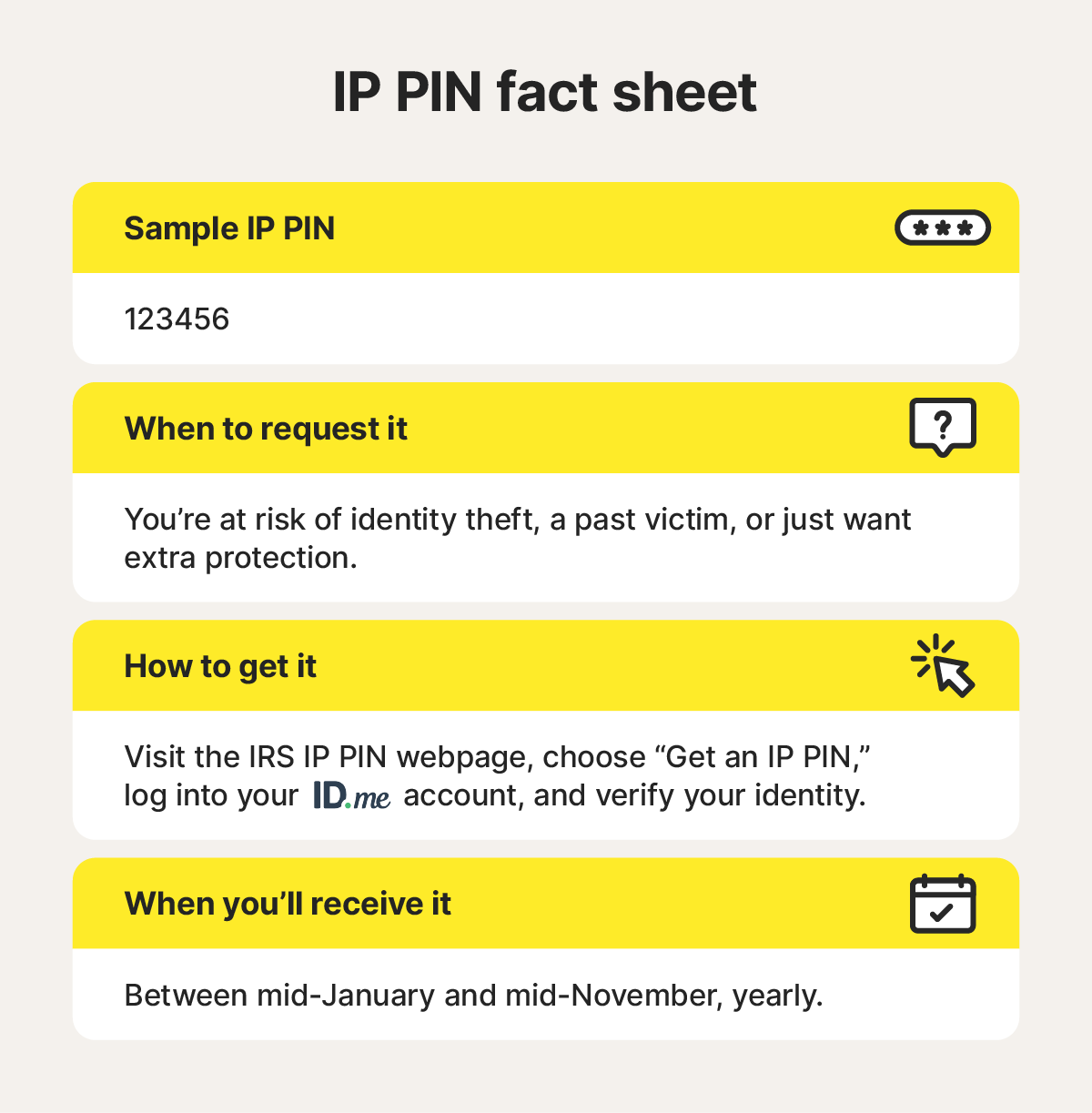
- Get an IP PIN: An IRS Identity Protection PIN is a six-digit code that must be entered when filing a tax return connected to your SSN. Setting one up for your SSN makes it much less likely that a fraudster can file in your name, and you don’t need to have experienced identity theft in the past to do so.
What to do if someone files taxes in your name before you do
If someone files taxes in your name, you’re still legally required to file your legitimate tax return. However, you’ll also need to confirm or report the fraud and prove your identity. While the matter is under investigation, the IRS may delay processing your return or issuing a refund until your identity is verified.
Next steps play out in one of two ways, depending on whether the IRS instructs you to verify your identity or report tax-related identity theft:
If you receive a letter from the Taxpayer Protection Program |
If you discover the fraud yourself and haven’t gotten an IRS letter |
|---|---|
|
|
|
|
|
|
|
After the IRS resolves your case (this may take longer if you flag the fraud before they do), they’ll add an identity theft indicator to your account and enroll you in the IP PIN program to help block fraudulent returns in the future.
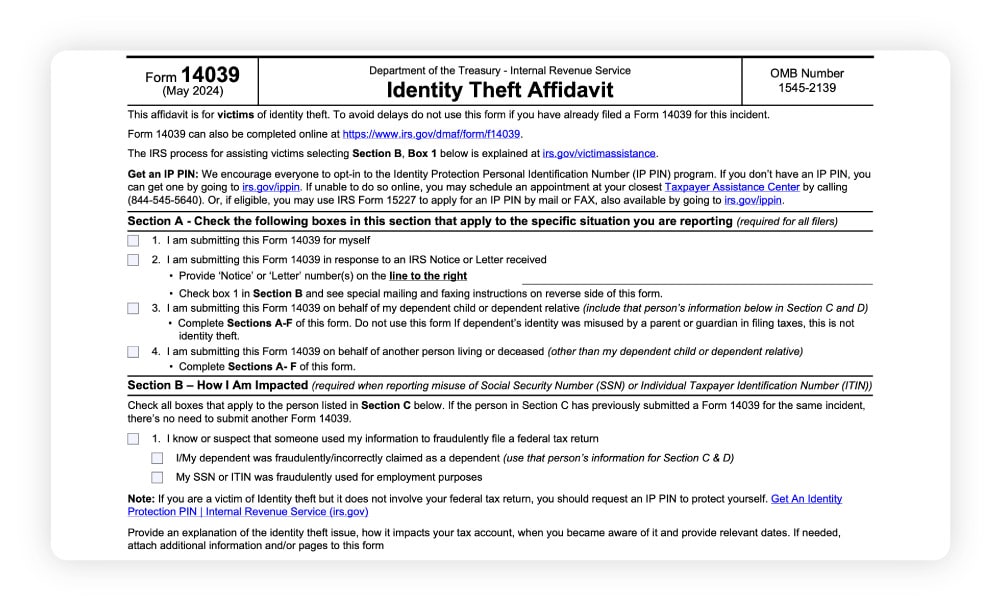
Additionally, you should consider notifying the police and the Federal Trade Commission (FTC) to create an official paper trail. This can help stop further misuse of your information, give you identity restoration support, and help you prove your case in an identity theft insurance claim.
Other ways criminals can use stolen tax information
A lot of times, the information criminals use to steal your tax refund isn’t used just once. Outside of committing tax fraud, thieves may use key data like your SSN to:
- Apply for jobs: Criminals can use your SSN to apply for jobs in your name, often to earn a paycheck or gain access to benefits like health insurance.
- Claim government or insurance benefits: Thieves may use your SSN to receive government or medical benefits.
- Take out loans and credit cards: Using your SSN and other personal details, fraudsters can open credit accounts or take out loans in your name.
- Open accounts: Criminals may open utility accounts, bank accounts, mobile phone plans, or financial subscription services in your name.
- Create synthetic identities: By pairing your SSN with fake names, addresses, or birth dates, criminals create new identities that don’t immediately trigger fraud alerts tied to your real credit profile. This makes it easier to build credit, open multiple accounts, and carry out long-term fraud.
If your information was exposed on the dark web, many people may attempt to use it for these purposes at the same time.
Monitor for unauthorized SSN usage this tax season
Recovering from tax identity theft can be a long, complicated process. But LifeLock helps protect your sensitive data to help reduce the risk that you’re targeted and monitor for early signs of identity fraud. Plus, if your identity is stolen, a U.S.-based restoration expert will be on hand to guide you through the recovery process and you’ll get reimbursement coverage to help protect your finances.
FAQs
How can I check if my SSN is compromised?
Signs that your SSN was compromised include errors or suspicious accounts on your credit report, transactions you don’t recognize on your bank or credit card statements, strange entries on your Social Security Administration (SSA) account, and unfamiliar IRS tax transcripts. If you notice suspicious activity across any of these accounts, someone may be using your SSN.
How do I report tax identity theft to the IRS?
You can report tax identity theft by filing IRS Form 14039, the Identity Theft Affidavit. Submit the affidavit online or mail a copy when you turn in your revised paper tax return.
How common is tax identity theft?
Tax identity theft is more common than you might think. In 2025, the IRS flagged around 2.1 million returns for possible identity fraud, according to the National Taxpayer Advocate’s mid-year report to Congress.
Editors’ note: Our articles provide educational information about identity theft, scams, financial fraud, and other topics that can put your identity or personal accounts at risk. LifeLock offerings may not cover or protect against every type of crime, fraud, scam, or threat we write about. For more details about how we write, review, and update our articles, see our Editorial Policy.
This article contains
- What is tax identity theft?
- How tax identity theft typically happens
- Warning signs of tax identity theft
- How to protect against tax identity theft
- What to do if someone files taxes in your name before you do
- Other ways criminals can use stolen tax information
- Monitor for unauthorized SSN usage this tax season
- FAQs
Related articles