


 Why do we ask?


Remember: Venmo will never ask for your six-digit code via phone call, text, email, or chat. If you receive a request for this number, or any other login information, it’s likely a scammer impersonating Venmo.
Has your personal data been recently exposed?
Check if information like your Social Security number, email, and passwords is exposed on the dark web.


You have reached the maximum number of scans allowed. Please come back after 24 hours.

Scanning the dark web...
Scanning public databases...
Scanning millions of records...
Narrowing down the search...
We need more information
Please enter a few more details to ensure we show you the right information.
Risk level:
High
You’re at high risk
We found your personal information on the dark web and on data broker sites.
Your personalized protection plan
Product Benefits:
 Up to $3M Reimbursement for identity theft, with up to $1M for Stolen Funds†††
$10K Scam Reimbursement7
Scam Support
Credit, Checking and Savings Activity Alerts: Unlimited Accounts
Credit & Payday Loan Lock2
Credit Monitoring:
3 Bureau1
Automatic Data Broker Removal8
Dark Web Monitoring
Priority 24/7 Customer Phone Support
Up to $3M Reimbursement for identity theft, with up to $1M for Stolen Funds†††
$10K Scam Reimbursement7
Scam Support
Credit, Checking and Savings Activity Alerts: Unlimited Accounts
Credit & Payday Loan Lock2
Credit Monitoring:
3 Bureau1
Automatic Data Broker Removal8
Dark Web Monitoring
Priority 24/7 Customer Phone Support
LifeLock Total
Your price:
$
349.99
Your price:
$
34.99
60-day money back guarantee with an annual plan
24/7 Live Member Support
No one can prevent all cybercrime or prevent all identity theft.
- Price valid for introductory term. After that, your price will renew at the standard price.
- Your subscription begins immediately after your transaction is complete. A payment method is required at sign-up for trials, and you will be charged at the end of your trial, unless canceled first.
- Prices are subject to change and may be charged up to 35 days prior to renewal. Cancel here or contact Member Services.
- Restrictions apply. Automatically renewing subscription required. If you're a victim of identity theft and not satisfied with our resolution, you may receive a refund for the current term of your subscription. See lifelock.norton.com/guarantee for complete details.
††† Up to $1 million coverage for Lawyers and Experts included with all plans. Reimbursement and expense compensation vary according to plan. Insurance benefits are issued by third parties. See lifelock.norton.com/legal for policy info.
1 Bureau Monitoring and Monthly Credit Report and Score / 3 Bureau Monitoring and Monthly Credit Report and Score.
2 Credit Lock cannot prevent all account takeovers, unauthorized account openings, or credit file inquiries. Deactivates if you downgrade or cancel your subscription.
7 Scam protection coverage as part of identity theft benefits is currently available to all customers residing in the United States, including U.S. territories and the District of Columbia, with the exception of residents of New York. Gen Digital is not a licensed insurance producer. Benefits under the Master Policy are issued and covered by HSB Specialty Insurance Company. You can find further details and exclusions in the summary of benefits.
8 After setup, automatic data broker removal service scans and requests removal every 90 days.
Risk level:
Medium
You’re at medium risk
We found your personal information on data broker sites.
Your personalized protection plan
Product Benefits:
Up to $1.2M Reimbursement for identity theft, with up to $100K for Stolen Funds†††
$5K Scam Reimbursement7
Scam Support
Credit, Checking and Savings Activity Alerts:
5 Accounts
Credit & Payday Loan Lock2
Credit Monitoring:
3 Bureau1
Automatic Data Broker Removal8
Dark Web Monitoring
Priority 24/7 Customer Phone Support
LifeLock Advanced
Your price:
$
199.99
Your price:
$
19.99
60-day money back guarantee with an annual plan
24/7 Live Member Support
No one can prevent all cybercrime or prevent all identity theft.
- Price valid for introductory term. After that, your price will renew at the standard price.
- Your subscription begins immediately after your transaction is complete. A payment method is required at sign-up for trials, and you will be charged at the end of your trial, unless canceled first.
- Prices are subject to change and may be charged up to 35 days prior to renewal. Cancel here or contact Member Services.
- Restrictions apply. Automatically renewing subscription required. If you're a victim of identity theft and not satisfied with our resolution, you may receive a refund for the current term of your subscription. See lifelock.norton.com/guarantee for complete details.
††† Up to $1 million coverage for Lawyers and Experts included with all plans. Reimbursement and expense compensation vary according to plan. Insurance benefits are issued by third parties. See lifelock.norton.com/legal for policy info.
1 Bureau Monitoring and Monthly Credit Report and Score / 3 Bureau Monitoring and Monthly Credit Report and Score.
2 Credit Lock cannot prevent all account takeovers, unauthorized account openings, or credit file inquiries. Deactivates if you downgrade or cancel your subscription.
7 Scam protection coverage as part of identity theft benefits is currently available to all customers residing in the United States, including U.S. territories and the District of Columbia, with the exception of residents of New York. Gen Digital is not a licensed insurance producer. Benefits under the Master Policy are issued and covered by HSB Specialty Insurance Company. You can find further details and exclusions in the summary of benefits.
8 After setup, automatic data broker removal service scans and requests removal every 90 days.
Risk level:
Low
Good news!
We didn’t find your personal information across millions of records or on public data sources.
Your personalized protection plan
Product Benefits:
Up to $1.05M Reimbursement for identity theft, with up to $25K for Stolen Funds†††
Identity Restoration Specialists
Credit, Checking and Savings Activity Alerts:
2 Accounts
Credit & Payday Loan Lock2
Credit Monitoring:
2 Bureau1
Automatic Data Broker Removal8
Dark Web Monitoring
Breach Alerts
24/7 Customer Phone Support
Lifelock Core
Your price:
$
124.99
Your price:
$
12.49
60-day money back guarantee with an annual plan
24/7 Live Member Support
No one can prevent all cybercrime or prevent all identity theft.
- Price valid for introductory term. After that, your price will renew at the standard price.
- Your subscription begins immediately after your transaction is complete. A payment method is required at sign-up for trials, and you will be charged at the end of your trial, unless canceled first.
- Prices are subject to change and may be charged up to 35 days prior to renewal. Cancel here or contact Member Services.
- Restrictions apply. Automatically renewing subscription required. If you're a victim of identity theft and not satisfied with our resolution, you may receive a refund for the current term of your subscription. See lifelock.norton.com/guarantee for complete details.
††† Up to $1 million coverage for Lawyers and Experts included with all plans. Reimbursement and expense compensation vary according to plan. Insurance benefits are issued by third parties. See lifelock.norton.com/legal for policy info.
1 Credit features require successful setup, identity verification, and sufficient credit history by the appropriate credit bureau. Credit monitoring features may take several days to activate after enrollment.
2 Identity Lock cannot prevent all account takeovers, unauthorized account openings, or credit file inquiries. Deactivates if you downgrade or cancel your subscription.
8 After setup, automatic data broker removal service scans and requests removal every 90 days.
1/2
Finding your match...

DID YOU KNOW?
10 cents
If your information is exposed or stolen in a data breach, it can end up on the dark web where it can be sold for as little as 10 cents.
100M+
LifeLock monitors hundreds of millions of data points a second.
Based on your concerns, the best plan for you is:
LifeLock Core
(Individual)
LifeLock Advanced
(Individual)
LifeLock Total
(Individual)
LifeLock Core
(2 adults)
LifeLock Advanced
(2 adults)
LifeLock Total
(2 adults)
LifeLock Core
(2 adults + up to 10 kids)
LifeLock Advanced
(2 adults + up to 10 kids)
LifeLock Total
(2 adults + up to 10 kids)
Pricing details below*
Pricing details below*
Pricing details below*
Pricing details below*
Pricing details below*
Pricing details below*
Pricing details below*
Pricing details below*
Pricing details below*
- Up to $1.05M Reimbursement for identity theft, with up to $25K for Stolen Funds†††
- Up to $1.2M Reimbursement for identity theft, with up to $100K for Stolen Funds†††
- Up to $3M Reimbursement for identity theft, with up to $1M for Stolen Funds†††
- Up to $1.05M Reimbursement for identity theft, with up to $25K for Stolen Funds††† for each adult
- Up to $1.2M Reimbursement for identity theft, with up to $100K for Stolen Funds††† for each adult
- Up to $3M Reimbursement for identity theft, with up to $1M for Stolen Funds††† for each adult
- Up to $1.05M Reimbursement for identity theft, with up to $25K for Stolen Funds††† for each adult
- Up to $1.2M Reimbursement for identity theft, with up to $100K for Stolen Funds††† for each adult
- Up to $3M Reimbursement for identity theft, with up to $1M for Stolen Funds††† for each adult
- Credit Monitoring Coverage1
- Credit Monitoring1 each adult
- Credit Monitoring1 for family
- Credit, Checking & Savings Account Activity Alerts
- Credit, Checking and Savings Activity Alerts for each adult
- Credit, Checking and Savings Activity Alerts for family
- 401K & Investment Account Activity Alerts
- 401K/Investment Account Alerts for each adult
- 401K/Investment Account Alerts for family
- Recurring and Unusual Charge Alerts
- Unexpected & Suspicious Charge Alerts for each adult
- Unexpected & Suspicious Charge Alerts for family
- Stolen Funds Reimbursement†††
- Stolen Funds Reimbursement††† for each adult
- Stolen Funds Reimbursement††† for family
- Lawyers and Experts†††
- Lawyers & Experts††† for each adult
- Lawyers & Experts††† for family
- Automatic Data Broker Removal8
- Automatic Data Broker Removal8 for each adult
- Automatic Data Broker Removal8 for family
- Scam Reimbursement7
- Scam Reimbursement7 for each adult
- Scam Reimbursement7 for family
- Credit Reports & Scores1
- Credit Report & Score for each adult
- Credit Report & Score for family
- Social Media Monitoring
- Social Media Monitoring for each adult
- Social Media Monitoring for family

We have more plans to choose from.
See all plans

Have questions?
Contact sales
*Your subscription begins immediately after payment and automatically renews unless cancelled. Discount for annual plans are compared to monthly billing. Prices subject to change and may be charged up to 35 days before current term ends. Cancel here or contact Member Services.
††† Up to $1 million coverage for Lawyers and Experts included with all plans. Reimbursement and expense compensation vary according to plan. Insurance benefits are issued by third parties. See LifeLock.Norton.com/legal for policy info.
1 Credit features require successful setup, identity verification and sufficient credit history by the appropriate credit bureau. Credit monitoring features may take several days to activate after enrollment.
7 Scam protection coverage as part of identity theft benefits is currently available to all customers residing in the United States, including U.S. territories and the District of Columbia, with the exception of residents of New York. Gen Digital is not a licensed insurance producer. Benefits under the Master Policy are issued and covered by HSB Specialty Insurance Company. You can find further details and exclusions in the Summary of Benefits.
8 After setup, automatic data broker removal service scans and requests removal every 90 days.
Why do we ask?
Identifying your concerns gives us the ability to recommend the right plan for your needs.
Return to quiz
Why do we ask?
Knowing this number helps us recommend coverage that fits your needs.
Return to quiz
Why do we ask?
Providing your email address makes you eligible for notifications of potential identity threats.
Return to quiz
Is Venmo safe? What every user should know
Venmo is mostly safe to use, but it’s not entirely risk-free. In this post, we’ll break down the biggest security concerns and teach you how to safeguard against scams, account takeovers, and data breaches. And get LifeLock for features that can help protect against scams, fraud, and identity theft.


Venmo is a mobile payment app that allows you to send and receive money directly from your smartphone, and it also features a social media-like feed of your friends’ transactions. It’s so popular that phrases like “I’ll Venmo you” have become part of everyday language.
Data published by the Consumer Financial Protection Bureau (CFPB) in 2023 revealed that more than three quarters of adults in the U.S. use payment apps. And a YouGov study from around the same time found that Venmo was in the top three most-used apps, alongside PayPal and Zelle.
Although Venmo is convenient for splitting checks, paying your babysitter, or settling bets with your friends, its connection to your finances means you should take every precaution when using it. In this guide, we’ll explore some Venmo risks you should be aware of and tips you can use to transact more safely.
How safe is Venmo?
Venmo has a range of built-in security features that help protect your financial information and support data privacy, including encryption, identity verification, and customizable privacy settings. That makes it generally safe to use. However, like any peer-to-peer payment app, it also presents some risks, like scams and account takeovers.
Here’s a summary of key features on Venmo designed to keep users safe from these threats:
- Data encryption: Venmo uses encryption to help safeguard personal sensitive information that’s transmitted during transactions, reducing the risk of interception by hackers or potential insider threats.
- Identity verification: Venmo uses an identity verification system to help prevent fraud and offers tools to ensure you’re paying the right person, including a phone number confirmation system and the option to automatically sync your phone contacts to your friends list.
- Privacy controls: You can customize your privacy settings to control who sees your transaction activity, including the possibility to make it so only you can see your transactions.
- Purchase Protection: Venmo offers Purchase Protection for eligible transactions, provided you mark a payment as being for goods or services, and it’s made to a merchant authorized to receive it. The purchase protection program generally doesn’t cover standard peer-to-peer payments.
- Access controls: If you lose your phone or a thief steals it, you can log into your Venmo account from another device to revoke access on the device you’ve lost, helping prevent the thief from accessing your finances.
Venmo security risks
Despite Venmo’s security features, cybercriminals and scammers are always looking for ways to bypass the user protections and find attack vectors they can use to commit theft or fraud. Here are some potential risks to watch out for as you use Venmo:
- Scams and fraud: Scammers often target payment apps like Venmo to trick users into sending money, which can be difficult to recover. They may impersonate someone you know or a company you trust in a phishing attack that aims to trick you into revealing sensitive information that could lead to identity theft.
- Account takeovers: If a hacker launches an account takeover attack and gets access to your Venmo account, they could send money to themselves or steal your financial details to defraud you. Weak passwords or your credentials for other platforms being compromised can increase this risk.
- Data breaches: Like any large company, Venmo faces the constant threat of a data breach caused by hackers. And since Venmo requires you to verify your identity with personally identifiable information (PII) like your Social Security number (SSN), a breach could leave you vulnerable to serious fraud or dark web exposure.
- Limited protection: Venmo offers Purchase Protection for buyers and sellers, but it doesn’t apply to most person-to-person payments. If you get scammed in a regular transaction, you likely won’t be reimbursed.
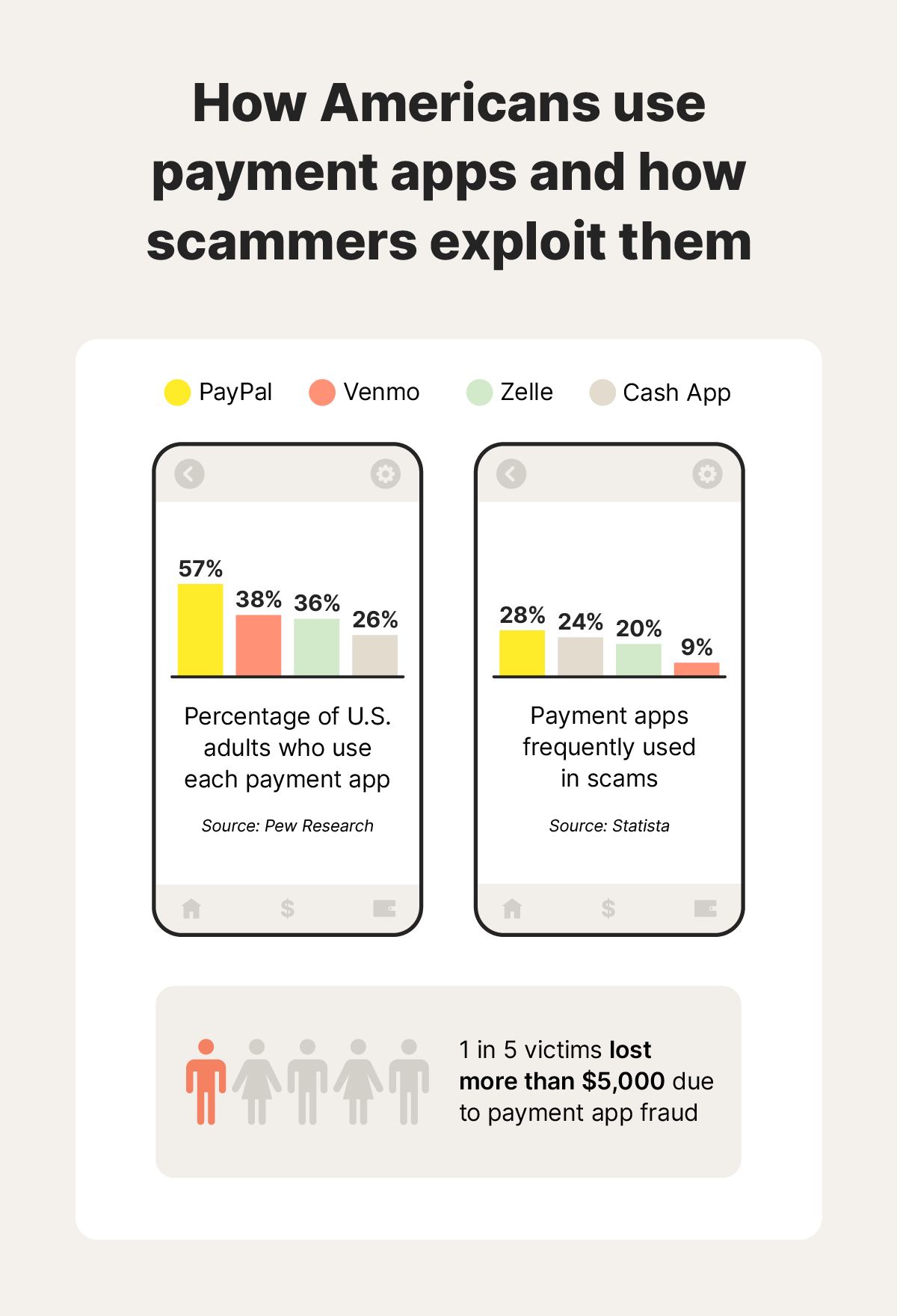
Bar graphs of the percentage of U.S. adults who use each payment app and which apps are frequently used in scams.
Common Venmo scam tactics
Scammers on Venmo use a variety of strategies to try and trick you into sending money under false pretenses or reveal sensitive information that they can use in fraud.
These are some of the most common Venmo scam tactics:
- Accidental payment scams: Scammers “accidentally” send you money before asking you to return it. But if you do, the original payment will be reversed, leaving you out of pocket.
- Fake payment confirmation scams: Scammers send fake “payment confirmation” emails or screenshots that make it look like they’ve sent you money. They’ll pressure you to refund the money, but the transaction was fake from the start.
- Impersonation scams: Scammers pose as someone you trust, like a friend or Venmo customer support agent, in phishing messages where they request an urgent payment or ask for your login details to resolve a made-up “account issue.”
- Overpayment/refund scams: Scammers overpay for an item you’re selling and ask you to refund the difference, but they’ll then reverse the original payment, meaning you lose out on the extra.
- Prize, job, or investment scams: Scammers promise rewards, jobs, or quick profits if you send them a small payment first. But if you comply, they’ll disappear completely.
How you can use Venmo safely
Understanding the risks of using Venmo is the first step towards keeping your data, finances, and identity safer. But you can also take proactive steps like boosting your account security, upgrading your privacy settings, and staying alert to potential threats.
Here’s a step-by-step guide of actions you can take to protect yourself on Venmo:
1. Create a strong password
When creating your Venmo account, keep password security in mind to make it harder for hackers to take over your account. Aim for at least 15 characters and include a mix of numbers, uppercase letters, lowercase letters, and symbols for maximum protection.
Avoid passwords that hackers who know you or do some research might be able to guess, like names or birthdays, and make sure to use different passwords for every online account. If you have trouble remembering your login credentials, a password manager can be a helpful tool to store them in one place.
2. Enable multi-factor authentication (MFA)
Setting up MFA or two-factor authentication (2FA) adds an extra layer of protection to your Venmo account. With it enabled, you’ll receive a verification code on your registered phone number each time you sign in from a new device or location, helping confirm it’s really you.
3. Set up a PIN and use biometrics
For added security, enable a passcode or biometric login like Face ID to access your Venmo app. This extra layer of protection helps keep your account safe even if someone gets hold of your phone when it’s unlocked.
Here’s how to set up a passcode and Face ID on your device:
- Open the Venmo app and go to the Me tab in the bottom right corner.
- Tap the Settings icon in the top right.
- Select Face ID & Passcode (iPhone) or Passcode & Biometric Unlock (Android).
- Toggle on the options you’d like to use.
- Set and confirm your passcode.
4. Update your Venmo privacy settings
Venmo has three different privacy levels — Public, Friends, and Private — that control who can see your transaction activity. Depending on your settings, transaction data like participants and descriptions may be visible to third parties. Updating your settings can enhance your security and help protect your personal information.
When you first join the platform, your account defaults to Public settings, meaning anyone on the internet can see your transactions. This includes information like who you’re sending money to, the date of the transaction, and a description of what it’s for. This increases your digital footprint and poses a cybersecurity risk, potentially making it easier for scammers to trick you or expose you to identity theft.
While you might be tempted to set your account to Public or Friends to share fun details like a cute martini emoji when sending money for drinks, it’s not worth the risk. To protect your digital footprint and keep your financial activity secure, it’s best to set your account to Private.
Here’s how to change your Venmo privacy settings:
- Open the Venmo app and tap the Me tab in the bottom right corner.
- Tap the Settings icon in the top right, then select Privacy.
- Choose Private, then confirm by tapping Change Anyway.
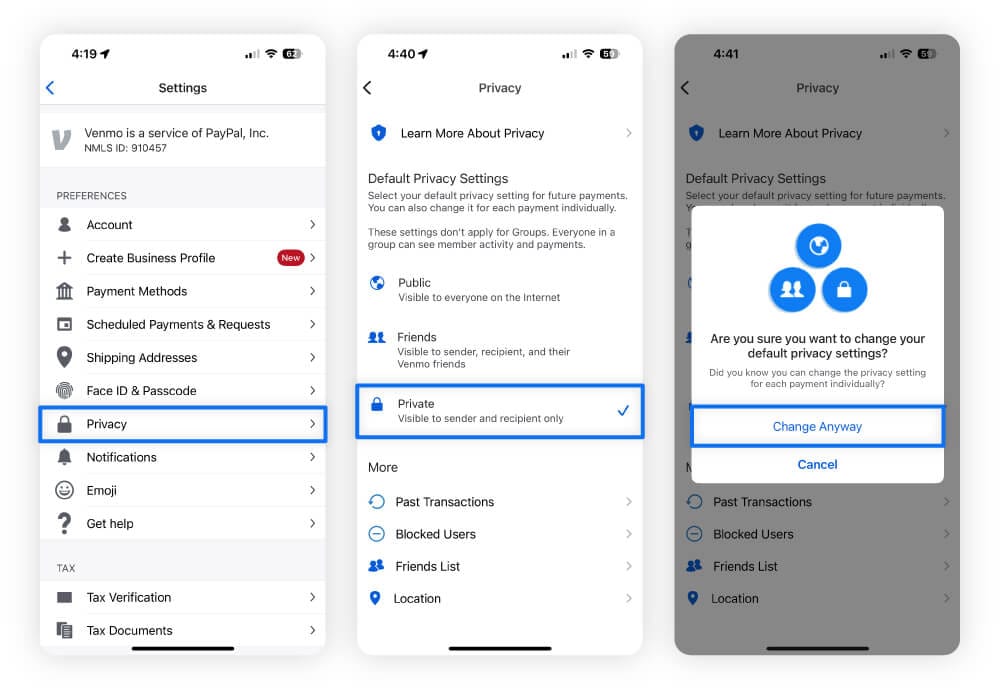
Screenshots showing how to update your Venmo privacy settings on your device.
5. Consider linking a credit card
When using Venmo to send or receive money, you can link a bank account, debit card, or credit card. For the best protection against fraud, it’s safest to link a credit card that offers stronger consumer protections, including the ability to dispute unauthorized charges.
Keep in mind, though, that Venmo charges a 3% fee for payments sent using a linked credit card, although the fee doesn’t apply when you send money to authorized merchants.
Remember: Venmo will never contact you to request banking or credit card information. Protect your privacy and never disclose sensitive data over the phone.
6. Don’t keep a balance in your Venmo account
Funds stored in payment apps like Venmo don’t always benefit from the same Federal protection as money held in a bank account.
Some balances may be eligible for “pass-through” Federal Deposit Insurance Corporation (FDIC) insurance when held in partner banks. But coverage of funds depends on meeting specific criteria outlined in the User Agreement, like having used the Venmo Direct Deposit feature. And, even then, your funds may only be covered against the failure of a partner bank, not Venmo itself.
According to the Consumer Financial Protection Bureau (CFPB), money held in payment apps like Venmo may not be safe during times of economic instability. To protect your funds, transfer them to an FDIC- covered bank account.
7. Stay alert for potential scams
Scammers often target Venmo users with tactics to trick them into sending money. To protect yourself, get familiar with common Venmo scams and learn how to recognize the warning signs.
Some common tactics include phishing attempts, impersonating Venmo customer support, and catfishing users on dating apps. To identify a scammer, watch for red flags like urgent requests for money from people you don’t know.
Remember: Ignore texts containing suspicious links or threats about your Venmo account being locked. Go directly to the app or official website if you’re unsure.
8. Only exchange money with trusted contacts
Venmo was created to split bills between friends and family, but as its popularity has grown, so has its use among mere acquaintances and even strangers. This is especially common when buying items through online marketplaces like OfferUp.
The problem? Venmo doesn’t offer Purchase Protection for standard peer-to-peer payments. That means you’re likely out of luck if you fall for an OfferUp scam, send money to someone you don’t know, and things go wrong.
To stay safe, only exchange money on Venmo with people you know and trust. If you’re using the platform to pay for goods or services, toggle the purchase option. This activates Venmo’s Purchase Protection, which can help if your item arrives damaged or counterfeit — or if it doesn’t show up at all.
Help protect your finances with LifeLock
Although Venmo is a reliable platform, the risk of fraud still exists. To add an extra layer of protection to your finances and identity, get LifeLock. You’ll benefit from a range of features that can help you protect against fraud and identity theft, including three-bureau credit monitoring, scam reimbursement coverage, and automatic alerts of data breaches that may have compromised your information.
FAQs
Which is safer, Venmo or PayPal?
While both PayPal and Venmo are generally considered safe, there’s an argument for the former being the safer platform. PayPal offers more robust security features, including 24/7 fraud monitoring and stronger purchase protection for buyers and sellers. That said, no platform is scam-proof, and users can still fall victim to fraud on either app.
Can Venmo be hacked?
Yes, as with most online platforms, your Venmo account can be hacked, especially if your account isn’t properly secured. Cybercriminals may gain access by guessing your weak or reused password, stealing your information in a phishing scam, or exploiting an unsecured device.
Can someone get my bank account information from Venmo?
Venmo doesn’t share your bank account details with others during transactions. However, if someone hacks your Venmo account, they could potentially access your linked bank information.
Is Venmo safe to use with strangers?
Venmo isn’t considered safe to use with strangers since doing so can increase the likelihood of encountering scams or fraud. If you transfer money to a scammer, you generally won’t be covered by the Venmo Purchase Protection policy.
Is Venmo safe to use for Marketplace purchases?
Using Venmo for Marketplace purchases can be risky due to the rise of Facebook Marketplace scams, which often involve payment apps like Venmo. To protect yourself, mark the payment as a purchase to enable Venmo’s Purchase Protection, which can help you get reimbursed if the item doesn’t arrive or isn’t as described.
Venmo is a trademark of PayPal, Inc.
Editors’ note: Our articles provide educational information about identity theft, scams, financial fraud, and other topics that can put your identity or personal accounts at risk. LifeLock offerings may not cover or protect against every type of crime, fraud, scam, or threat we write about. For more details about how we write, review, and update our articles, see our Editorial Policy.
Related articles