





 Why do we ask?


Tip: The Internal Revenue Service (IRS) advises holding onto your tax records for at least three years in normal situations, six years if some related income was unreported, and indefinitely if you haven’t yet filed a return.
Has your personal data been recently exposed?
Check if information like your Social Security number, email, and passwords is exposed on the dark web.


You have reached the maximum number of scans allowed. Please come back after 24 hours.

Scanning the dark web...
Scanning public databases...
Scanning millions of records...
Narrowing down the search...
We need more information
Please enter a few more details to ensure we show you the right information.
Risk level:
High
You’re at high risk
We found your personal information on the dark web and on data broker sites.
Your personalized protection plan
Product Benefits:
 Up to $3M Reimbursement for identity theft, with up to $1M for Stolen Funds†††
$10K Scam Reimbursement7
Scam Support
Credit, Checking and Savings Activity Alerts: Unlimited Accounts
Credit & Payday Loan Lock2
Credit Monitoring:
3 Bureau1
Automatic Data Broker Removal8
Dark Web Monitoring
Priority 24/7 Customer Phone Support
Up to $3M Reimbursement for identity theft, with up to $1M for Stolen Funds†††
$10K Scam Reimbursement7
Scam Support
Credit, Checking and Savings Activity Alerts: Unlimited Accounts
Credit & Payday Loan Lock2
Credit Monitoring:
3 Bureau1
Automatic Data Broker Removal8
Dark Web Monitoring
Priority 24/7 Customer Phone Support
LifeLock Total
Your price:
$
349.99
Your price:
$
34.99
60-day money back guarantee with an annual plan
24/7 Live Member Support
No one can prevent all cybercrime or prevent all identity theft.
- Price valid for introductory term. After that, your price will renew at the standard price.
- Your subscription begins immediately after your transaction is complete. A payment method is required at sign-up for trials, and you will be charged at the end of your trial, unless canceled first.
- Prices are subject to change and may be charged up to 35 days prior to renewal. Cancel here or contact Member Services.
- Restrictions apply. Automatically renewing subscription required. If you're a victim of identity theft and not satisfied with our resolution, you may receive a refund for the current term of your subscription. See lifelock.norton.com/guarantee for complete details.
††† Up to $1 million coverage for Lawyers and Experts included with all plans. Reimbursement and expense compensation vary according to plan. Insurance benefits are issued by third parties. See lifelock.norton.com/legal for policy info.
1 Bureau Monitoring and Monthly Credit Report and Score / 3 Bureau Monitoring and Monthly Credit Report and Score.
2 Credit Lock cannot prevent all account takeovers, unauthorized account openings, or credit file inquiries. Deactivates if you downgrade or cancel your subscription.
7 Scam protection coverage as part of identity theft benefits is currently available to all customers residing in the United States, including U.S. territories and the District of Columbia, with the exception of residents of New York. Gen Digital is not a licensed insurance producer. Benefits under the Master Policy are issued and covered by HSB Specialty Insurance Company. You can find further details and exclusions in the summary of benefits.
8 After setup, automatic data broker removal service scans and requests removal every 90 days.
Risk level:
Medium
You’re at medium risk
We found your personal information on data broker sites.
Your personalized protection plan
Product Benefits:
Up to $1.2M Reimbursement for identity theft, with up to $100K for Stolen Funds†††
$5K Scam Reimbursement7
Scam Support
Credit, Checking and Savings Activity Alerts:
5 Accounts
Credit & Payday Loan Lock2
Credit Monitoring:
3 Bureau1
Automatic Data Broker Removal8
Dark Web Monitoring
Priority 24/7 Customer Phone Support
LifeLock Advanced
Your price:
$
199.99
Your price:
$
19.99
60-day money back guarantee with an annual plan
24/7 Live Member Support
No one can prevent all cybercrime or prevent all identity theft.
- Price valid for introductory term. After that, your price will renew at the standard price.
- Your subscription begins immediately after your transaction is complete. A payment method is required at sign-up for trials, and you will be charged at the end of your trial, unless canceled first.
- Prices are subject to change and may be charged up to 35 days prior to renewal. Cancel here or contact Member Services.
- Restrictions apply. Automatically renewing subscription required. If you're a victim of identity theft and not satisfied with our resolution, you may receive a refund for the current term of your subscription. See lifelock.norton.com/guarantee for complete details.
††† Up to $1 million coverage for Lawyers and Experts included with all plans. Reimbursement and expense compensation vary according to plan. Insurance benefits are issued by third parties. See lifelock.norton.com/legal for policy info.
1 Bureau Monitoring and Monthly Credit Report and Score / 3 Bureau Monitoring and Monthly Credit Report and Score.
2 Credit Lock cannot prevent all account takeovers, unauthorized account openings, or credit file inquiries. Deactivates if you downgrade or cancel your subscription.
7 Scam protection coverage as part of identity theft benefits is currently available to all customers residing in the United States, including U.S. territories and the District of Columbia, with the exception of residents of New York. Gen Digital is not a licensed insurance producer. Benefits under the Master Policy are issued and covered by HSB Specialty Insurance Company. You can find further details and exclusions in the summary of benefits.
8 After setup, automatic data broker removal service scans and requests removal every 90 days.
Risk level:
Low
Good news!
We didn’t find your personal information across millions of records or on public data sources.
Your personalized protection plan
Product Benefits:
Up to $1.05M Reimbursement for identity theft, with up to $25K for Stolen Funds†††
Identity Restoration Specialists
Credit, Checking and Savings Activity Alerts:
2 Accounts
Credit & Payday Loan Lock2
Credit Monitoring:
2 Bureau1
Automatic Data Broker Removal8
Dark Web Monitoring
Breach Alerts
24/7 Customer Phone Support
Lifelock Core
Your price:
$
124.99
Your price:
$
12.49
60-day money back guarantee with an annual plan
24/7 Live Member Support
No one can prevent all cybercrime or prevent all identity theft.
- Price valid for introductory term. After that, your price will renew at the standard price.
- Your subscription begins immediately after your transaction is complete. A payment method is required at sign-up for trials, and you will be charged at the end of your trial, unless canceled first.
- Prices are subject to change and may be charged up to 35 days prior to renewal. Cancel here or contact Member Services.
- Restrictions apply. Automatically renewing subscription required. If you're a victim of identity theft and not satisfied with our resolution, you may receive a refund for the current term of your subscription. See lifelock.norton.com/guarantee for complete details.
††† Up to $1 million coverage for Lawyers and Experts included with all plans. Reimbursement and expense compensation vary according to plan. Insurance benefits are issued by third parties. See lifelock.norton.com/legal for policy info.
1 Credit features require successful setup, identity verification, and sufficient credit history by the appropriate credit bureau. Credit monitoring features may take several days to activate after enrollment.
2 Identity Lock cannot prevent all account takeovers, unauthorized account openings, or credit file inquiries. Deactivates if you downgrade or cancel your subscription.
8 After setup, automatic data broker removal service scans and requests removal every 90 days.
1/2
Finding your match...

DID YOU KNOW?
10 cents
If your information is exposed or stolen in a data breach, it can end up on the dark web where it can be sold for as little as 10 cents.
100M+
LifeLock monitors hundreds of millions of data points a second.
Based on your concerns, the best plan for you is:
LifeLock Core
(Individual)
LifeLock Advanced
(Individual)
LifeLock Total
(Individual)
LifeLock Core
(2 adults)
LifeLock Advanced
(2 adults)
LifeLock Total
(2 adults)
LifeLock Core
(2 adults + up to 10 kids)
LifeLock Advanced
(2 adults + up to 10 kids)
LifeLock Total
(2 adults + up to 10 kids)
Pricing details below*
Pricing details below*
Pricing details below*
Pricing details below*
Pricing details below*
Pricing details below*
Pricing details below*
Pricing details below*
Pricing details below*
- Up to $1.05M Reimbursement for identity theft, with up to $25K for Stolen Funds†††
- Up to $1.2M Reimbursement for identity theft, with up to $100K for Stolen Funds†††
- Up to $3M Reimbursement for identity theft, with up to $1M for Stolen Funds†††
- Up to $1.05M Reimbursement for identity theft, with up to $25K for Stolen Funds††† for each adult
- Up to $1.2M Reimbursement for identity theft, with up to $100K for Stolen Funds††† for each adult
- Up to $3M Reimbursement for identity theft, with up to $1M for Stolen Funds††† for each adult
- Up to $1.05M Reimbursement for identity theft, with up to $25K for Stolen Funds††† for each adult
- Up to $1.2M Reimbursement for identity theft, with up to $100K for Stolen Funds††† for each adult
- Up to $3M Reimbursement for identity theft, with up to $1M for Stolen Funds††† for each adult
- Credit Monitoring Coverage1
- Credit Monitoring1 each adult
- Credit Monitoring1 for family
- Credit, Checking & Savings Account Activity Alerts
- Credit, Checking and Savings Activity Alerts for each adult
- Credit, Checking and Savings Activity Alerts for family
- 401K & Investment Account Activity Alerts
- 401K/Investment Account Alerts for each adult
- 401K/Investment Account Alerts for family
- Recurring and Unusual Charge Alerts
- Unexpected & Suspicious Charge Alerts for each adult
- Unexpected & Suspicious Charge Alerts for family
- Stolen Funds Reimbursement†††
- Stolen Funds Reimbursement††† for each adult
- Stolen Funds Reimbursement††† for family
- Lawyers and Experts†††
- Lawyers & Experts††† for each adult
- Lawyers & Experts††† for family
- Automatic Data Broker Removal8
- Automatic Data Broker Removal8 for each adult
- Automatic Data Broker Removal8 for family
- Scam Reimbursement7
- Scam Reimbursement7 for each adult
- Scam Reimbursement7 for family
- Credit Reports & Scores1
- Credit Report & Score for each adult
- Credit Report & Score for family
- Social Media Monitoring
- Social Media Monitoring for each adult
- Social Media Monitoring for family

We have more plans to choose from.
See all plans

Have questions?
Contact sales
*Your subscription begins immediately after payment and automatically renews unless cancelled. Discount for annual plans are compared to monthly billing. Prices subject to change and may be charged up to 35 days before current term ends. Cancel here or contact Member Services.
††† Up to $1 million coverage for Lawyers and Experts included with all plans. Reimbursement and expense compensation vary according to plan. Insurance benefits are issued by third parties. See LifeLock.Norton.com/legal for policy info.
1 Credit features require successful setup, identity verification and sufficient credit history by the appropriate credit bureau. Credit monitoring features may take several days to activate after enrollment.
7 Scam protection coverage as part of identity theft benefits is currently available to all customers residing in the United States, including U.S. territories and the District of Columbia, with the exception of residents of New York. Gen Digital is not a licensed insurance producer. Benefits under the Master Policy are issued and covered by HSB Specialty Insurance Company. You can find further details and exclusions in the Summary of Benefits.
8 After setup, automatic data broker removal service scans and requests removal every 90 days.
Why do we ask?
Identifying your concerns gives us the ability to recommend the right plan for your needs.
Return to quiz
Why do we ask?
Knowing this number helps us recommend coverage that fits your needs.
Return to quiz
Why do we ask?
Providing your email address makes you eligible for notifications of potential identity threats.
Return to quiz
Tips to avoid tax fraud: A tax security checklist
Millions of dollars in refunds are flagged for fraud each year, with victims of tax identity theft often facing lengthy delays before they can reclaim the money they’re owed. Use our checklist to help avoid tax fraud before, during, and after filing. And get an identity theft protection service to monitor your financial accounts, help protect against fraud, and get expert restoration assistance if you face identity issues this tax season.


Tax season is prime time for identity thieves. As you collect your tax documents, share sensitive personal information, and file your return, lots of your sensitive data is in motion, passing through accountants, business reps, digital records systems, and others. This creates the perfect opportunity for fraudsters to ramp up phishing scams and cyberattacks, targeting data they can use to steal your identity.
All it takes is one exposed document, compromised account, or moment of pressure during a scam for fraudsters to file a fraudulent tax return in your name or misuse your identity months later. But you’re not powerless. Follow this step-by-step process to help reduce your risk this tax season and stay in control of both your identity and your finances.
To mark your progress as you go, download our simple tax security checklist and tick the boxes once you’ve completed each step.
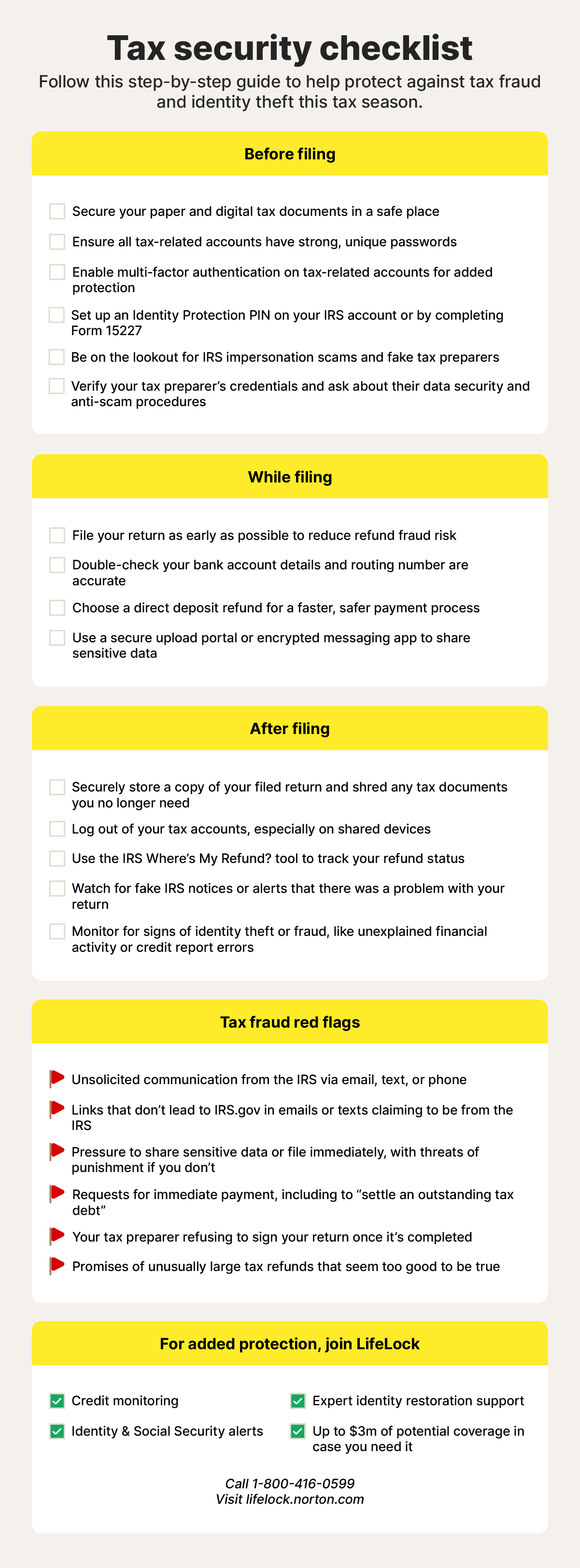
A tax security checklist to help guard against tax fraud and identity theft.
Click here to download an interactive tax security checklist.
1. Secure your tax documents
Tax document security matters year-round, but tax season is a good reminder to make sure any documents containing your sensitive information are stored securely and out of reach of identity thieves who could use them to target you.
This includes W-2 forms, 1099 forms, completed tax returns from previous years, and any other paperwork that lists your Social Security number (SSN) or financial data.
Here’s where to store them for maximum security:
- Paper copies: A safe or lockbox in your home.
- Digital copies: An encrypted storage folder, password-protected local folder, or a secure tax portal provided by trusted tax software or your tax professional.
Avoid saving copies of sensitive tax information in email inboxes, shared cloud folders, or unprotected personal devices. And, when you need to share your tax information, use secure upload links, password-protected tax portals, or approved tax software designed to protect sensitive data in transit.
Emails and text messages, in particular, may be vulnerable to interception and could leave your info exposed if your account is hacked.
2. Lock down your online tax accounts
Tax information stored online is only as secure as the accounts tied to it. Boosting the protection of your tax preparation software, your IRS online account, and any financial accounts linked to refunds can help prevent account takeovers, where hackers crack your password and gain access to sensitive data.
Start by strengthening your account passwords. Use strong, unique passwords for each account, since reused logins make it easier for criminals to break in through credential stuffing attacks after accessing passwords following a data breach.
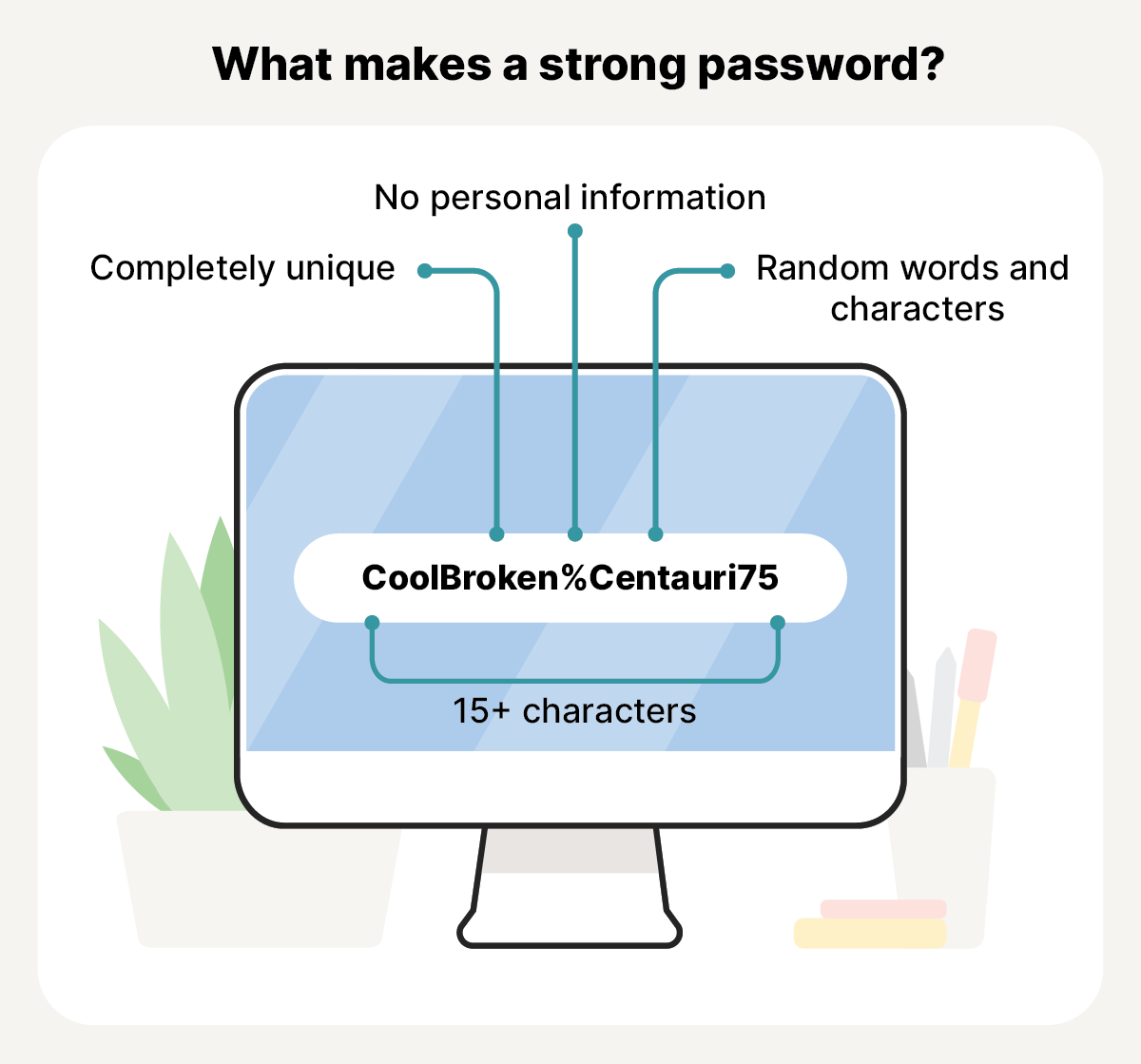
A graphic showcasing what makes a strong password with an example.
Next, enable multi-factor authentication on any accounts where it’s available, such as your tax preparer’s client portal or your chosen do-it-yourself tax software platform. This adds a second layer of protection by requiring a code sent to your phone or email in addition to your password, helping to stop criminals even if they already have your login credentials.
For added protection, consider setting up an IRS Identity Protection PIN (IP PIN) using your IRS account, or by completing Form 15227 if you don’t have an IRS account. An IP PIN is a unique six-digit code that you’ll need to provide when filing your return to reduce the risk of an identity thief filing in your name before you get a chance.
3. Watch out for tax season scams
Tax season is one of the biggest opportunities of the year for scammers. Filing puts your entire financial identity in motion, increasing the risk that sensitive data falls into the wrong hands. You’re also more likely to expect messages from employers, tax preparers, or the IRS, which makes it easier for scammers to pass phishing messages off as real.
Some of the most common tax season scams include:
- Fake IRS emails: Fraudsters contact you pretending to be from the IRS, suggesting you need to settle an outstanding debt or send sensitive documents.
- Imposters posing as tax preparers: Scammers pretend to be qualified tax professionals to steal your sensitive information or direct your refund to their account.
- Tax refund fraud: Criminals hacking into your account to redirect your return to their account, or commit mail fraud to steal a check refund.
These scams often use sophisticated social engineering tactics to appear legitimate and create a sense of urgency, pushing you to act quickly and hand over sensitive information. Scammers may threaten penalties, claim your refund is at risk, or insist immediate action is required. Some even launch AI-assisted scams, such as fake tax assistants or voice cloning, to make it seem like you’re speaking with a trusted professional.
And these scams aren’t rare — in fact, a study commissioned by Gen* found that 17% of respondents encountered a tax-related scam in 2025. The most commonly reported schemes included IRS impersonation, phishing texts or emails, identity theft using a stolen SSN, and fake AI chatbots posing as legitimate tax assistants.
Before responding to any tax-related message, pause and verify the sender’s legitimacy. Look for signs of a fake email, or contact the organization directly using the official contact information listed on its website. Avoid clicking links or downloading attachments unless you’re confident the message is genuine.
Tip: The IRS has strict guidelines on how they initiate contact, and will almost never reach out to taxpayers by email, text message, or phone. If they need to contact you, they’ll first send a letter informing you of their intention to get in touch. Treat any other type of unsolicited contact from “the IRS” as a major red flag.
4. Verify your tax preparer’s data security
If you use a certified public accountant (CPA) or other professional tax preparer — like 37% of Americans — it’s critical to pay attention to how they protect your data. Since they’ll be handling your W-2, SSN, and full tax history, their security practices are just as important as yours. If your preparer’s system is weak, your sensitive data could be exposed.
A secure tax preparer should use encrypted storage, secure client portals, and strict access controls to manage who can see your information. They should also have strong cybersecurity, know about common phishing scams, and have a solid data theft recovery plan, as suggested in the IRS Taxes-Security-Together checklist.
To verify your tax preparer’s data-security standards, ask them the following questions:
- How is my tax data stored and protected?
- Who can access my personal information?
- Do you use multi-factor authentication on client accounts?
- How do you verify my identity before sharing or releasing information?
If a preparer can’t answer these basic security questions, or provides answers that don’t satisfy you, think about looking for an alternative. In some cases, they may simply fail to meet your security standards. But being picky also reduces the risk that you accidentally enlist the services of a fake tax preparer, who could steal your refund and your identity.
5. File early to reduce the risk of refund fraud
The IRS flagged $16.5 billion in refunds for possible identity fraud in 2024, according to the National Taxpayers Advocate mid-year report to Congress. Part of this total figure represents stolen tax refunds, where fraudsters use stolen personal information to file fake tax returns in someone else’s name.
Timing plays a major role in reducing the risk of tax fraud. Fraudsters often file fake returns as early as possible, hoping to beat you to it. If you wait until close to the deadline, you may discover that a return has already been submitted in your name, leaving you with a lengthy, frustrating process to resolve the issue.
Whenever possible, file as soon as you have all the required documents, such as your W-2 or 1099. That said, don’t rush at the expense of accuracy. If you’re still waiting on paperwork, it’s better to delay than to submit an incomplete or incorrect return. In the meantime, consider setting up an IRS Identity Protection PIN (IP PIN) to help reduce the risk of tax-related identity theft.
Will I get my refund back if it’s stolen? In most cases, yes. If the IRS investigates your case and confirms that you were at no fault, they should reissue your paper check or direct deposit so you get the money you’re owed. However, tax-related identity theft victims wait nearly two years on average for resolution, according to the 2025 National Taxpayer Advocate Objectives Report to Congress.
6. Opt for a direct deposit refund
How you choose to receive your refund can affect how vulnerable it is to fraud or mail theft. Direct deposit is generally safer than a paper check, which may be lost, intercepted, or stolen before it reaches you. Paper checks are especially risky if your mail is frequently misdelivered or could be accessed by someone else.
Choosing direct deposit also reduces the time it takes for your refund to arrive, typically resulting in any money you’re owed appearing in your bank account within 21 days. This reduces the window in which a criminal might attempt to interfere with your return.
When setting up your direct deposit, avoid using a shared or public device and make sure to enter your bank information accurately. Then, use the IRS Where’s My Refund? tool to check the status of your tax refund.
7. Monitor for signs of identity theft
Successfully filing your tax return doesn’t mean the risk of identity theft is over. Tax-related identity theft isn’t always immediately apparent, and signs of fraud could surface weeks or months later as criminals begin using stolen information to access credit or services in your name.
Short-term signs that your identity might have been stolen include unexpected notices from the IRS that you didn’t file, suspicious alerts about changes to your tax account, or your refund not turning up, even after the IRS Where’s My Refund? tool says it’s been issued.
Over the longer term, look out for common warning signs of identity theft, like unexplained bank activity, errors on your credit report, and issues accessing online accounts. You can freeze your credit proactively to help reduce the risk of fraud, and consider investing in an identity theft protection service like LifeLock to monitor your credit and personal information for signs of misuse.
Protect your identity this tax season
Following this checklist — taking simple steps to secure your tax documents and accounts, staying alert to scams, and being cautious during the filing process — can help reduce the risk of tax fraud. For added protection, join LifeLock to benefit from identity theft alerts, credit monitoring, and expert restoration support from a U.S.-based specialist if your identity is compromised.
FAQs
Why is tax season a high-risk time for identity theft?
Tax season increases the amount of sensitive personal and financial information being shared, stored, and transmitted, including SSNs and W-2s. Criminals exploit this activity by targeting tax filers and preparers with scams, filing fraudulent returns, or launching attacks against organizations that handle tax information.
Is it safe to email tax documents to my CPA?
In general, no, email isn’t a secure way to send sensitive documents like W-2s or completed tax returns. Secure client portals or encrypted upload tools offer far better protection against unauthorized access, and should be used whenever possible.
Does the IRS ever contact taxpayers by email or text?
The IRS rarely initiates contact by email or text. While you may receive electronic messages if you’re already in active communication with the agency, unsolicited messages claiming to be from the IRS should be treated as potential scams. If you’re unsure, contact the IRS directly using official contact information.
What is an IRS Identity Protection PIN (IP PIN)?
An IP PIN is a six-digit code issued by the IRS that adds an extra layer of security to your tax return. You must enter it when filing, which helps prevent someone else from submitting a return in your name, even if they have access to your SSN.
*The study was conducted online within the United States by Dynata on behalf of Gen from 20th November to 26th November 2025 among 1,000 adults ages 18 and older. Data are weighted where necessary by age, gender, and region, to be nationally representative.
Editors’ note: Our articles provide educational information about identity theft, scams, financial fraud, and other topics that can put your identity or personal accounts at risk. LifeLock offerings may not cover or protect against every type of crime, fraud, scam, or threat we write about. For more details about how we write, review, and update our articles, see our Editorial Policy.
This article contains
- 1. Secure your tax documents
- 2. Lock down your online tax accounts
- 3. Watch out for tax season scams
- 4. Verify your tax preparer’s data security
- 5. File early to reduce the risk of refund fraud
- 6. Opt for a direct deposit refund
- 7. Monitor for signs of identity theft
- Protect your identity this tax season
- FAQs
Related articles






Scams & Fraud
What to do if someone steals your tax refund | LifeLock
February 02, 2026
·
10 min read
Scams & Fraud
What to do if someone steals your tax refund | LifeLock
February 02, 2026
·
10 min read