

Has your personal data been recently exposed?
Check if information like your Social Security number, email, and passwords is exposed on the dark web.


You have reached the maximum number of scans allowed. Please come back after 24 hours.

Scanning the dark web...
Scanning public databases...
Scanning millions of records...
Narrowing down the search...
We need more information
Please enter a few more details to ensure we show you the right information.
You’re at high risk
We found your personal information on the dark web and on data broker sites.
 Up to $3M Reimbursement for identity theft, with up to $1M for Stolen Funds†††
$10K Scam Reimbursement7
Scam Support
Credit, Checking and Savings Activity Alerts: Unlimited Accounts
Credit & Payday Loan Lock2
Credit Monitoring:
3 Bureau1
Automatic Data Broker Removal8
Dark Web Monitoring
Priority 24/7 Customer Phone Support
Up to $3M Reimbursement for identity theft, with up to $1M for Stolen Funds†††
$10K Scam Reimbursement7
Scam Support
Credit, Checking and Savings Activity Alerts: Unlimited Accounts
Credit & Payday Loan Lock2
Credit Monitoring:
3 Bureau1
Automatic Data Broker Removal8
Dark Web Monitoring
Priority 24/7 Customer Phone Support
LifeLock Total

No one can prevent all cybercrime or prevent all identity theft.
- Price valid for introductory term. After that, your price will renew at the standard price.
- Your subscription begins immediately after your transaction is complete. A payment method is required at sign-up for trials, and you will be charged at the end of your trial, unless canceled first.
- Prices are subject to change and may be charged up to 35 days prior to renewal. Cancel here or contact Member Services.
- Restrictions apply. Automatically renewing subscription required. If you're a victim of identity theft and not satisfied with our resolution, you may receive a refund for the current term of your subscription. See lifelock.norton.com/guarantee for complete details.
††† Up to $1 million coverage for Lawyers and Experts included with all plans. Reimbursement and expense compensation vary according to plan. Insurance benefits are issued by third parties. See lifelock.norton.com/legal for policy info.
1 Bureau Monitoring and Monthly Credit Report and Score / 3 Bureau Monitoring and Monthly Credit Report and Score.
2 Credit Lock cannot prevent all account takeovers, unauthorized account openings, or credit file inquiries. Deactivates if you downgrade or cancel your subscription.
7 Scam protection coverage as part of identity theft benefits is currently available to all customers residing in the United States, including U.S. territories and the District of Columbia, with the exception of residents of New York. Gen Digital is not a licensed insurance producer. Benefits under the Master Policy are issued and covered by HSB Specialty Insurance Company. You can find further details and exclusions in the summary of benefits.
8 After setup, automatic data broker removal service scans and requests removal every 90 days.
You’re at medium risk
We found your personal information on data broker sites.
Up to $1.2M Reimbursement for identity theft, with up to $100K for Stolen Funds†††
$5K Scam Reimbursement7
Scam Support
Credit, Checking and Savings Activity Alerts:
5 Accounts
Credit & Payday Loan Lock2
Credit Monitoring:
3 Bureau1
Automatic Data Broker Removal8
Dark Web Monitoring
Priority 24/7 Customer Phone Support
LifeLock Advanced
No one can prevent all cybercrime or prevent all identity theft.
- Price valid for introductory term. After that, your price will renew at the standard price.
- Your subscription begins immediately after your transaction is complete. A payment method is required at sign-up for trials, and you will be charged at the end of your trial, unless canceled first.
- Prices are subject to change and may be charged up to 35 days prior to renewal. Cancel here or contact Member Services.
- Restrictions apply. Automatically renewing subscription required. If you're a victim of identity theft and not satisfied with our resolution, you may receive a refund for the current term of your subscription. See lifelock.norton.com/guarantee for complete details.
††† Up to $1 million coverage for Lawyers and Experts included with all plans. Reimbursement and expense compensation vary according to plan. Insurance benefits are issued by third parties. See lifelock.norton.com/legal for policy info.
1 Bureau Monitoring and Monthly Credit Report and Score / 3 Bureau Monitoring and Monthly Credit Report and Score.
2 Credit Lock cannot prevent all account takeovers, unauthorized account openings, or credit file inquiries. Deactivates if you downgrade or cancel your subscription.
7 Scam protection coverage as part of identity theft benefits is currently available to all customers residing in the United States, including U.S. territories and the District of Columbia, with the exception of residents of New York. Gen Digital is not a licensed insurance producer. Benefits under the Master Policy are issued and covered by HSB Specialty Insurance Company. You can find further details and exclusions in the summary of benefits.
8 After setup, automatic data broker removal service scans and requests removal every 90 days.
Good news!
We didn’t find your personal information across millions of records or on public data sources.
Up to $1.05M Reimbursement for identity theft, with up to $25K for Stolen Funds†††
Identity Restoration Specialists
Credit, Checking and Savings Activity Alerts:
2 Accounts
Credit & Payday Loan Lock2
Credit Monitoring:
2 Bureau1
Automatic Data Broker Removal8
Dark Web Monitoring
Breach Alerts
24/7 Customer Phone Support
Lifelock Core
No one can prevent all cybercrime or prevent all identity theft.
- Price valid for introductory term. After that, your price will renew at the standard price.
- Your subscription begins immediately after your transaction is complete. A payment method is required at sign-up for trials, and you will be charged at the end of your trial, unless canceled first.
- Prices are subject to change and may be charged up to 35 days prior to renewal. Cancel here or contact Member Services.
- Restrictions apply. Automatically renewing subscription required. If you're a victim of identity theft and not satisfied with our resolution, you may receive a refund for the current term of your subscription. See lifelock.norton.com/guarantee for complete details.
††† Up to $1 million coverage for Lawyers and Experts included with all plans. Reimbursement and expense compensation vary according to plan. Insurance benefits are issued by third parties. See lifelock.norton.com/legal for policy info.
1 Credit features require successful setup, identity verification, and sufficient credit history by the appropriate credit bureau. Credit monitoring features may take several days to activate after enrollment.
2 Identity Lock cannot prevent all account takeovers, unauthorized account openings, or credit file inquiries. Deactivates if you downgrade or cancel your subscription.
8 After setup, automatic data broker removal service scans and requests removal every 90 days.

 Why do we ask?
Finding your match...

10 cents
If your information is exposed or stolen in a data breach, it can end up on the dark web where it can be sold for as little as 10 cents.
100M+
LifeLock monitors hundreds of millions of data points a second.
- Up to $1.05M Reimbursement for identity theft, with up to $25K for Stolen Funds†††
- Up to $1.2M Reimbursement for identity theft, with up to $100K for Stolen Funds†††
- Up to $3M Reimbursement for identity theft, with up to $1M for Stolen Funds†††
- Up to $1.05M Reimbursement for identity theft, with up to $25K for Stolen Funds††† for each adult
- Up to $1.2M Reimbursement for identity theft, with up to $100K for Stolen Funds††† for each adult
- Up to $3M Reimbursement for identity theft, with up to $1M for Stolen Funds††† for each adult
- Up to $1.05M Reimbursement for identity theft, with up to $25K for Stolen Funds††† for each adult
- Up to $1.2M Reimbursement for identity theft, with up to $100K for Stolen Funds††† for each adult
- Up to $3M Reimbursement for identity theft, with up to $1M for Stolen Funds††† for each adult
- Credit Monitoring Coverage1
- Credit Monitoring1 each adult
- Credit Monitoring1 for family
- Credit, Checking & Savings Account Activity Alerts
- Credit, Checking and Savings Activity Alerts for each adult
- Credit, Checking and Savings Activity Alerts for family
- 401K & Investment Account Activity Alerts
- 401K/Investment Account Alerts for each adult
- 401K/Investment Account Alerts for family
- Recurring and Unusual Charge Alerts
- Unexpected & Suspicious Charge Alerts for each adult
- Unexpected & Suspicious Charge Alerts for family
- Stolen Funds Reimbursement†††
- Stolen Funds Reimbursement††† for each adult
- Stolen Funds Reimbursement††† for family
- Lawyers and Experts†††
- Lawyers & Experts††† for each adult
- Lawyers & Experts††† for family
- Automatic Data Broker Removal8
- Automatic Data Broker Removal8 for each adult
- Automatic Data Broker Removal8 for family
- Scam Reimbursement7
- Scam Reimbursement7 for each adult
- Scam Reimbursement7 for family
- Credit Reports & Scores1
- Credit Report & Score for each adult
- Credit Report & Score for family
- Social Media Monitoring
- Social Media Monitoring for each adult
- Social Media Monitoring for family


††† Up to $1 million coverage for Lawyers and Experts included with all plans. Reimbursement and expense compensation vary according to plan. Insurance benefits are issued by third parties. See LifeLock.Norton.com/legal for policy info.
1 Credit features require successful setup, identity verification and sufficient credit history by the appropriate credit bureau. Credit monitoring features may take several days to activate after enrollment.
7 Scam protection coverage as part of identity theft benefits is currently available to all customers residing in the United States, including U.S. territories and the District of Columbia, with the exception of residents of New York. Gen Digital is not a licensed insurance producer. Benefits under the Master Policy are issued and covered by HSB Specialty Insurance Company. You can find further details and exclusions in the Summary of Benefits.
8 After setup, automatic data broker removal service scans and requests removal every 90 days.
Why do we ask?
Identifying your concerns gives us the ability to recommend the right plan for your needs.
Why do we ask?
Knowing this number helps us recommend coverage that fits your needs.
Why do we ask?
Providing your email address makes you eligible for notifications of potential identity threats.
12 Amazon gift card scams and tips to avoid them
Amazon gift cards are quick and easy to acquire, practically untraceable, and almost impossible to recover once used. That makes them attractive to scammers, who run all sorts of schemes to get their hands on them. Learn about some common Amazon gift card scams and join LifeLock to help detect fraud or identity theft following a scam.





Gift card scams can take many forms, like fake tech support calls, suspicious emails, or messages from someone pretending to be your boss. But they’re all designed to catch you off guard and trick you into sending valuable gift cards before you realize something’s wrong.
In this post, we’ll break down 12 of the most common Amazon gift card scams, teach you how to spot them, and provide some actionable tips you can use to help protect your personal information.
1. Tech support gift card scams
Tech support gift card scams typically involve fraudsters pretending to be from Amazon’s support team. They use social engineering tactics to grab your attention and create a sense of urgency, claiming that your Amazon account has been compromised, for example.
Amazon tech support scammers might call you, reach out via email or social media, or even send a pop-up warning to your screen if your device is infected with adware. Once they’ve made contact, they’ll say they can “fix” the issue. You just have to pay for their help with an Amazon gift card.
That’s what happened to one woman who received a message claiming her account had been locked due to suspicious activity. The scammer asked her to verify her identity to regain access. As part of the “verification” process, they claimed $200 had been deposited into her account and requested she return it via gift card. Fortunately, the woman, a financial literacy teacher, recognized the red flags and refused.
You can identify scammers posing as tech support representatives if they ask you to pay with a gift card. Amazon support will never ask for payment to fix an issue. If you’re ever unsure about whether you’re being targeted by a scam, reach out to Amazon customer support directly.
2. Amazon phishing emails
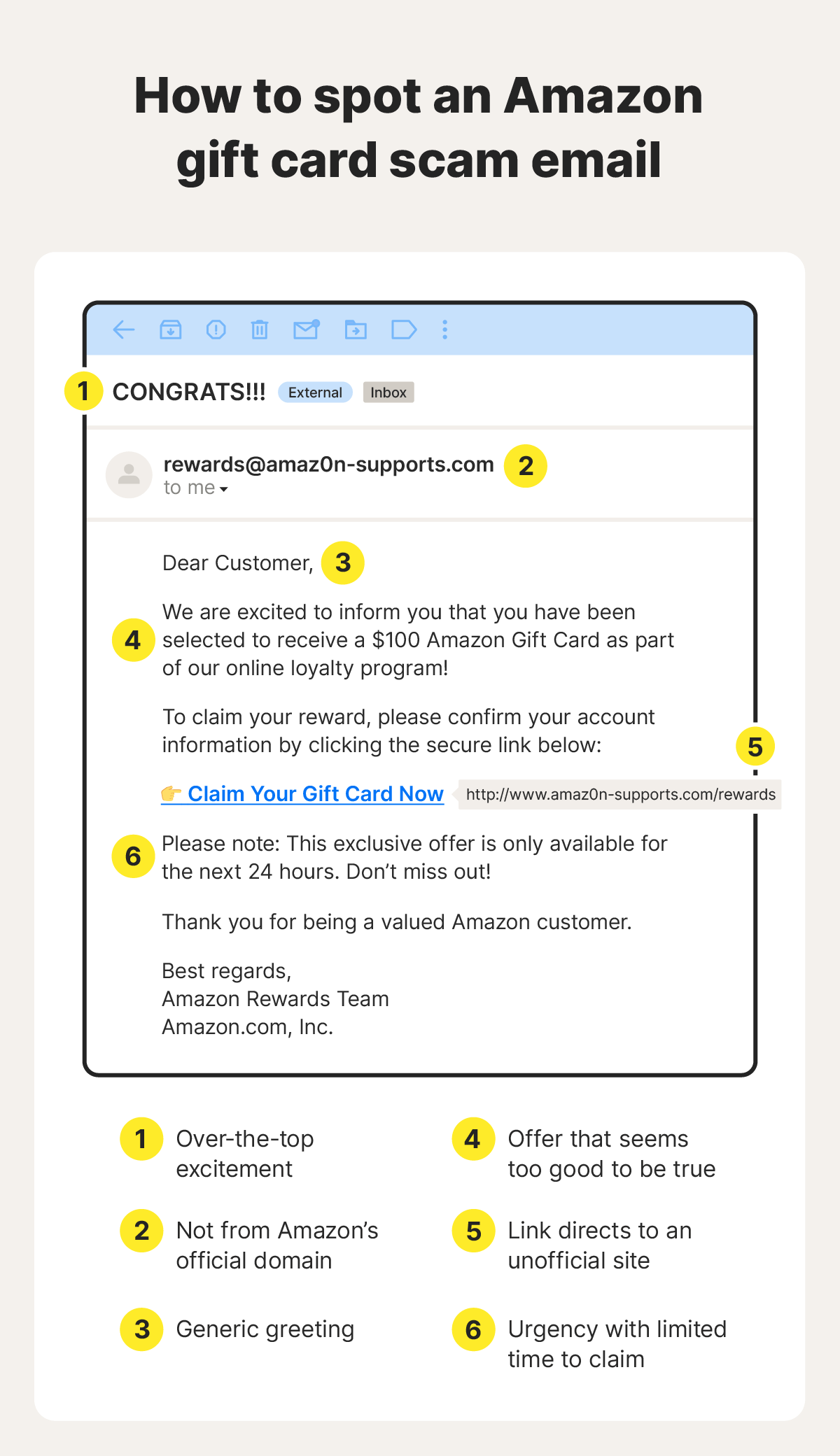
Amazon phishing emails may look official — complete with Amazon logos, professional language, and an email address that appears convincing at first glance. But it’s all a facade, they’re actually fake emails designed to get you to visit a spoofed website that will steal your personal or financial info.
According to the FTC, Amazon is one of the most impersonated companies by scammers, making Amazon phishing emails especially common. The best ways to spot fake emails include looking out for fake email addresses, weird phrasing, odd attachments, or links to suspicious URLs.
3. Free Amazon gift card scams
In this scam, which is a variant of the Amazon phishing scam explained above, you get an email or see a pop-up saying you’ve won a free Amazon gift card. However, instead of a reward, clicking the link results in a spyware download or redirects you to a fake webpage containing a form that asks for your personal or financial details.
Downloading suspicious files or disclosing sensitive information in exchange for a gift card could expose you to malware, account takeover attacks, and identity theft. The key warning sign of this scam is a claim that you’ve won a “free” Amazon gift card, even if you’ve not entered a competition.
4. Romance scams
Romance scams and Amazon scams sometimes intersect. They start with a friendly connection on an online dating app, which will typically be moved to a less moderated environment, like a secure messaging app. Eventually, the conversation turns deep and, finally, the request comes: “Can you help me out with an Amazon gift card?”
Committed scammers build trust before asking for money, often inventing elaborate stories involving sick relatives, travel emergencies, or temporary money problems. They usually start subtly, perhaps asking you for a gift card to buy necessities because they’re low on cash. But scammers can be persistent, and they might ramp up the intensity if you don’t give in straight away.
5. Government or utility impersonation scams
Some scammers pose as IRS agents, police officers, or utility companies, claiming you owe money and must pay immediately with Amazon gift cards to avoid arrest or service shutoff. They rely on you being afraid of the potential consequences of not paying.
However, legitimate agencies will never request (or even accept) gift cards as payment, and they certainly won’t insist on ones that come specifically from Amazon. If someone “from the government” is demanding an Amazon gift card, they’re a fraudster.
6. Prize and lottery scams
Prize or lottery scams are a common social media trick. Scammers lure you with the promise of a “free gift” or prize — like a $1,000 Amazon gift card — but claim you need to pay a small “processing fee” or share your personal information to collect it. Ironically, they might even ask you to pay the processing fee with an Amazon gift card.
In reality, legitimate sweepstakes never require that you make a payment to claim your prize — and you should never have to use gift cards to collect winnings.
7. Friend-in-need scams
An urgent message from a friend or loved one in need can send you into panic mode — making this type of impersonation scam difficult to spot. If your friend texts you “Hey, can you do me a huge favor?”, you might not think to verify their identity before jumping to help them.
Friend-in-need scam messages appear to be from a friend, coworker, or family member. They’ll often involve a worrying pretext, perhaps claiming that they’ve lost their wallet and need you to send them an Amazon gift card to cover groceries or make an urgent purchase.
In one case, a Reddit user shared that they got an email from a friend saying they were having issues with their Amazon account and needed help with a gift card. It turns out the friend’s account had been hacked.
If you’re ever suspicious about whether a contact is really who they’re claiming to be, double-check with a phone call to see if the request is legit.
8. Fake job offers
Scammers often target job seekers with job advertisements or offers that look legitimate, but will request an upfront payment. These job application scams may involve a “recruiter” claiming you need to purchase Amazon gift cards to cover training, onboarding, or equipment costs.
While the role might sound perfect for you, any employer that asks you to make a payment to proceed with an application (especially using gift cards) is almost certainly a scammer. Legitimate companies will never require applicants to pay money before they can start a job.
9. Overpayment scams
Overpayment scams exploit your good faith. A scammer sends you a fake check or money transfer, perhaps after buying something from you on an online marketplace, and then they claim that they “accidentally” overpaid. But they’ll ask you to refund the difference using an Amazon gift card, instead of a more conventional method like a simple transfer.
If you refund them the money they’ve “accidentally” overpaid, they’ll try to reverse the original payment, leaving you without the money you’re owed and down the amount sent via gift card.
10. Boss impersonation scams
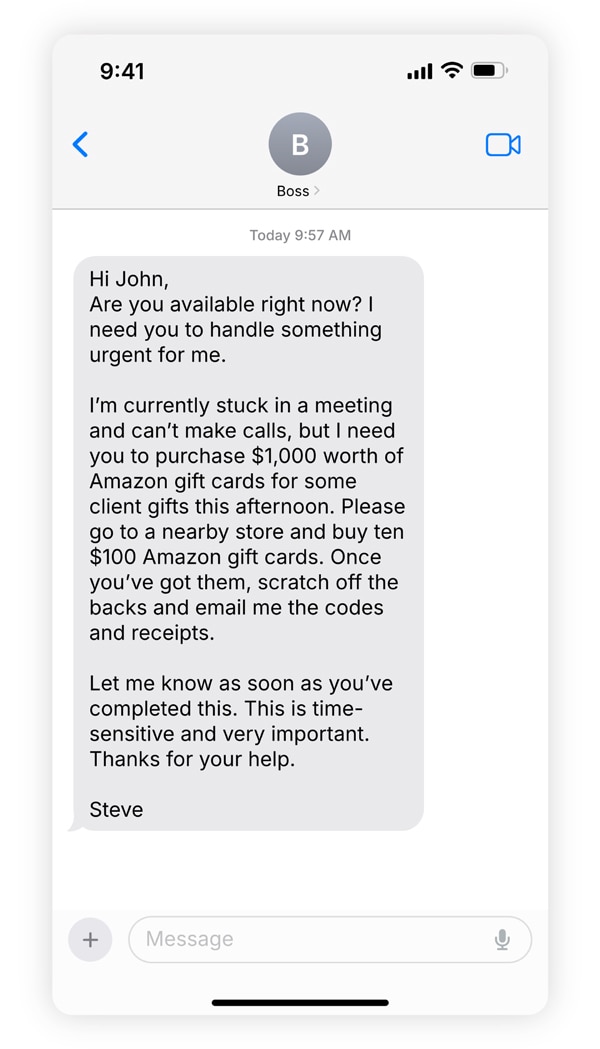
Boss impersonation scams are very similar to the friend-in-need scam, but they target professional relationships instead of friendships. In these scams, you get a fake text or email from your “boss” asking you to urgently grab a few Amazon gift cards that will be used as “gifts” for employees.
One tech writer fell victim to this exact scenario. She received an email seemingly from the president of a nonprofit organization where she served on the board, requesting that she buy $400 in Amazon gift cards as a surprise for staff members. The message seemed legitimate at first; however, upon closer inspection of the sender’s email address, she realized something was wrong.
Always confirm these kinds of requests via a phone call or in-person conversation. Even if the sender’s address or number seems legitimate, it could be because the scammer has managed to hack into your boss’s account.
11. Fake online listings scams
Some scammers post fake listings for tickets, electronics, or rental properties on online marketplaces like eBay or Facebook Marketplace. Their aim is to lure you in with deals that look amazing but, when you inquire about the product, they ask for payment via an Amazon gift card as a deposit.
If a seller demands a gift card instead of payment via a more conventional and secure method, walk away from the “deal.” It’s better to do some safe online shopping instead.
12. Survey scams
The survey scam begins with a deal: take a quick online survey, and you’ll receive a $50 Amazon gift card as a reward. However, in order to “claim” your prize, you’ll be asked to provide personal information or download a suspicious file, inadvertently giving a scammer valuable details they can use in identity theft or installing data-stealing malware on your device. You won’t get your Amazon gift card, either.
Unfortunately, since some legitimate organizations do offer Amazon gift cards in return for filling out surveys, these scams can be difficult to spot. To be safe, only fill out surveys from respected, well-known organizations, double-checking their official social media channels to see if the survey is mentioned there. If you’re a student asked to take part in a “study,” make sure the survey request comes from a sender bearing your university’s official .edu email domain.
How to spot Amazon gift card scams
Learning how to spot Amazon gift card scams can help you stay safer online. Stay sharp by watching for these red flags:
- Gift cards as payment: If someone insists upon payment in gift cards, treat it as an immediate red flag and think before doing anything else. Gift cards are not a conventional payment method.
- Free gift cards: Legitimate companies and organizations rarely give away items like gift cards out of the blue. If you receive a free gift card offer out of nowhere, that should raise a red flag.
- Social media silence: If a well-known company’s official social channels don’t mention the “contest” or “giveaway” that arrived in your inbox, it’s probably fake. Legitimate promotions are almost always announced publicly.
- Urgency or threats: Scammers often pressure you to act fast. Don’t be swayed by their demands for immediate action.
- Impersonation: Scammers pose as Amazon, government agencies, or someone you trust. Take a moment to confirm and look at the contact information they reached out with.
- Strange links or grammar: Poor formatting and unusual URLs are major warnings. Hover over links and look for typos or awkward phrasing. Double-check URLs in links against the company’s official website.
- PIN requests: Never share a gift card code or PIN, especially through email or chat. This is all a scammer needs to steal the value of the gift card from you.
What to do if you fell for an Amazon gift card scam
If you fell for an Amazon gift card scam, you need to act fast. Here’s what to do if you shared a gift card or personal information:
- Notify your bank: If you shared banking or card details, you need to report it to the relevant financial institutions as quickly as possible. They’ll advise you on additional steps to take to protect your accounts.
- Contact Amazon: Report the gift card scam directly to Amazon using their relevant support page. This will help Amazon look into the issue and fight scammers in the future.
- Report the scam: File a complaint with the FTC or your local consumer protection agency. These reports go towards helping scam-busting institutions learn about the latest tactics in use so they can do more to help future victims.
- Monitor your identity: If you gave away personal or sensitive information to a scammer, investing in identity theft protection can help you monitor for signs that your identity is being used in fraud.
Safeguard your personal information
Amazon gift card scams can happen to anyone. But the more you know about them, the better protected you are. From staying alert to phishing emails to rejecting requests to make payments with gift cards, a few smart moves go a long way.
LifeLock adds another layer of protection by monitoring your personal information online and alerting you to potential identity threats. It can also help you find and remove your personal data from public websites, making it harder for scammers to find you in the first place.
And, if the worst happens and your identity is stolen, LifeLock’s U.S.-based personal restoration specialists will help make the identity recovery process smoother.
FAQs
Can gift card scams be traced?
Tracing gift cards isn’t usually possible. Scammers will often use gift cards quickly and anonymously, making them difficult to track once the balance is gone.
Can I get my money back if I fell for a gift card scam?
Unfortunately, it’s rare to get your money back from a gift card scam. Once the code is shared and used, it’s nearly impossible to recover the funds.
Is the $1,000 Amazon gift card survey legit?
Most surveys promising $1,000 worth of Amazon gift cards are scams. If a survey asks for payment info or sensitive data, it’s best to close the page.
Editors’ note: Our articles provide educational information about identity theft, scams, financial fraud, and other topics that can put your identity or personal accounts at risk. LifeLock offerings may not cover or protect against every type of crime, fraud, scam, or threat we write about. For more details about how we write, review, and update our articles, see our Editorial Policy.
This article contains
- 1. Tech support gift card scams
- 2. Amazon phishing emails
- 3. Free Amazon gift card scams
- 4. Romance scams
- 5. Government or utility impersonation scams
- 6. Prize and lottery scams
- 7. Friend-in-need scams
- 8. Fake job offers
- 9. Overpayment scams
- 10. Boss impersonation scams
- 11. Fake online listings scams
- 12. Survey scams
- How to spot Amazon gift card scams
- What to do if you fell for an Amazon gift card scam
- Safeguard your personal information
- FAQs
Related articles