


Has your personal data been recently exposed?
Check if information like your Social Security number, email, and passwords is exposed on the dark web.


You have reached the maximum number of scans allowed. Please come back after 24 hours.

Scanning the dark web...
Scanning public databases...
Scanning millions of records...
Narrowing down the search...
We need more information
Please enter a few more details to ensure we show you the right information.
You’re at high risk
We found your personal information on the dark web and on data broker sites.
 Up to $3M Reimbursement for identity theft, with up to $1M for Stolen Funds†††
$10K Scam Reimbursement7
Scam Support
Credit, Checking and Savings Activity Alerts: Unlimited Accounts
Credit & Payday Loan Lock2
Credit Monitoring:
3 Bureau1
Automatic Data Broker Removal8
Dark Web Monitoring
Priority 24/7 Customer Phone Support
Up to $3M Reimbursement for identity theft, with up to $1M for Stolen Funds†††
$10K Scam Reimbursement7
Scam Support
Credit, Checking and Savings Activity Alerts: Unlimited Accounts
Credit & Payday Loan Lock2
Credit Monitoring:
3 Bureau1
Automatic Data Broker Removal8
Dark Web Monitoring
Priority 24/7 Customer Phone Support
LifeLock Total

No one can prevent all cybercrime or prevent all identity theft.
- Price valid for introductory term. After that, your price will renew at the standard price.
- Your subscription begins immediately after your transaction is complete. A payment method is required at sign-up for trials, and you will be charged at the end of your trial, unless canceled first.
- Prices are subject to change and may be charged up to 35 days prior to renewal. Cancel here or contact Member Services.
- Restrictions apply. Automatically renewing subscription required. If you're a victim of identity theft and not satisfied with our resolution, you may receive a refund for the current term of your subscription. See lifelock.norton.com/guarantee for complete details.
††† Up to $1 million coverage for Lawyers and Experts included with all plans. Reimbursement and expense compensation vary according to plan. Insurance benefits are issued by third parties. See lifelock.norton.com/legal for policy info.
1 Bureau Monitoring and Monthly Credit Report and Score / 3 Bureau Monitoring and Monthly Credit Report and Score.
2 Credit Lock cannot prevent all account takeovers, unauthorized account openings, or credit file inquiries. Deactivates if you downgrade or cancel your subscription.
7 Scam protection coverage as part of identity theft benefits is currently available to all customers residing in the United States, including U.S. territories and the District of Columbia, with the exception of residents of New York. Gen Digital is not a licensed insurance producer. Benefits under the Master Policy are issued and covered by HSB Specialty Insurance Company. You can find further details and exclusions in the summary of benefits.
8 After setup, automatic data broker removal service scans and requests removal every 90 days.
You’re at medium risk
We found your personal information on data broker sites.
Up to $1.2M Reimbursement for identity theft, with up to $100K for Stolen Funds†††
$5K Scam Reimbursement7
Scam Support
Credit, Checking and Savings Activity Alerts:
5 Accounts
Credit & Payday Loan Lock2
Credit Monitoring:
3 Bureau1
Automatic Data Broker Removal8
Dark Web Monitoring
Priority 24/7 Customer Phone Support
LifeLock Advanced
No one can prevent all cybercrime or prevent all identity theft.
- Price valid for introductory term. After that, your price will renew at the standard price.
- Your subscription begins immediately after your transaction is complete. A payment method is required at sign-up for trials, and you will be charged at the end of your trial, unless canceled first.
- Prices are subject to change and may be charged up to 35 days prior to renewal. Cancel here or contact Member Services.
- Restrictions apply. Automatically renewing subscription required. If you're a victim of identity theft and not satisfied with our resolution, you may receive a refund for the current term of your subscription. See lifelock.norton.com/guarantee for complete details.
††† Up to $1 million coverage for Lawyers and Experts included with all plans. Reimbursement and expense compensation vary according to plan. Insurance benefits are issued by third parties. See lifelock.norton.com/legal for policy info.
1 Bureau Monitoring and Monthly Credit Report and Score / 3 Bureau Monitoring and Monthly Credit Report and Score.
2 Credit Lock cannot prevent all account takeovers, unauthorized account openings, or credit file inquiries. Deactivates if you downgrade or cancel your subscription.
7 Scam protection coverage as part of identity theft benefits is currently available to all customers residing in the United States, including U.S. territories and the District of Columbia, with the exception of residents of New York. Gen Digital is not a licensed insurance producer. Benefits under the Master Policy are issued and covered by HSB Specialty Insurance Company. You can find further details and exclusions in the summary of benefits.
8 After setup, automatic data broker removal service scans and requests removal every 90 days.
Good news!
We didn’t find your personal information across millions of records or on public data sources.
Up to $1.05M Reimbursement for identity theft, with up to $25K for Stolen Funds†††
Identity Restoration Specialists
Credit, Checking and Savings Activity Alerts:
2 Accounts
Credit & Payday Loan Lock2
Credit Monitoring:
2 Bureau1
Automatic Data Broker Removal8
Dark Web Monitoring
Breach Alerts
24/7 Customer Phone Support
Lifelock Core
No one can prevent all cybercrime or prevent all identity theft.
- Price valid for introductory term. After that, your price will renew at the standard price.
- Your subscription begins immediately after your transaction is complete. A payment method is required at sign-up for trials, and you will be charged at the end of your trial, unless canceled first.
- Prices are subject to change and may be charged up to 35 days prior to renewal. Cancel here or contact Member Services.
- Restrictions apply. Automatically renewing subscription required. If you're a victim of identity theft and not satisfied with our resolution, you may receive a refund for the current term of your subscription. See lifelock.norton.com/guarantee for complete details.
††† Up to $1 million coverage for Lawyers and Experts included with all plans. Reimbursement and expense compensation vary according to plan. Insurance benefits are issued by third parties. See lifelock.norton.com/legal for policy info.
1 Credit features require successful setup, identity verification, and sufficient credit history by the appropriate credit bureau. Credit monitoring features may take several days to activate after enrollment.
2 Identity Lock cannot prevent all account takeovers, unauthorized account openings, or credit file inquiries. Deactivates if you downgrade or cancel your subscription.
8 After setup, automatic data broker removal service scans and requests removal every 90 days.

 Why do we ask?
Finding your match...

10 cents
If your information is exposed or stolen in a data breach, it can end up on the dark web where it can be sold for as little as 10 cents.
100M+
LifeLock monitors hundreds of millions of data points a second.
- Up to $1.05M Reimbursement for identity theft, with up to $25K for Stolen Funds†††
- Up to $1.2M Reimbursement for identity theft, with up to $100K for Stolen Funds†††
- Up to $3M Reimbursement for identity theft, with up to $1M for Stolen Funds†††
- Up to $1.05M Reimbursement for identity theft, with up to $25K for Stolen Funds††† for each adult
- Up to $1.2M Reimbursement for identity theft, with up to $100K for Stolen Funds††† for each adult
- Up to $3M Reimbursement for identity theft, with up to $1M for Stolen Funds††† for each adult
- Up to $1.05M Reimbursement for identity theft, with up to $25K for Stolen Funds††† for each adult
- Up to $1.2M Reimbursement for identity theft, with up to $100K for Stolen Funds††† for each adult
- Up to $3M Reimbursement for identity theft, with up to $1M for Stolen Funds††† for each adult
- Credit Monitoring Coverage1
- Credit Monitoring1 each adult
- Credit Monitoring1 for family
- Credit, Checking & Savings Account Activity Alerts
- Credit, Checking and Savings Activity Alerts for each adult
- Credit, Checking and Savings Activity Alerts for family
- 401K & Investment Account Activity Alerts
- 401K/Investment Account Alerts for each adult
- 401K/Investment Account Alerts for family
- Recurring and Unusual Charge Alerts
- Unexpected & Suspicious Charge Alerts for each adult
- Unexpected & Suspicious Charge Alerts for family
- Stolen Funds Reimbursement†††
- Stolen Funds Reimbursement††† for each adult
- Stolen Funds Reimbursement††† for family
- Lawyers and Experts†††
- Lawyers & Experts††† for each adult
- Lawyers & Experts††† for family
- Automatic Data Broker Removal8
- Automatic Data Broker Removal8 for each adult
- Automatic Data Broker Removal8 for family
- Scam Reimbursement7
- Scam Reimbursement7 for each adult
- Scam Reimbursement7 for family
- Credit Reports & Scores1
- Credit Report & Score for each adult
- Credit Report & Score for family
- Social Media Monitoring
- Social Media Monitoring for each adult
- Social Media Monitoring for family


††† Up to $1 million coverage for Lawyers and Experts included with all plans. Reimbursement and expense compensation vary according to plan. Insurance benefits are issued by third parties. See LifeLock.Norton.com/legal for policy info.
1 Credit features require successful setup, identity verification and sufficient credit history by the appropriate credit bureau. Credit monitoring features may take several days to activate after enrollment.
7 Scam protection coverage as part of identity theft benefits is currently available to all customers residing in the United States, including U.S. territories and the District of Columbia, with the exception of residents of New York. Gen Digital is not a licensed insurance producer. Benefits under the Master Policy are issued and covered by HSB Specialty Insurance Company. You can find further details and exclusions in the Summary of Benefits.
8 After setup, automatic data broker removal service scans and requests removal every 90 days.
Why do we ask?
Identifying your concerns gives us the ability to recommend the right plan for your needs.
Why do we ask?
Knowing this number helps us recommend coverage that fits your needs.
Why do we ask?
Providing your email address makes you eligible for notifications of potential identity threats.
Card Exposure Control by LifeLock
Online shopping is obviously convenient. But when apps and websites save your card details, your financial information can be spread across more places than you realize. And if this data leaks, you could be at risk of financial fraud. Card Exposure Control by LifeLock helps identify where your card details are stored, guiding you through the steps to request removal from risky merchants.





Whenever you save your credit or debit card online, you’re entrusting another company to protect your sensitive financial information. Over time, your card details can end up on an array of shopping sites, delivery apps, subscription services, and travel platforms, many of which you probably don’t even remember using. And the more places your card details are stored, the more vulnerable they are to being exposed in a data breach.
Card Exposure Control, available on all LifeLock plans, gives you better visibility and more control over your stored payment information, helping reduce the risk of your data being exposed in a data leak or breach that could lead to financial fraud or identity theft.
How Card Exposure Control works
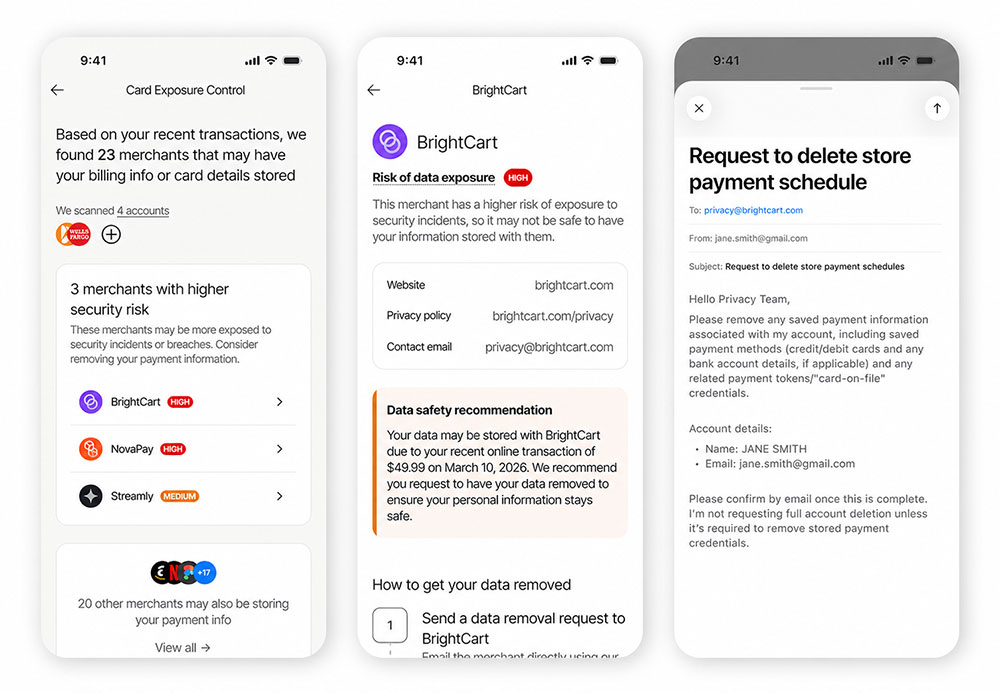
Card Exposure Control reviews your transaction history across connected accounts and identifies online merchants where you’ve used your credit or debit card. It then determines which of those merchants are most likely to still have your information, provides a risk rating of the merchants, and guides you through the process of requesting removal.
Here’s a step-by-step look at what Card Exposure Control does:
- It reviews your transaction history, scanning up to 12 months of transaction data across all your connected financial accounts to detect merchants where you’ve previously made a purchase.
- It identifies potentially risky merchants, reviewing each merchant’s privacy policy to check whether they store card details and providing an individual security rating for each merchant to assess the risk of data exposure.
- It helps you remove your card details, offering personalized instructions to guide you through the process of requesting removal of your financial data from each merchant’s database, and providing prefilled opt-out requests when relevant.
Why stored payment details can increase the risk of financial fraud
Every online merchant that has your card details on record is a potential weak point in your defense against data exposure. These merchants, like any other company, can suffer data breaches or leaks that leave your financial data compromised and at risk of being sold to cybercriminals on the dark web.
In fact, there were a record number of data breaches in 2025, according to the Identity Theft Resource Center's latest Annual Data Breach Report. And the Federal Trade Commission (FTC) consistently cites credit card fraud as the most commonly reported type of identity theft, most recently in its 2024 Consumer Sentinel Network Data Book.
Meanwhile, according to VISA’s 2025 Global Digital Shopping Index, 67% of U.S. shoppers used stored credentials for their most recent online purchase, and 41% store their payment credentials with online merchants most or all of the time.
In other words, even as consumers increasingly trust online merchants to store payment details, data breaches are exposing sensitive information at a record rate. That creates more opportunities for identity theft in the form of credit card fraud. And identity theft remains one of the most likely crimes to happen to you.
How Card Exposure Control helps you keep track of your payment details
Card Exposure Control is designed to help you understand where your payment information is stored, which merchants might pose a risk to your data security, and how you can reduce the overall risk that your financial details leak or end up with cybercriminals.
Depending on how much you use your cards online, it may be impossible to remember every purchase you’ve made and every e-shop you’ve made it from. Plus, how are you supposed to know which merchants you can trust?
Here are some examples of real-world use cases for Card Exposure Control, all of which can help you defend against the risk of fraud or identity theft:
- Find old retailer accounts: An online store you made one purchase with months ago might still have your card details saved without you realizing it. Card Exposure Control identifies these potential vulnerabilities, so you can tie up loose ends that could be putting your finances at risk.
- Identify risky merchants: Not every company handles sensitive financial data carefully. Card Exposure Control assigns a risk level to each merchant that you store card details with, helping you prioritize data removal and decide how to balance convenience with security.
- Clean up old or unused subscriptions: How many current subscriptions do you no longer use? And how many of those have you canceled in the last 12 months? Card Exposure Control can help you identify subscription services that you no longer want holding your card details, so you can limit your exposure to major data breaches.
Note that Card Exposure Control doesn’t change your billing information with merchants or affect automatic payments. It just gives you insights that make it easier for you to take control of your own financial exposure.
Protect your financial data with LifeLock
Card Exposure Control, available in all LifeLock plans, helps you balance convenience and financial security, making it easier than ever to identify where your payment details are stored online and providing step-by-step guidance to help reduce the risk that they’re exposed. Plus, as a LifeLock member, you’ll also benefit from alerts to suspicious activity on your financial accounts, dark web monitoring, and identity theft reimbursement coverage.
FAQs
How does Card Exposure Control know where my billing information may be stored?
Card Exposure Control analyzes your transaction history to identify which merchants are likely to have your card details on file, based on signals like whether a transaction was completed online or in-person and what the merchant’s privacy policy says.
Why would I want to remove my billing information from a merchant?
Removing saved billing details from online merchants you no longer use or don’t trust to protect your data can reduce your exposure to fraud or data breaches. Thousands of data breaches happen each year, with billions of records like names, email addresses, passwords, and credit card numbers having been exposed in the past. In 2024 alone, the Leakd.com security team discovered a collection of 5 million unique credit and debit card details.
Can Card Exposure Control remove my card details for me?
No. Card Exposure Control guides you through the removal process with step-by-step instructions and pre-filled request forms, where available. It won’t make any changes to your card details with online merchants automatically.
Editors’ note: Our articles provide educational information about identity theft, scams, financial fraud, and other topics that can put your identity or personal accounts at risk. LifeLock offerings may not cover or protect against every type of crime, fraud, scam, or threat we write about. For more details about how we write, review, and update our articles, see our Editorial Policy.
Related articles