





 Why do we ask?


Etsy shopping tip: While buying vintage branded products online is always a risk, you can reduce your chances of getting scammed by paying close attention to logos, tags, and seller reviews.
Has your personal data been recently exposed?
Check if information like your Social Security number, email, and passwords is exposed on the dark web.

You have reached the maximum number of scans allowed. Please come back after 24 hours.

Scanning the dark web...
Scanning public databases...
Scanning millions of records...
Narrowing down the search...
We need more information
Please enter a few more details to ensure we show you the right information.
Risk level:
High
You’re at high risk
We found your personal information on the dark web and on data broker sites.
Your personalized protection plan
Product Benefits:
 Up to $3M Reimbursement for identity theft, with up to $1M for Stolen Funds†††
$10K Scam Reimbursement7
Scam Support
Credit, Checking and Savings Activity Alerts: Unlimited Accounts
Credit & Payday Loan Lock2
Credit Monitoring:
3 Bureau1
Automatic Data Broker Removal8
Dark Web Monitoring
Priority 24/7 Customer Phone Support
Up to $3M Reimbursement for identity theft, with up to $1M for Stolen Funds†††
$10K Scam Reimbursement7
Scam Support
Credit, Checking and Savings Activity Alerts: Unlimited Accounts
Credit & Payday Loan Lock2
Credit Monitoring:
3 Bureau1
Automatic Data Broker Removal8
Dark Web Monitoring
Priority 24/7 Customer Phone Support
LifeLock Total
Your price:
$
349.99
Your price:
$
34.99
60-day money back guarantee with an annual plan
24/7 Live Member Support
No one can prevent all cybercrime or prevent all identity theft.
- Price valid for introductory term. After that, your price will renew at the standard price.
- Your subscription begins immediately after your transaction is complete. A payment method is required at sign-up for trials, and you will be charged at the end of your trial, unless canceled first.
- Prices are subject to change and may be charged up to 35 days prior to renewal. Cancel here or contact Member Services.
- Restrictions apply. Automatically renewing subscription required. If you're a victim of identity theft and not satisfied with our resolution, you may receive a refund for the current term of your subscription. See lifelock.norton.com/guarantee for complete details.
††† Up to $1 million coverage for Lawyers and Experts included with all plans. Reimbursement and expense compensation vary according to plan. Insurance benefits are issued by third parties. See lifelock.norton.com/legal for policy info.
1 Bureau Monitoring and Monthly Credit Report and Score / 3 Bureau Monitoring and Monthly Credit Report and Score.
2 Credit Lock cannot prevent all account takeovers, unauthorized account openings, or credit file inquiries. Deactivates if you downgrade or cancel your subscription.
7 Scam protection coverage as part of identity theft benefits is currently available to all customers residing in the United States, including U.S. territories and the District of Columbia, with the exception of residents of New York. Gen Digital is not a licensed insurance producer. Benefits under the Master Policy are issued and covered by HSB Specialty Insurance Company. You can find further details and exclusions in the summary of benefits.
8 After setup, automatic data broker removal service scans and requests removal every 90 days.
Risk level:
Medium
You’re at medium risk
We found your personal information on data broker sites.
Your personalized protection plan
Product Benefits:
Up to $1.2M Reimbursement for identity theft, with up to $100K for Stolen Funds†††
$5K Scam Reimbursement7
Scam Support
Credit, Checking and Savings Activity Alerts:
5 Accounts
Credit & Payday Loan Lock2
Credit Monitoring:
3 Bureau1
Automatic Data Broker Removal8
Dark Web Monitoring
Priority 24/7 Customer Phone Support
LifeLock Advanced
Your price:
$
199.99
Your price:
$
19.99
60-day money back guarantee with an annual plan
24/7 Live Member Support
No one can prevent all cybercrime or prevent all identity theft.
- Price valid for introductory term. After that, your price will renew at the standard price.
- Your subscription begins immediately after your transaction is complete. A payment method is required at sign-up for trials, and you will be charged at the end of your trial, unless canceled first.
- Prices are subject to change and may be charged up to 35 days prior to renewal. Cancel here or contact Member Services.
- Restrictions apply. Automatically renewing subscription required. If you're a victim of identity theft and not satisfied with our resolution, you may receive a refund for the current term of your subscription. See lifelock.norton.com/guarantee for complete details.
††† Up to $1 million coverage for Lawyers and Experts included with all plans. Reimbursement and expense compensation vary according to plan. Insurance benefits are issued by third parties. See lifelock.norton.com/legal for policy info.
1 Bureau Monitoring and Monthly Credit Report and Score / 3 Bureau Monitoring and Monthly Credit Report and Score.
2 Credit Lock cannot prevent all account takeovers, unauthorized account openings, or credit file inquiries. Deactivates if you downgrade or cancel your subscription.
7 Scam protection coverage as part of identity theft benefits is currently available to all customers residing in the United States, including U.S. territories and the District of Columbia, with the exception of residents of New York. Gen Digital is not a licensed insurance producer. Benefits under the Master Policy are issued and covered by HSB Specialty Insurance Company. You can find further details and exclusions in the summary of benefits.
8 After setup, automatic data broker removal service scans and requests removal every 90 days.
Risk level:
Low
Good news!
We didn’t find your personal information across millions of records or on public data sources.
Your personalized protection plan
Product Benefits:
Up to $1.05M Reimbursement for identity theft, with up to $25K for Stolen Funds†††
Identity Restoration Specialists
Credit, Checking and Savings Activity Alerts:
2 Accounts
Credit & Payday Loan Lock2
Credit Monitoring:
2 Bureau1
Automatic Data Broker Removal8
Dark Web Monitoring
Breach Alerts
24/7 Customer Phone Support
Lifelock Core
Your price:
$
124.99
Your price:
$
12.49
60-day money back guarantee with an annual plan
24/7 Live Member Support
No one can prevent all cybercrime or prevent all identity theft.
- Price valid for introductory term. After that, your price will renew at the standard price.
- Your subscription begins immediately after your transaction is complete. A payment method is required at sign-up for trials, and you will be charged at the end of your trial, unless canceled first.
- Prices are subject to change and may be charged up to 35 days prior to renewal. Cancel here or contact Member Services.
- Restrictions apply. Automatically renewing subscription required. If you're a victim of identity theft and not satisfied with our resolution, you may receive a refund for the current term of your subscription. See lifelock.norton.com/guarantee for complete details.
††† Up to $1 million coverage for Lawyers and Experts included with all plans. Reimbursement and expense compensation vary according to plan. Insurance benefits are issued by third parties. See lifelock.norton.com/legal for policy info.
1 Credit features require successful setup, identity verification, and sufficient credit history by the appropriate credit bureau. Credit monitoring features may take several days to activate after enrollment.
2 Identity Lock cannot prevent all account takeovers, unauthorized account openings, or credit file inquiries. Deactivates if you downgrade or cancel your subscription.
8 After setup, automatic data broker removal service scans and requests removal every 90 days.
1/2
Finding your match...

DID YOU KNOW?
10 cents
If your information is exposed or stolen in a data breach, it can end up on the dark web where it can be sold for as little as 10 cents.
100M+
LifeLock monitors hundreds of millions of data points a second.
Based on your concerns, the best plan for you is:
LifeLock Core
(Individual)
LifeLock Advanced
(Individual)
LifeLock Total
(Individual)
LifeLock Core
(2 adults)
LifeLock Advanced
(2 adults)
LifeLock Total
(2 adults)
LifeLock Core
(2 adults + up to 10 kids)
LifeLock Advanced
(2 adults + up to 10 kids)
LifeLock Total
(2 adults + up to 10 kids)
Pricing details below*
Pricing details below*
Pricing details below*
Pricing details below*
Pricing details below*
Pricing details below*
Pricing details below*
Pricing details below*
Pricing details below*
- Up to $1.05M Reimbursement for identity theft, with up to $25K for Stolen Funds†††
- Up to $1.2M Reimbursement for identity theft, with up to $100K for Stolen Funds†††
- Up to $3M Reimbursement for identity theft, with up to $1M for Stolen Funds†††
- Up to $1.05M Reimbursement for identity theft, with up to $25K for Stolen Funds††† for each adult
- Up to $1.2M Reimbursement for identity theft, with up to $100K for Stolen Funds††† for each adult
- Up to $3M Reimbursement for identity theft, with up to $1M for Stolen Funds††† for each adult
- Up to $1.05M Reimbursement for identity theft, with up to $25K for Stolen Funds††† for each adult
- Up to $1.2M Reimbursement for identity theft, with up to $100K for Stolen Funds††† for each adult
- Up to $3M Reimbursement for identity theft, with up to $1M for Stolen Funds††† for each adult
- Credit Monitoring Coverage1
- Credit Monitoring1 each adult
- Credit Monitoring1 for family
- Credit, Checking & Savings Account Activity Alerts
- Credit, Checking and Savings Activity Alerts for each adult
- Credit, Checking and Savings Activity Alerts for family
- 401K & Investment Account Activity Alerts
- 401K/Investment Account Alerts for each adult
- 401K/Investment Account Alerts for family
- Recurring and Unusual Charge Alerts
- Unexpected & Suspicious Charge Alerts for each adult
- Unexpected & Suspicious Charge Alerts for family
- Stolen Funds Reimbursement†††
- Stolen Funds Reimbursement††† for each adult
- Stolen Funds Reimbursement††† for family
- Lawyers and Experts†††
- Lawyers & Experts††† for each adult
- Lawyers & Experts††† for family
- Automatic Data Broker Removal8
- Automatic Data Broker Removal8 for each adult
- Automatic Data Broker Removal8 for family
- Scam Reimbursement7
- Scam Reimbursement7 for each adult
- Scam Reimbursement7 for family
- Credit Reports & Scores1
- Credit Report & Score for each adult
- Credit Report & Score for family
- Social Media Monitoring
- Social Media Monitoring for each adult
- Social Media Monitoring for family

We have more plans to choose from.
See all plans

Have questions?
Contact sales
*Your subscription begins immediately after payment and automatically renews unless cancelled. Discount for annual plans are compared to monthly billing. Prices subject to change and may be charged up to 35 days before current term ends. Cancel here or contact Member Services.
††† Up to $1 million coverage for Lawyers and Experts included with all plans. Reimbursement and expense compensation vary according to plan. Insurance benefits are issued by third parties. See LifeLock.Norton.com/legal for policy info.
1 Credit features require successful setup, identity verification and sufficient credit history by the appropriate credit bureau. Credit monitoring features may take several days to activate after enrollment.
7 Scam protection coverage as part of identity theft benefits is currently available to all customers residing in the United States, including U.S. territories and the District of Columbia, with the exception of residents of New York. Gen Digital is not a licensed insurance producer. Benefits under the Master Policy are issued and covered by HSB Specialty Insurance Company. You can find further details and exclusions in the Summary of Benefits.
8 After setup, automatic data broker removal service scans and requests removal every 90 days.
Why do we ask?
Identifying your concerns gives us the ability to recommend the right plan for your needs.
Return to quiz
Why do we ask?
Knowing this number helps us recommend coverage that fits your needs.
Return to quiz
Why do we ask?
Providing your email address makes you eligible for notifications of potential identity threats.
Return to quiz
8 Etsy scams to watch for and tips for safer shopping
Etsy is a great place to find unique items, but its direct buyer-to-seller model comes with some risks. Learn how to identify eight common Etsy scams. Then get an identity theft protection service that monitors your personal info and accounts for misuse and includes reimbursement of up to $5k for scam-related losses.


Etsy is an online marketplace that connects independent sellers with buyers looking for unique, customized, and handmade products. However, the platform’s popularity makes it attractive to scammers, who try to sell fake items, steal personal information, or engage in other fraudulent schemes.
While Etsy removes millions of scam messages and bans large numbers of fraudulent sellers annually, some scams still manage to slip through. Keep reading to learn about the most common Etsy scams and how to avoid them.
1. Counterfeit goods scam
Some Etsy scammers use the platform to sell knock-off items disguised as high-quality, branded products. Often advertised as “vintage” finds, these counterfeit goods frequently feature logos or designs stolen from popular brands like Nike or Chanel, but they lack the high-quality finish of the items they imitate.
On the r/Etsy subreddit, an Etsy buyer shared that they purchased autographed items on Etsy but suspected they were fake as soon as they arrived. Later, a professional authenticator confirmed the autographs were counterfeit. The buyer had used Klarna for the purchase (the popular buy-now-pay-later payment option akin to layaway) and reported the issue directly to Klarna before contacting Etsy. Because the complaint went to Klarna first, Etsy closed the case and denied a refund. Klarna, meanwhile, said Etsy was responsible, leaving the buyer out $1,500.
Here are a few ways to spot a counterfeit goods scam on Etsy:
- The seller doesn’t include clear pictures of the item’s logo and tags.
- There are subtle differences between the logo on the product and the official brand.
- The product is being sold for a suspiciously low price.
- The seller has comparatively few positive reviews.
2. Fake Etsy shop scam
In this scheme, a scammer creates fake Etsy shops solely to collect payments or steal personal information from buyers, with no intention of delivering any products. Some fake Etsy shops now use AI to look legitimate. Scammers can generate shop descriptions, product listings, and even reviews within minutes, making it easy to launch convincing storefronts and then disappear with buyer info just as fast.
These scams often fall into what experts call VibeScams in a recent Gen Threat Report. This is fraud that succeeds not because of technical sophistication, but because the shop feels legit — the colors, layout, branding, and small trust signals pass a quick “vibe check,” convincing shoppers the store is legitimate before they think to look closer.
Shops may use AI-generated images that claim to show handmade or custom items. These images look polished, but the product may not even exist. Buyers instead receive a cheap, mass-produced item or nothing at all. By the time you realize you’ve purchased from a fake Etsy shop, the seller has likely removed it from the platform, potentially leaving you out of pocket and vulnerable to identity theft with limited options for recourse.
There are several things to keep in mind when looking out for fake Etsy shops, including:
Limited or otherwise suspicious reviews
Reviews lacking detailed descriptions of the items, seller communication, or shipping process can sometimes be signs that the shop and reviews are fake.
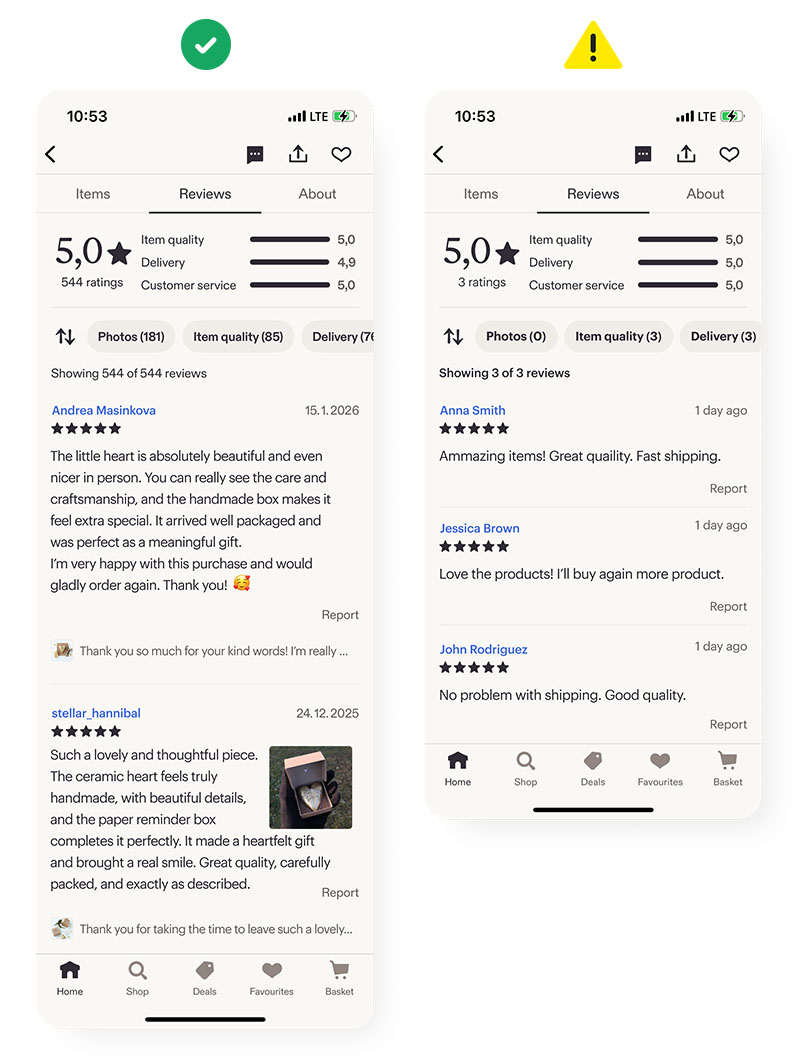
A screenshot of an Etsy shop with good, detailed reviews, and an example of a fake Etsy shop with limited reviews.
Incomplete shop details
Shops that lack basic information like a description, policies, or even banner images or logos can sometimes be a sign that the shop is fake. It can mean that the seller created a scam account quickly and didn’t take the time to fill in basic details.
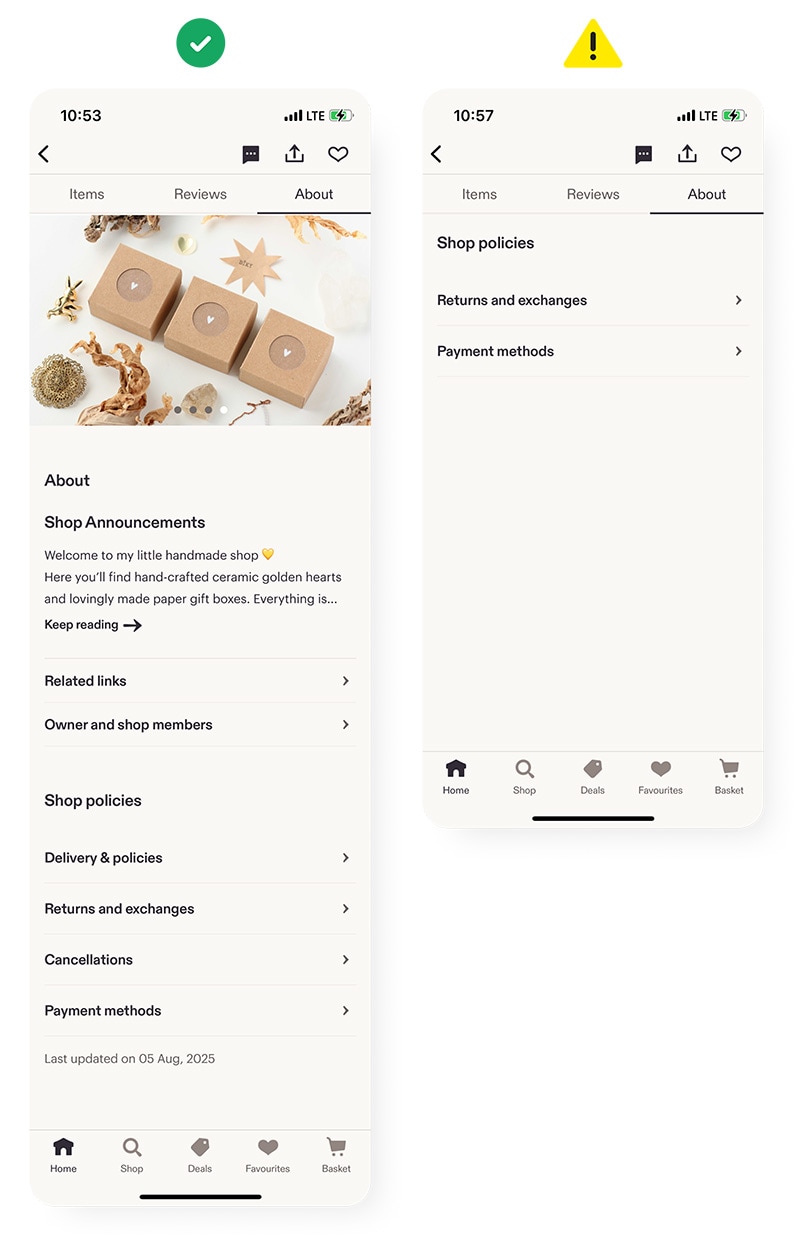
A screenshot of two Etsy shops: one with complete shop details, and a fake Etsy shop with no description or shop logo.
Poor grammar and spelling
Some scam shops on Etsy have spelling errors in the shop details or item listings. Scammers may do this on purpose to target impressionable victims, but these mistakes may also occur if the scammer is moving fast to create fake shops at scale and not spending time perfecting each listing.
A screenshot of a real Etsy shop and a fake Etsy shop, which has spelling and grammar errors (among other red flags).
Strange listing photos
Images that are AI-generated is one of the biggest signs that an Etsy shop is fake. If you purchase an item with an AI-generated listing image, there’s no telling what you’ll receive — if you receive anything at all. Low-quality images coupled with descriptions promising designer or other high-quality items is also a sign that the Etsy shop is fraudulent and trying to pull a fast one on you.
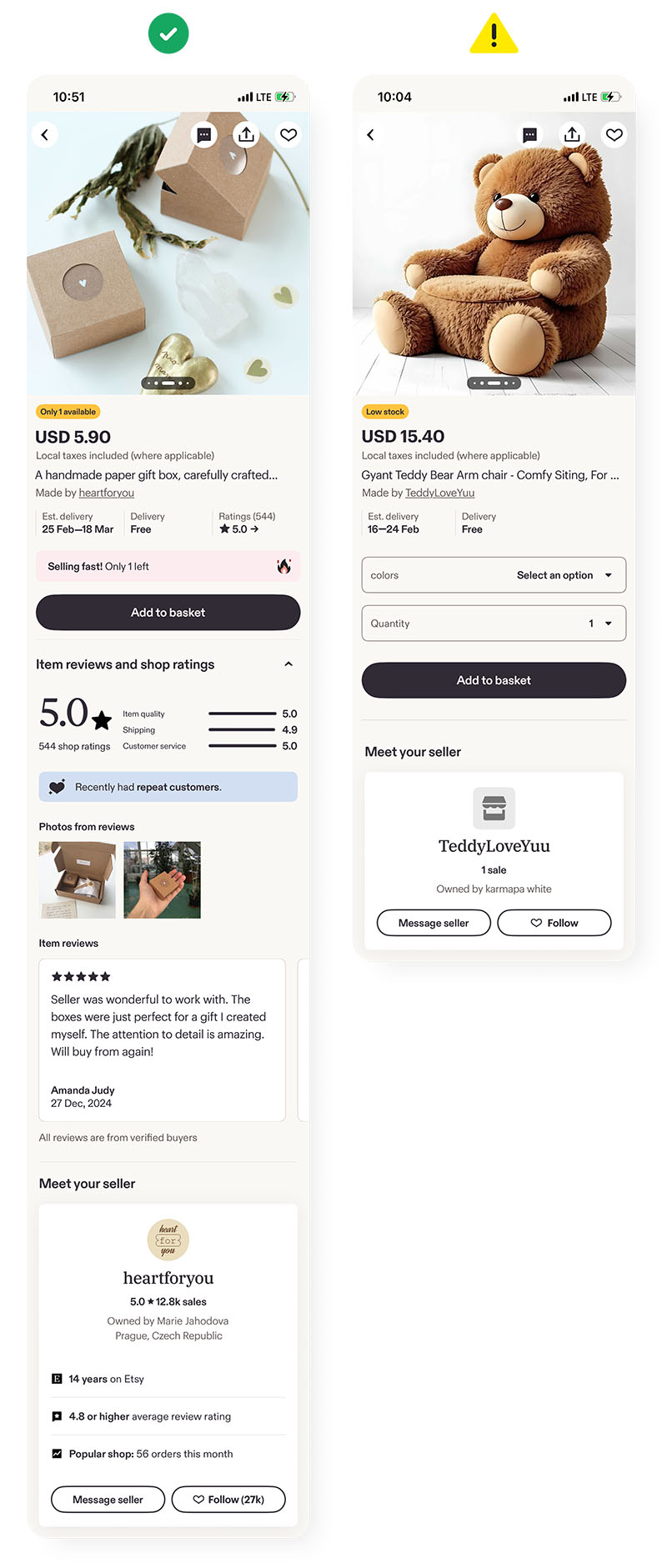
An example of a legitimate Etsy shop with real images, and a screenshot of a fake Etsy shop with AI-generated listings images.
Etsy shopping tip: Shop for items with an “Etsy’s Pick” badge. These products are hand-selected by Etsy experts on the basis of consistent quality, reliability, and style.
3. Fake buyers
In the fake buyer scam, Etsy sellers are suddenly overwhelmed with a surge of orders that appear legitimate, creating pressure to ship before fraud is detected. Scammers create multiple buyer accounts and place a wave of orders within a short time frame. Some payments fail, others go through, and the activity can seem legitimate enough to pressure sellers into prompt shipment.
In many cases, scammers are testing stolen payment methods or setting up future chargebacks. Even if Etsy flags some transactions, others may still appear valid, leaving sellers uncertain about how to proceed.
A seller on the r/EtsySeller subreddit recently reported waking up to dozens of orders placed within just a few hours, all from newly created U.K.-based accounts, even though most of their customers were typically in the U.S. Each account placed multiple separate orders, often for the same item, with oddly formatted names and addresses and seemingly random or inactive email addresses.
While Etsy acknowledged the activity was unusual, they advised the seller to ship. But the pattern continued for days, and legitimate sales dropped sharply, prompting the seller to cancel the suspicious orders to avoid potential fraud and chargebacks.
Here are a few ways to spot a suspicious buyer on Etsy:
- A sudden spike in orders within a short time frame.
- Multiple orders from the same buyer, especially if it's a newly-created account.
- The same formatting across names and addresses, often without spaces.
- Payments stuck in “processing” or later declined.
- Buyer locations that don’t match your usual customer base.
- No response to messages sent through Etsy.
Etsy selling tip: Fake buyer scams often rely on creating urgency, forcing sellers to ship before payments fully clear or before fraud is detected. Only ship orders that are fully paid and marked as complete in Etsy. And if something feels off, contact Etsy support before shipping.
4. Wrong address scam
In this scam, the seller intentionally ships an item you’ve bought to an address they have access to, instead of yours. When your purchase doesn’t arrive, and you file a claim, the seller can provide proof of delivery to Etsy. This makes it more difficult to secure a refund for your order, giving the seller time to disappear with your money.
One Etsy buyer shared that their order was marked as delivered, but nothing arrived. When they checked the tracking details, they noticed the package had been delivered to a different city entirely. The buyer messaged the seller but never received a response, and later realized they had accidentally called a number they believed was a scam while trying to resolve the issue.
Here are a few ways to spot a wrong address scam on Etsy:
- The shipping address on the order tracking info appears incomplete or incorrect.
- Reviews mention other buyers experiencing delivery issues.
- The seller provides vague or evasive answers when you ask about your package.
- The tracking information shows your package was delivered, but you never received it.
Etsy shopping tip: If you order an item that never arrives and the seller is unreachable, file a formal complaint with Etsy immediately. Contacting Etsy Support is straightforward and is your best pathway to successfully securing a refund.
5. Off-platform payment scam
Some Etsy sellers may ask you to pay off-platform using methods like Cash App or PayPal. Doing this puts you at risk because Etsy only provides purchase protection for transactions made on the site. If you make a payment off-platform and there’s an issue with your order, you won’t be able to open a valid support case.
Paying a scammer using an off-platform method means you’re unlikely to receive what you bought. To try and get a refund, you’ll have to contact your bank’s anti-fraud department, which doesn’t guarantee a successful resolution.
Here are some of the warning signs of an off-platform payment scam:
- The seller asks you to pay through a platform that isn’t Etsy.
- A promise of better deals and discounts if you pay off the platform.
- Requests for unusual payment forms like gift cards, cryptocurrency, or a wire transfer.
Etsy shopping tip: Etsy prohibits sellers from communicating with buyers off the platform. It’s a red flag if a seller asks you to continue the conversation on an app like Telegram or if they request off-platform payment, even if they promise a lower price. Sometimes, sellers put off-platform payment demands directly in their shop description, so check them closely.
6. Phishing scams
Phishing scams on Etsy target both buyers and sellers by tricking them into sharing sensitive information. Scammers often pose as “Etsy Support” and reach out through email or Etsy messages, claiming there’s an issue with your account that needs immediate attention. These messages are designed to appear official, prompting you to act first without verifying the request.
Once scammers get access to personal or financial details, they can attempt unauthorized charges, steal payment information, or use the data for identity theft. In extreme cases, phishing attempts can escalate into account takeovers, but the scam usually starts with a fake message asking you to “verify” your information.
In other cases, phishing messages may come from accounts posing as interested buyers. These scammers claim they can’t complete a purchase unless the seller shares personal details, such as an email address or phone number, often citing a technical issue or verification requirement. The goal is to move the conversation off Etsy or extract sensitive information under the guise of completing a sale.
An Etsy buyer posted a screenshot on Reddit of a scammy message purportedly from “Etsy Support,” which stated that a recent purchase had triggered a security alert. The scam message requested confirmation of card details and identity information.
Here are a few ways to spot a phishing scam:
- Unsolicited messages claiming to be from Etsy Support.
- Requests for login credentials, card details, bank information, or other personal information.
- Messages that pressure you to act quickly or threaten account suspension.
- Poor grammar, spelling errors, or strange branding.
- Links that lead outside Etsy’s official website.
Etsy shopping tip: Never share or confirm your login credentials, payment details, or identity through messages or email. Enable two-factor authentication on your Etsy account and only respond to support requests by logging into Etsy directly and contacting support through the official Help Center.
7. Bait and switch scams
In a bait-and-switch scam, an Etsy seller advertises a specific item but delivers something different. The product you receive may look similar to the listing photos but be lower quality, made with different materials, or sourced from a mass-produced supplier instead of being custom.
Some sellers also change the terms after purchase. They may ask for extra fees, alter product specifications, or substitute a different item entirely, hoping buyers won’t notice or push back.
A recent buyer asked for advice on Reddit after ordering a lab-grown diamond listed with exact measurements and the flag “one in stock” in the Etsy description. After the purchase, the seller had demanded extra shipping funds, sent different ring measurements, and refused to cancel the order, despite offering free shipping and returns on their profile. Luckily, the buyer reported the case directly to Etsy within the allotted time frame.
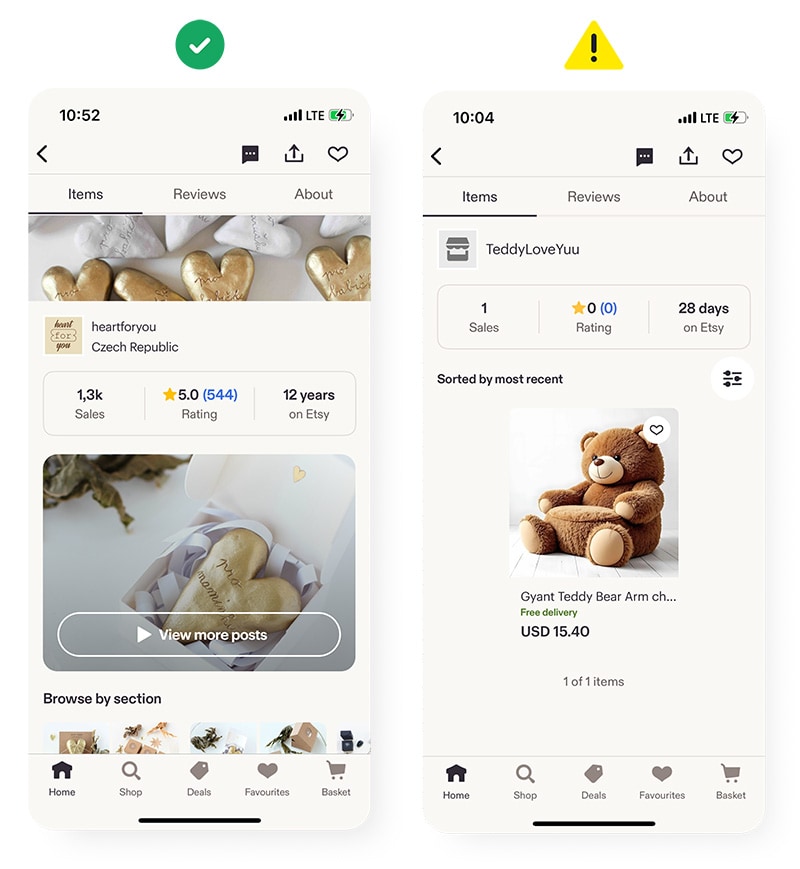
This type of Etsy scam is often seen on TikTok and other social media captioned with, “what I ordered vs. what I got,” such as in this example below:
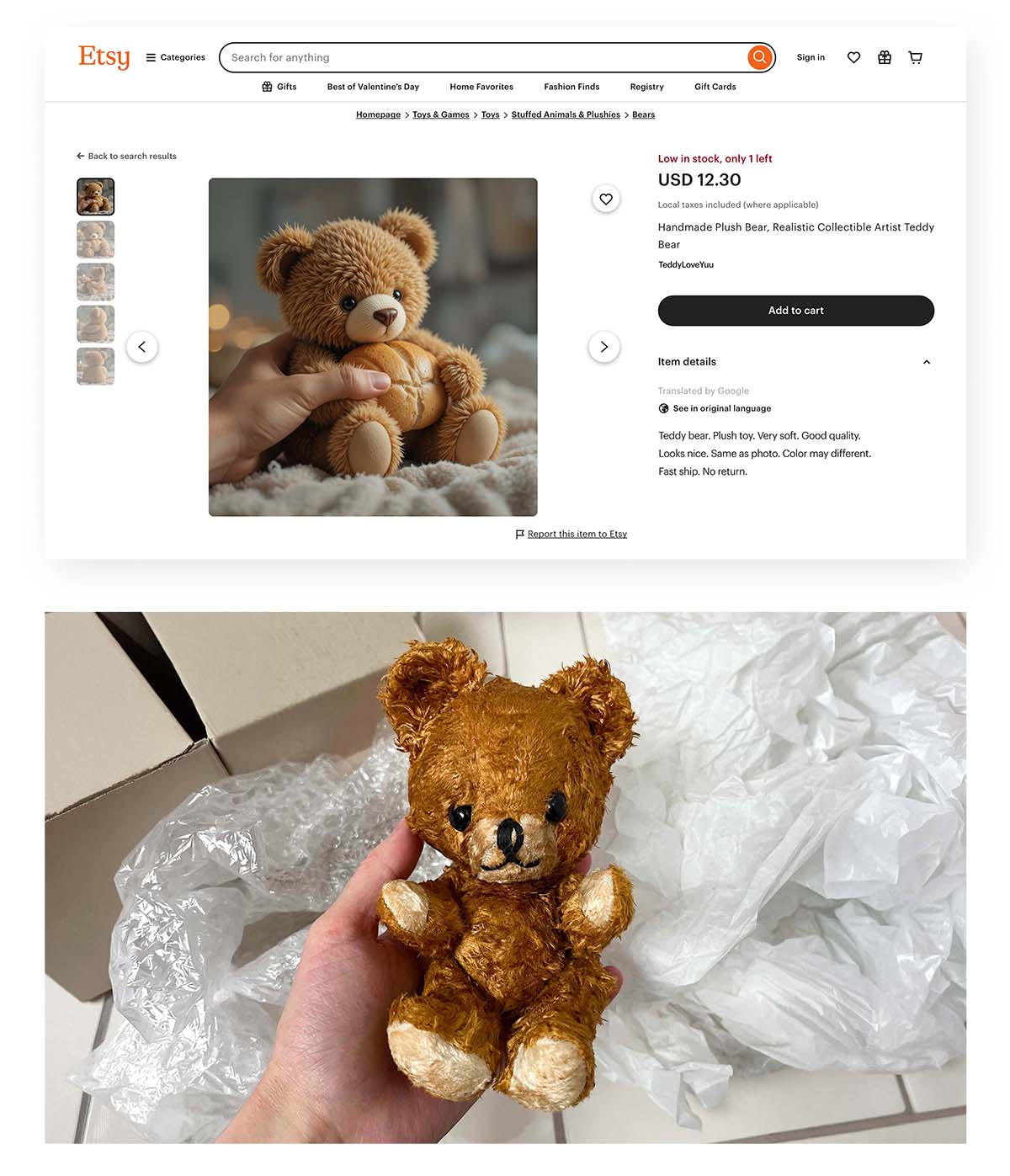
A screenshot depicting an AI-generated teddy bear and the real picture of a cheap, low-quality teddy bear that the buyer received.
Here are a few signs of a bait-and-switch scam:
- The item you receive doesn’t match the listing photos or description.
- Sellers request extra fees after purchase.
- Product specifications change after you place your order.
- Reviews mention quality, size, or material discrepancies.
- Sellers give evasive or inconsistent answers when questioned.
Etsy shopping tip: Save screenshots of the original listing, including photos, measurements, and shipping terms. If anything changes after checkout, open a case with Etsy and use the saved listing details to support your claim.
8. Fake reviews scam
Some Etsy sellers post or purchase fake reviews to make their shop appear more trustworthy, and their products seem higher quality than they actually are. These fraudulent reviews can mislead buyers into purchasing based on false feedback, leaving them disappointed with products that fall short of expectations.
A few ways to spot fake reviews include:
- Generic, repetitive, or suspiciously similar reviews on the same buyer’s profile.
- A pattern of lots of reviews posted within a short time frame, with large breaks in between.
Etsy shopping tip: Look out for reviews that read authentically, provide detailed, honest feedback, and include customer-submitted photos for a more accurate representation of the product.
How to protect yourself against Etsy scams
Taking precautions can help you spot Etsy scams and protect yourself against falling victim to a fraudulent scheme.
Use the following best practices to help keep yourself safer while shopping on Etsy:
- Review product images: Scammers may steal photos from other sources or generate AI photos to cover up fake products. Use a reverse image search to identify if a product photo originates from another website or listing.
- Read customer reviews: Before making a purchase, read through customer reviews. Look for reviews that include specific details about the item and the buyer’s experience to get a clearer picture of what to expect.
- Research the seller: Reliable sellers should have professional-looking Etsy shops with images, thorough descriptions, and multiple reviews. For additional peace of mind, look for sellers with the Star Seller badge, which indicates a seller has a proven track record of quality customer service.
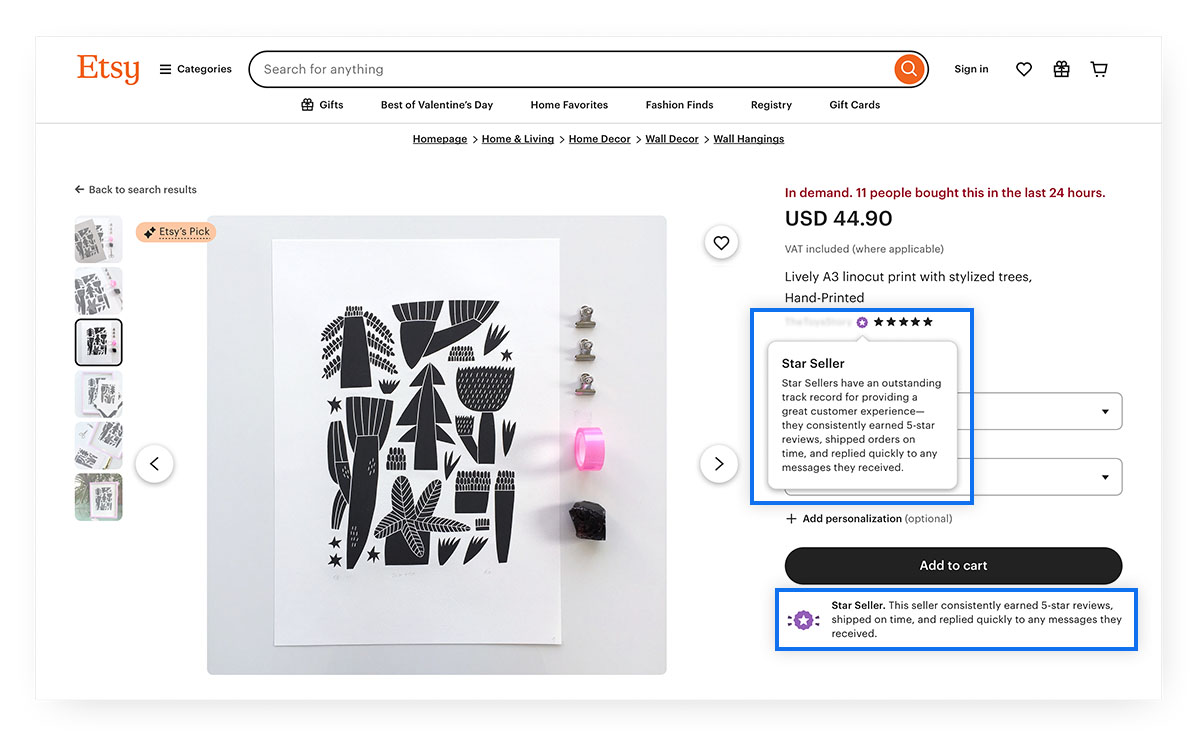
Legitimate Etsy sellers have "Star Seller" labels on their profiles, indicating their track record of good customer service.
- Use two-factor authentication: Two-factor authentication reduces the likelihood that a scammer can access your Etsy account, even if they happen to get your password.
- Stay on the Etsy platform: To ensure you qualify for Etsy’s payment protection program, never leave the Etsy website or app to communicate with or pay an Etsy seller.
- Block suspicious messages: Don’t respond to suspicious messages on Etsy. Report any suspected scam messages as spam to flag them to the Etsy support team and auto-block the sender.
- Create strong passwords: A strong and unique password is one of the best defenses against scammers trying to hack into your Etsy account.
- Use a VPN: A VPN (virtual private network) encrypts your internet connection and hides your IP address. This added security can help protect your personal information from hackers when you browse or make purchases online.
What to do if you fall for an Etsy scam
Did you fall for an Etsy scam? Use the following strategies to take action and help protect your Etsy account, your finances, and your identity.
- Contact the seller: If there was an issue with your purchase or it never arrived, a legitimate seller should issue a refund.
- Report the scam to Etsy: If the seller refuses to issue a refund, open a case with Etsy.
- Change your password: If you gave a scammer your login information, change your password as soon as possible and set up two-factor authentication to help resecure your account
- Freeze your credit: If you shared sensitive information like your bank details or Social Security number with a scammer, freeze your credit with all three major bureaus to stop new credit accounts from being opened in your name.
- Monitor your financial statements: After being scammed, check your bank and credit card statements regularly for unauthorized transactions or use a credit monitoring service to be alerted of further suspicious activity.
- Report the scam to the Federal Trade Commission: Filing a complaint with the FTC can help authorities track scam trends, helping protect other users in the future.
- Get identity theft protection: An identity theft protection tool like LifeLock Advanced can help you safeguard your personal information and financial accounts by monitoring for fraudulent use of your personal information and suspicious banking and credit card activity.
Shop safely on Etsy
Understanding how Etsy scams work and what steps you can take to help protect yourself can keep you safer against fraud risks. Get LifeLock Advanced for added protection, including alerts for potentially fraudulent banking or credit card activity and scam reimbursement protection of up to $5k.
FAQs
Is Etsy safe?
Yes, Etsy is generally a safe platform for shopping. It uses built-in protection like secure payments, a purchase protection program, seller verification, and communication tracking. To receive these protections, never make off-platform Etsy purchases.
Can you get scammed on Etsy as a seller?
Yes, Etsy sellers can be scammed through fake buyers, chargebacks, phishing messages, and fraudulent orders. Scammers may place suspicious purchases, request off-platform communication, or use stolen payment methods. Sellers may also accuse you of bait-and-switch scams in order to get a refund and keep the desired item, so always document your shipping process.
Is Etsy reliable?
For the most part, Etsy is a reliable marketplace that’s great for buying unique items. However, like any online marketplace, take precautions and verify the legitimacy of sellers, buyers, and products before making a purchase. Etsy’s payment protection plan offers full refunds for qualifying scam orders, but it’s better not to fall for one in the first place.
Does Etsy support send customers messages?
Yes, Etsy support sends messages that always appear in the “From Etsy” folder with a “From Etsy” badge. If a message claiming to be from Etsy isn’t in this folder, it may be a phishing scam, and you should report it as spam.
Does Etsy offer protection for buyers?
Yes, Etsy has a Purchase Protection program. This program typically grants refunds in the following scenarios:
- Your item never arrives.
- Your item arrives damaged.
- Your item arrives late.
- Your item differs significantly from the description.
How can I report a scam on Etsy?
To report a scammer on Etsy, go to the listing or shop page in question and select either “Report this item to Etsy” or “Report this shop to Etsy.” You can also report suspicious messages directly from your Etsy inbox by choosing “Report as Spam.”
Editors’ note: Our articles provide educational information about identity theft, scams, financial fraud, and other topics that can put your identity or personal accounts at risk. LifeLock offerings may not cover or protect against every type of crime, fraud, scam, or threat we write about. For more details about how we write, review, and update our articles, see our Editorial Policy.
This article contains
Related articles


Scams & Fraud
What is a brushing scam? Why free packages raise red flags
November 13, 2025
·
10 min read
Scams & Fraud
What is a brushing scam? Why free packages raise red flags
November 13, 2025
·
10 min read
Scams & Fraud
What is a brushing scam? Why free packages raise red flags
November 13, 2025
·
10 min read