


Has your personal data been recently exposed?
Check if information like your Social Security number, email, and passwords is exposed on the dark web.


You have reached the maximum number of scans allowed. Please come back after 24 hours.

Scanning the dark web...
Scanning public databases...
Scanning millions of records...
Narrowing down the search...
We need more information
Please enter a few more details to ensure we show you the right information.
You’re at high risk
We found your personal information on the dark web and on data broker sites.
 Up to $3M Reimbursement for identity theft, with up to $1M for Stolen Funds†††
$10K Scam Reimbursement7
Scam Support
Credit, Checking and Savings Activity Alerts: Unlimited Accounts
Credit & Payday Loan Lock2
Credit Monitoring:
3 Bureau1
Automatic Data Broker Removal8
Dark Web Monitoring
Priority 24/7 Customer Phone Support
Up to $3M Reimbursement for identity theft, with up to $1M for Stolen Funds†††
$10K Scam Reimbursement7
Scam Support
Credit, Checking and Savings Activity Alerts: Unlimited Accounts
Credit & Payday Loan Lock2
Credit Monitoring:
3 Bureau1
Automatic Data Broker Removal8
Dark Web Monitoring
Priority 24/7 Customer Phone Support
LifeLock Total

No one can prevent all cybercrime or prevent all identity theft.
- Price valid for introductory term. After that, your price will renew at the standard price.
- Your subscription begins immediately after your transaction is complete. A payment method is required at sign-up for trials, and you will be charged at the end of your trial, unless canceled first.
- Prices are subject to change and may be charged up to 35 days prior to renewal. Cancel here or contact Member Services.
- Restrictions apply. Automatically renewing subscription required. If you're a victim of identity theft and not satisfied with our resolution, you may receive a refund for the current term of your subscription. See lifelock.norton.com/guarantee for complete details.
††† Up to $1 million coverage for Lawyers and Experts included with all plans. Reimbursement and expense compensation vary according to plan. Insurance benefits are issued by third parties. See lifelock.norton.com/legal for policy info.
1 Bureau Monitoring and Monthly Credit Report and Score / 3 Bureau Monitoring and Monthly Credit Report and Score.
2 Credit Lock cannot prevent all account takeovers, unauthorized account openings, or credit file inquiries. Deactivates if you downgrade or cancel your subscription.
7 Scam protection coverage as part of identity theft benefits is currently available to all customers residing in the United States, including U.S. territories and the District of Columbia, with the exception of residents of New York. Gen Digital is not a licensed insurance producer. Benefits under the Master Policy are issued and covered by HSB Specialty Insurance Company. You can find further details and exclusions in the summary of benefits.
8 After setup, automatic data broker removal service scans and requests removal every 90 days.
You’re at medium risk
We found your personal information on data broker sites.
Up to $1.2M Reimbursement for identity theft, with up to $100K for Stolen Funds†††
$5K Scam Reimbursement7
Scam Support
Credit, Checking and Savings Activity Alerts:
5 Accounts
Credit & Payday Loan Lock2
Credit Monitoring:
3 Bureau1
Automatic Data Broker Removal8
Dark Web Monitoring
Priority 24/7 Customer Phone Support
LifeLock Advanced
No one can prevent all cybercrime or prevent all identity theft.
- Price valid for introductory term. After that, your price will renew at the standard price.
- Your subscription begins immediately after your transaction is complete. A payment method is required at sign-up for trials, and you will be charged at the end of your trial, unless canceled first.
- Prices are subject to change and may be charged up to 35 days prior to renewal. Cancel here or contact Member Services.
- Restrictions apply. Automatically renewing subscription required. If you're a victim of identity theft and not satisfied with our resolution, you may receive a refund for the current term of your subscription. See lifelock.norton.com/guarantee for complete details.
††† Up to $1 million coverage for Lawyers and Experts included with all plans. Reimbursement and expense compensation vary according to plan. Insurance benefits are issued by third parties. See lifelock.norton.com/legal for policy info.
1 Bureau Monitoring and Monthly Credit Report and Score / 3 Bureau Monitoring and Monthly Credit Report and Score.
2 Credit Lock cannot prevent all account takeovers, unauthorized account openings, or credit file inquiries. Deactivates if you downgrade or cancel your subscription.
7 Scam protection coverage as part of identity theft benefits is currently available to all customers residing in the United States, including U.S. territories and the District of Columbia, with the exception of residents of New York. Gen Digital is not a licensed insurance producer. Benefits under the Master Policy are issued and covered by HSB Specialty Insurance Company. You can find further details and exclusions in the summary of benefits.
8 After setup, automatic data broker removal service scans and requests removal every 90 days.
Good news!
We didn’t find your personal information across millions of records or on public data sources.
Up to $1.05M Reimbursement for identity theft, with up to $25K for Stolen Funds†††
Identity Restoration Specialists
Credit, Checking and Savings Activity Alerts:
2 Accounts
Credit & Payday Loan Lock2
Credit Monitoring:
2 Bureau1
Automatic Data Broker Removal8
Dark Web Monitoring
Breach Alerts
24/7 Customer Phone Support
Lifelock Core
No one can prevent all cybercrime or prevent all identity theft.
- Price valid for introductory term. After that, your price will renew at the standard price.
- Your subscription begins immediately after your transaction is complete. A payment method is required at sign-up for trials, and you will be charged at the end of your trial, unless canceled first.
- Prices are subject to change and may be charged up to 35 days prior to renewal. Cancel here or contact Member Services.
- Restrictions apply. Automatically renewing subscription required. If you're a victim of identity theft and not satisfied with our resolution, you may receive a refund for the current term of your subscription. See lifelock.norton.com/guarantee for complete details.
††† Up to $1 million coverage for Lawyers and Experts included with all plans. Reimbursement and expense compensation vary according to plan. Insurance benefits are issued by third parties. See lifelock.norton.com/legal for policy info.
1 Credit features require successful setup, identity verification, and sufficient credit history by the appropriate credit bureau. Credit monitoring features may take several days to activate after enrollment.
2 Identity Lock cannot prevent all account takeovers, unauthorized account openings, or credit file inquiries. Deactivates if you downgrade or cancel your subscription.
8 After setup, automatic data broker removal service scans and requests removal every 90 days.

 Why do we ask?
Finding your match...

10 cents
If your information is exposed or stolen in a data breach, it can end up on the dark web where it can be sold for as little as 10 cents.
100M+
LifeLock monitors hundreds of millions of data points a second.
- Up to $1.05M Reimbursement for identity theft, with up to $25K for Stolen Funds†††
- Up to $1.2M Reimbursement for identity theft, with up to $100K for Stolen Funds†††
- Up to $3M Reimbursement for identity theft, with up to $1M for Stolen Funds†††
- Up to $1.05M Reimbursement for identity theft, with up to $25K for Stolen Funds††† for each adult
- Up to $1.2M Reimbursement for identity theft, with up to $100K for Stolen Funds††† for each adult
- Up to $3M Reimbursement for identity theft, with up to $1M for Stolen Funds††† for each adult
- Up to $1.05M Reimbursement for identity theft, with up to $25K for Stolen Funds††† for each adult
- Up to $1.2M Reimbursement for identity theft, with up to $100K for Stolen Funds††† for each adult
- Up to $3M Reimbursement for identity theft, with up to $1M for Stolen Funds††† for each adult
- Credit Monitoring Coverage1
- Credit Monitoring1 each adult
- Credit Monitoring1 for family
- Credit, Checking & Savings Account Activity Alerts
- Credit, Checking and Savings Activity Alerts for each adult
- Credit, Checking and Savings Activity Alerts for family
- 401K & Investment Account Activity Alerts
- 401K/Investment Account Alerts for each adult
- 401K/Investment Account Alerts for family
- Recurring and Unusual Charge Alerts
- Unexpected & Suspicious Charge Alerts for each adult
- Unexpected & Suspicious Charge Alerts for family
- Stolen Funds Reimbursement†††
- Stolen Funds Reimbursement††† for each adult
- Stolen Funds Reimbursement††† for family
- Lawyers and Experts†††
- Lawyers & Experts††† for each adult
- Lawyers & Experts††† for family
- Automatic Data Broker Removal8
- Automatic Data Broker Removal8 for each adult
- Automatic Data Broker Removal8 for family
- Scam Reimbursement7
- Scam Reimbursement7 for each adult
- Scam Reimbursement7 for family
- Credit Reports & Scores1
- Credit Report & Score for each adult
- Credit Report & Score for family
- Social Media Monitoring
- Social Media Monitoring for each adult
- Social Media Monitoring for family


††† Up to $1 million coverage for Lawyers and Experts included with all plans. Reimbursement and expense compensation vary according to plan. Insurance benefits are issued by third parties. See LifeLock.Norton.com/legal for policy info.
1 Credit features require successful setup, identity verification and sufficient credit history by the appropriate credit bureau. Credit monitoring features may take several days to activate after enrollment.
7 Scam protection coverage as part of identity theft benefits is currently available to all customers residing in the United States, including U.S. territories and the District of Columbia, with the exception of residents of New York. Gen Digital is not a licensed insurance producer. Benefits under the Master Policy are issued and covered by HSB Specialty Insurance Company. You can find further details and exclusions in the Summary of Benefits.
8 After setup, automatic data broker removal service scans and requests removal every 90 days.
Why do we ask?
Identifying your concerns gives us the ability to recommend the right plan for your needs.
Why do we ask?
Knowing this number helps us recommend coverage that fits your needs.
Why do we ask?
Providing your email address makes you eligible for notifications of potential identity threats.
How to opt out of FastBackgroundCheck and remove your info
Opting out of FastBackgroundCheck helps remove your information from one of the most popular data broker websites, potentially reducing your vulnerability to spam and scammers. Follow the step-by-step opt-out process here. And use an automatic data broker removal service like LifeLock to remove your information from lots of similar websites.





FastBackgroundCheck is a prominent data broker website that collects people’s personal information from public records, aggregates it, and sells access to interested buyers.
Some of these buyers might be innocent — like long-lost family members looking to reconnect. But it’s not too cynical to suggest that the audience for aggregated personal information also includes spammers, scammers, and fraudsters all looking for their next mark.
Thankfully, it’s relatively easy to opt out of data broker websites, including FastBackgroundCheck. It just takes a few steps to remove your information and boost your online privacy.
How to opt out of FastBackgroundCheck
To remove your information from FastBackgroundCheck, you first have to submit the opt-out form linked at the bottom of the homepage. You’ll then receive an email containing a link to a more detailed form, on which you can specify what information you want to be removed.
Here’s a guide to completing the FastBackgroundCheck opt-out process, step-by-step:
1. Scroll to the footer at the bottom of the homepage and click Do Not Sell or Share My Personal Information
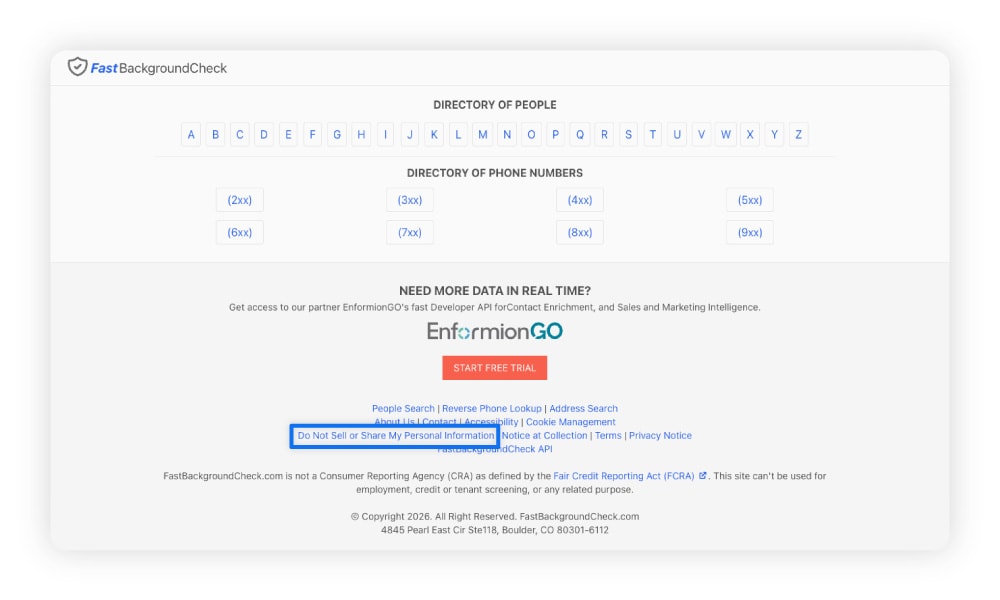
2. Scroll down to the How to Opt Out section and click Opt-Out Form to open the opt-out form. Alternatively, you can call FastBackgroundCheck at 866-679-8725.
3. Fill in the short form to tell FastBackgroundCheck where to send the full opt-out form. Consider using a new throwaway email address to keep your real one private if you want to minimize the risk of exposure.
4. In the email you receive, click the Click here to fill out the form button.
5. Complete the full opt-out form, providing all of the personal information you want to be removed from your listing on FastBackgroundCheck, such as your date of birth, street address, phone number, and email address.

You’ll receive a confirmation email confirming that your opt-out request has been received. FastBackgroundCheck aims to find and remove your information within three days of you submitting the opt-out request, but wait times can vary.
How my experience went: When I completed the opt-out process on FastBackgroundCheck, my information was removed within one day. Your results might depend on unique factors, but I have no evidence to suggest that FastBackgroundCheck will fail to comply with their offer to remove personal data on request.
How to fix issues opting out of FastBackgroundCheck
If FastBackgroundCheck denies your opt-out request, start by checking that you submitted your information correctly. The website claims that providing inaccurate information, like an incorrect phone number or email address, can hinder the opt-out process.
If it seems like your request was all correct, you can call FastBackgroundCheck at 888-747-4094 or use the details on the contact page to request support. After reaching out, check the site to make sure your information is gone.
Facing another issue? Here are some common problems with opting out of FastBackgroundCheck, and a quick tips on how to resolve them:
- Form doesn’t submit: Try again after switching browsers or clearing your cache. If it still happens, reach out over the phone to let FastBackgroundCheck know about the issue and ask for assistance.
- Profile still visible: Wait for up to two weeks after submitting your opt-out request, as it may take that long for FastBackgroundCheck to find and remove your information.
- Results still appear in Google search results: Click the link to see if it redirects to the homepage or still leads to your profile. If the latter is true, contact FastBackgroundCheck to let them know, or submit a Google personal content removal request form.
- Information reappears: Data brokers like FastBackgroundCheck will often reupload your information after several months. You’ll have to remove it again, or use an automatic data broker removal tool to send opt-out requests on a regular basis.
- Pre-change name still appears: If you’ve had a legal name change and find your old name, submit the form with your old information to remove it. You may need to submit two or more forms if you’ve changed your name multiple times.
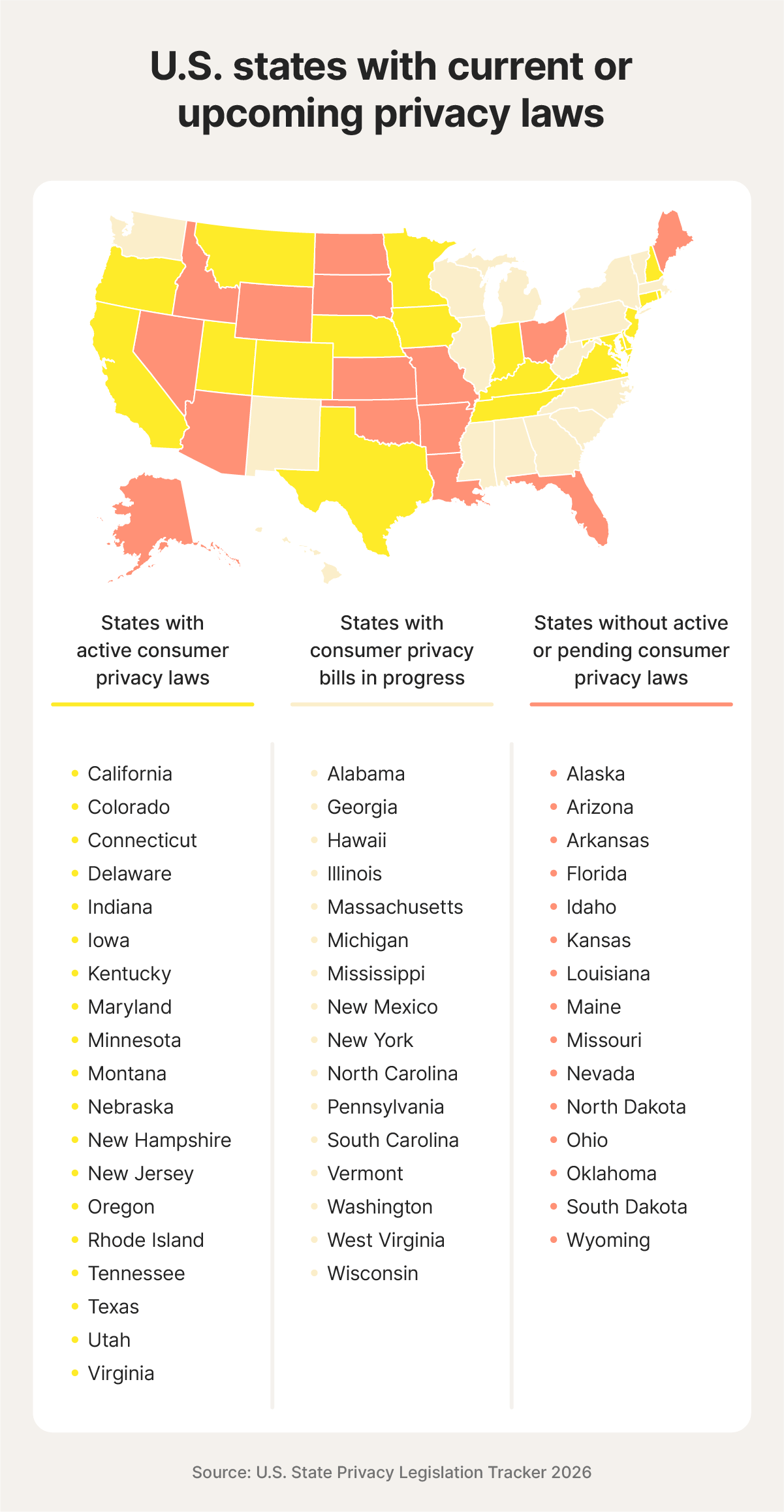
Bear in mind that there is no federal law forcing data brokers to remove your information on request. FastBackgroundCheck, like any other data broker, isn’t legally obliged to grant removal requests unless you live in a state with an active, relevant, and enforced data privacy law. These states include California, where residents are covered by the comprehensive California Delete Act, Oregon, and Texas.
Other ways to remove your information from FastBackgroundCheck
If, after submitting the opt-out form and following the troubleshooting steps above, your request is still being denied or your information still appears on FastBackgroundCheck, there are some other routes you can take to try and remove it. Start by checking your state’s privacy laws to see if you have a legal right to opt out.
According to the International Association of Privacy Professionals (IAPP), nearly 20 states have active consumer privacy laws that could help persuade site representatives to remove your data. If you’re in one of those states, you can consider trying the following steps:
- Remove information from Google: Use Google’s personal content removal request form to request the delisting of search results involving your information. While this won’t remove your data from FastBackgroundCheck.com, it will make it harder for people to find your information using Google (which handles 90% of the world’s searches).
- Send certified mail: Certified letters establish a record of removal attempts that could be helpful if you later decide to pursue legal options. Send a letter to FastBackgroundCheck at 4845 Pearl East Cir., Ste. 118, Boulder, CO 80301-6112, and keep a copy for your records.
- Use a data broker removal service: Automatic data broker removal tools track your information across tens of data broker websites and submit opt-out requests on your behalf, often on a regular basis like every 90 days. Repeated attempts may encourage the data broker to act on your request, without requiring more of your time.
- Hire an attorney: If all else fails and you’re serious about getting your information removed, consider hiring an attorney to send official requests. The threat of legal action may compel FastBackgroundCheck to act faster but, depending on your state’s laws, may not always be effective.
What information does FastBackgroundCheck collect?
FastBackgroundCheck’s Supplemental Privacy Notice states that the company collects personal information from various third party sources for “business and commercial purposes,” which may include providing it to buyers.
Here are a few specific examples of information FastBackgroundCheck collects to fill out their people listings:
- Identifiers: Real name, aliases, current and former postal addresses, telephone or mobile numbers, names of relatives, and email addresses.
- Characteristics: Gender, age, and marital status.
- Property or business information: Addresses, property details (like the square footage of your home), estimated value, and ownership type.
Aside from this personally identifiable information, FastBackgroundCheck also collects information you share directly, like the email address you use when you contact them, and technical data like your IP address.
None of this information is enough for a fraudster to steal your identity and open new credit accounts in your name, for example. But it can give cybercriminals the info they need to target you with personalized phishing attacks that gather more sensitive information, like your Social Security number or banking details.
How does FastBackgroundCheck get my info?
FastBackgroundCheck, like most other data broker or people-search websites, primarily collects information from public sources that have been lawfully made available online, including:
- Public records: Voter registration history, marriage licenses, and real estate records.
- Business records: Business registration information or professional licenses (such as insurance or accounting certifications).
- Subscriber lists: Public subscriber lists from television, phone, or internet companies.
- Other data brokers: Purchased or collected from other data brokers that collect or publish your information.
- Social media: Public YouTube, Instagram, or Facebook pages and posts.
In other words FastBackgroundCheck compiles information that’s already available publicly. This is in contrast to cybercriminals, who may use illegal scams like phishing schemes or fake websites to impersonate trustworthy people or organizations and steal sensitive information you don’t want them to have.
Why should I remove my information from FastBackgroundCheck?
Removing your information from FastBackgroundCheck helps reduce your digital footprint, which can minimize the amount of unsolicited marketing calls or mail you receive and limit the ease with which scammers, fraudsters, identity thieves, or stalkers can find out more about you.
Here’s a more detailed look at how tackling your data broker exposure can protect you against potential consequences:
- Reduce unsolicited marketing: Advertisers can collect your contact information from data brokers to send you junk mail, annoy you with calls, or spam your email.
- Defend against scams and fraud: Cybercriminals like scammers and fraudsters can get your contact information from data broker websites, or use other personal information they find to make their scams more personalized and convincing.
- Protect against identity theft: Identity thieves who already have access to sensitive information, like your Social Security number, can combine it with information they find on data broker websites to steal your identity.
- Limit stalking and harassment: Cyberstalkers may use data brokers to find out your contact details, or even your address, so they can harass you over the phone, via emails, or even in person.
Remove your information from data broker sites
FastBackgroundCheck is one of many data brokers on the web, and removing your information from them all requires you to invest significant amounts of time and be willing to follow up on your progress. But ignoring your exposure isn’t a great option, potentially leaving you vulnerable to spam or more serious threats, like phishing scams.
LifeLock makes the entire process easier, with an Automatic Data Broker Removal feature that submits opt-out requests to data broker sites on your behalf every 90 days. Plus, as a LifeLock member, you’ll also get data breach alerts, dark web monitoring, and scam reimbursement coverage, helping you monitor more threats and protect against the potential consequences.
FAQs
Is FastBackgroundCheck legal?
Yes, FastBackgroundCheck is a legal business that collects and sells data. The U.S. does not have any federal privacy laws that prevent data brokers like FastBackgroundCheck from selling personal information.
Do cybercriminals use FastBackgroundCheck?
While they’re not designed for cybercriminals, data brokers like FastBackgroundCheck can be used by criminals who are trying to find new victims or gather more information about existing targets. They can use the information found on data broker websites to personalize their scams and make them more convincing.
Can I prevent FastBackgroundCheck from collecting my data?
No, there’s no reliable way to prevent FastBackgroundCheck from collecting information about you from public records. However, you can limit some of the data the company collects by keeping your social media profiles private, and use an automatic data broker removal service to stay on top of public data exposure without manual effort.
Is FastBackgroundCheck safe?
While FastBackgroundCheck isn’t outright dangerous in the sense that it’s risky to visit the website, it also isn’t necessarily safe for anyone who’s privacy-conscious. It can make sensitive data more visible to cybercriminals by aggregating it into a single location, potentially making it easier for scammers or fraudsters to target you. Plus, it isn’t accredited by the BBB.
Editors’ note: Our articles provide educational information about identity theft, scams, financial fraud, and other topics that can put your identity or personal accounts at risk. LifeLock offerings may not cover or protect against every type of crime, fraud, scam, or threat we write about. For more details about how we write, review, and update our articles, see our Editorial Policy.
This article contains
- How to opt out of FastBackgroundCheck
- How to fix issues opting out of FastBackgroundCheck
- Other ways to remove your information from FastBackgroundCheck
- What information does FastBackgroundCheck collect?
- How does FastBackgroundCheck get my info?
- Why should I remove my information from FastBackgroundCheck?
- Remove your information from data broker sites
- FAQs
Related articles
![How to remove your information from the internet [11 free ways]](/content/dam/lifelock/learn/thumbnails/remove-personal-information-from-the-internet-thumb-2025.jpg)