

Has your personal data been recently exposed?
Check if information like your Social Security number, email, and passwords is exposed on the dark web.


You have reached the maximum number of scans allowed. Please come back after 24 hours.

Scanning the dark web...
Scanning public databases...
Scanning millions of records...
Narrowing down the search...
We need more information
Please enter a few more details to ensure we show you the right information.
You’re at high risk
We found your personal information on the dark web and on data broker sites.
 Up to $3M Reimbursement for identity theft, with up to $1M for Stolen Funds†††
$10K Scam Reimbursement7
Scam Support
Credit, Checking and Savings Activity Alerts: Unlimited Accounts
Credit & Payday Loan Lock2
Credit Monitoring:
3 Bureau1
Automatic Data Broker Removal8
Dark Web Monitoring
Priority 24/7 Customer Phone Support
Up to $3M Reimbursement for identity theft, with up to $1M for Stolen Funds†††
$10K Scam Reimbursement7
Scam Support
Credit, Checking and Savings Activity Alerts: Unlimited Accounts
Credit & Payday Loan Lock2
Credit Monitoring:
3 Bureau1
Automatic Data Broker Removal8
Dark Web Monitoring
Priority 24/7 Customer Phone Support
LifeLock Total

No one can prevent all cybercrime or prevent all identity theft.
- Price valid for introductory term. After that, your price will renew at the standard price.
- Your subscription begins immediately after your transaction is complete. A payment method is required at sign-up for trials, and you will be charged at the end of your trial, unless canceled first.
- Prices are subject to change and may be charged up to 35 days prior to renewal. Cancel here or contact Member Services.
- Restrictions apply. Automatically renewing subscription required. If you're a victim of identity theft and not satisfied with our resolution, you may receive a refund for the current term of your subscription. See lifelock.norton.com/guarantee for complete details.
††† Up to $1 million coverage for Lawyers and Experts included with all plans. Reimbursement and expense compensation vary according to plan. Insurance benefits are issued by third parties. See lifelock.norton.com/legal for policy info.
1 Bureau Monitoring and Monthly Credit Report and Score / 3 Bureau Monitoring and Monthly Credit Report and Score.
2 Credit Lock cannot prevent all account takeovers, unauthorized account openings, or credit file inquiries. Deactivates if you downgrade or cancel your subscription.
7 Scam protection coverage as part of identity theft benefits is currently available to all customers residing in the United States, including U.S. territories and the District of Columbia, with the exception of residents of New York. Gen Digital is not a licensed insurance producer. Benefits under the Master Policy are issued and covered by HSB Specialty Insurance Company. You can find further details and exclusions in the summary of benefits.
8 After setup, automatic data broker removal service scans and requests removal every 90 days.
You’re at medium risk
We found your personal information on data broker sites.
Up to $1.2M Reimbursement for identity theft, with up to $100K for Stolen Funds†††
$5K Scam Reimbursement7
Scam Support
Credit, Checking and Savings Activity Alerts:
5 Accounts
Credit & Payday Loan Lock2
Credit Monitoring:
3 Bureau1
Automatic Data Broker Removal8
Dark Web Monitoring
Priority 24/7 Customer Phone Support
LifeLock Advanced
No one can prevent all cybercrime or prevent all identity theft.
- Price valid for introductory term. After that, your price will renew at the standard price.
- Your subscription begins immediately after your transaction is complete. A payment method is required at sign-up for trials, and you will be charged at the end of your trial, unless canceled first.
- Prices are subject to change and may be charged up to 35 days prior to renewal. Cancel here or contact Member Services.
- Restrictions apply. Automatically renewing subscription required. If you're a victim of identity theft and not satisfied with our resolution, you may receive a refund for the current term of your subscription. See lifelock.norton.com/guarantee for complete details.
††† Up to $1 million coverage for Lawyers and Experts included with all plans. Reimbursement and expense compensation vary according to plan. Insurance benefits are issued by third parties. See lifelock.norton.com/legal for policy info.
1 Bureau Monitoring and Monthly Credit Report and Score / 3 Bureau Monitoring and Monthly Credit Report and Score.
2 Credit Lock cannot prevent all account takeovers, unauthorized account openings, or credit file inquiries. Deactivates if you downgrade or cancel your subscription.
7 Scam protection coverage as part of identity theft benefits is currently available to all customers residing in the United States, including U.S. territories and the District of Columbia, with the exception of residents of New York. Gen Digital is not a licensed insurance producer. Benefits under the Master Policy are issued and covered by HSB Specialty Insurance Company. You can find further details and exclusions in the summary of benefits.
8 After setup, automatic data broker removal service scans and requests removal every 90 days.
Good news!
We didn’t find your personal information across millions of records or on public data sources.
Up to $1.05M Reimbursement for identity theft, with up to $25K for Stolen Funds†††
Identity Restoration Specialists
Credit, Checking and Savings Activity Alerts:
2 Accounts
Credit & Payday Loan Lock2
Credit Monitoring:
2 Bureau1
Automatic Data Broker Removal8
Dark Web Monitoring
Breach Alerts
24/7 Customer Phone Support
Lifelock Core
No one can prevent all cybercrime or prevent all identity theft.
- Price valid for introductory term. After that, your price will renew at the standard price.
- Your subscription begins immediately after your transaction is complete. A payment method is required at sign-up for trials, and you will be charged at the end of your trial, unless canceled first.
- Prices are subject to change and may be charged up to 35 days prior to renewal. Cancel here or contact Member Services.
- Restrictions apply. Automatically renewing subscription required. If you're a victim of identity theft and not satisfied with our resolution, you may receive a refund for the current term of your subscription. See lifelock.norton.com/guarantee for complete details.
††† Up to $1 million coverage for Lawyers and Experts included with all plans. Reimbursement and expense compensation vary according to plan. Insurance benefits are issued by third parties. See lifelock.norton.com/legal for policy info.
1 Credit features require successful setup, identity verification, and sufficient credit history by the appropriate credit bureau. Credit monitoring features may take several days to activate after enrollment.
2 Identity Lock cannot prevent all account takeovers, unauthorized account openings, or credit file inquiries. Deactivates if you downgrade or cancel your subscription.
8 After setup, automatic data broker removal service scans and requests removal every 90 days.

 Why do we ask?
Finding your match...

10 cents
If your information is exposed or stolen in a data breach, it can end up on the dark web where it can be sold for as little as 10 cents.
100M+
LifeLock monitors hundreds of millions of data points a second.
- Up to $1.05M Reimbursement for identity theft, with up to $25K for Stolen Funds†††
- Up to $1.2M Reimbursement for identity theft, with up to $100K for Stolen Funds†††
- Up to $3M Reimbursement for identity theft, with up to $1M for Stolen Funds†††
- Up to $1.05M Reimbursement for identity theft, with up to $25K for Stolen Funds††† for each adult
- Up to $1.2M Reimbursement for identity theft, with up to $100K for Stolen Funds††† for each adult
- Up to $3M Reimbursement for identity theft, with up to $1M for Stolen Funds††† for each adult
- Up to $1.05M Reimbursement for identity theft, with up to $25K for Stolen Funds††† for each adult
- Up to $1.2M Reimbursement for identity theft, with up to $100K for Stolen Funds††† for each adult
- Up to $3M Reimbursement for identity theft, with up to $1M for Stolen Funds††† for each adult
- Credit Monitoring Coverage1
- Credit Monitoring1 each adult
- Credit Monitoring1 for family
- Credit, Checking & Savings Account Activity Alerts
- Credit, Checking and Savings Activity Alerts for each adult
- Credit, Checking and Savings Activity Alerts for family
- 401K & Investment Account Activity Alerts
- 401K/Investment Account Alerts for each adult
- 401K/Investment Account Alerts for family
- Recurring and Unusual Charge Alerts
- Unexpected & Suspicious Charge Alerts for each adult
- Unexpected & Suspicious Charge Alerts for family
- Stolen Funds Reimbursement†††
- Stolen Funds Reimbursement††† for each adult
- Stolen Funds Reimbursement††† for family
- Lawyers and Experts†††
- Lawyers & Experts††† for each adult
- Lawyers & Experts††† for family
- Automatic Data Broker Removal8
- Automatic Data Broker Removal8 for each adult
- Automatic Data Broker Removal8 for family
- Scam Reimbursement7
- Scam Reimbursement7 for each adult
- Scam Reimbursement7 for family
- Credit Reports & Scores1
- Credit Report & Score for each adult
- Credit Report & Score for family
- Social Media Monitoring
- Social Media Monitoring for each adult
- Social Media Monitoring for family


††† Up to $1 million coverage for Lawyers and Experts included with all plans. Reimbursement and expense compensation vary according to plan. Insurance benefits are issued by third parties. See LifeLock.Norton.com/legal for policy info.
1 Credit features require successful setup, identity verification and sufficient credit history by the appropriate credit bureau. Credit monitoring features may take several days to activate after enrollment.
7 Scam protection coverage as part of identity theft benefits is currently available to all customers residing in the United States, including U.S. territories and the District of Columbia, with the exception of residents of New York. Gen Digital is not a licensed insurance producer. Benefits under the Master Policy are issued and covered by HSB Specialty Insurance Company. You can find further details and exclusions in the Summary of Benefits.
8 After setup, automatic data broker removal service scans and requests removal every 90 days.
Why do we ask?
Identifying your concerns gives us the ability to recommend the right plan for your needs.
Why do we ask?
Knowing this number helps us recommend coverage that fits your needs.
Why do we ask?
Providing your email address makes you eligible for notifications of potential identity threats.
5 steps to take if your car registration was stolen
Your car registration being stolen can leave you vulnerable to identity theft. But you’re not helpless — there are ways to defend yourself. Learn what to do if your registration is stolen, and how LifeLock can help protect you against identity theft risks that may follow.





A stolen car registration is a gateway for criminals to misuse your personal information, which is perhaps why car registrations are often targeted during car break-ins. With details like your name, address, and vehicle information, someone can attempt to commit fraud or steal your entire identity, leaving you at risk of financial damage or legal complications.
Since the risks are costly, it’s important to act quickly after losing your registration to reduce the risk of follow-up consequences. Keep reading to learn five critical steps to take if your car registration is stolen.
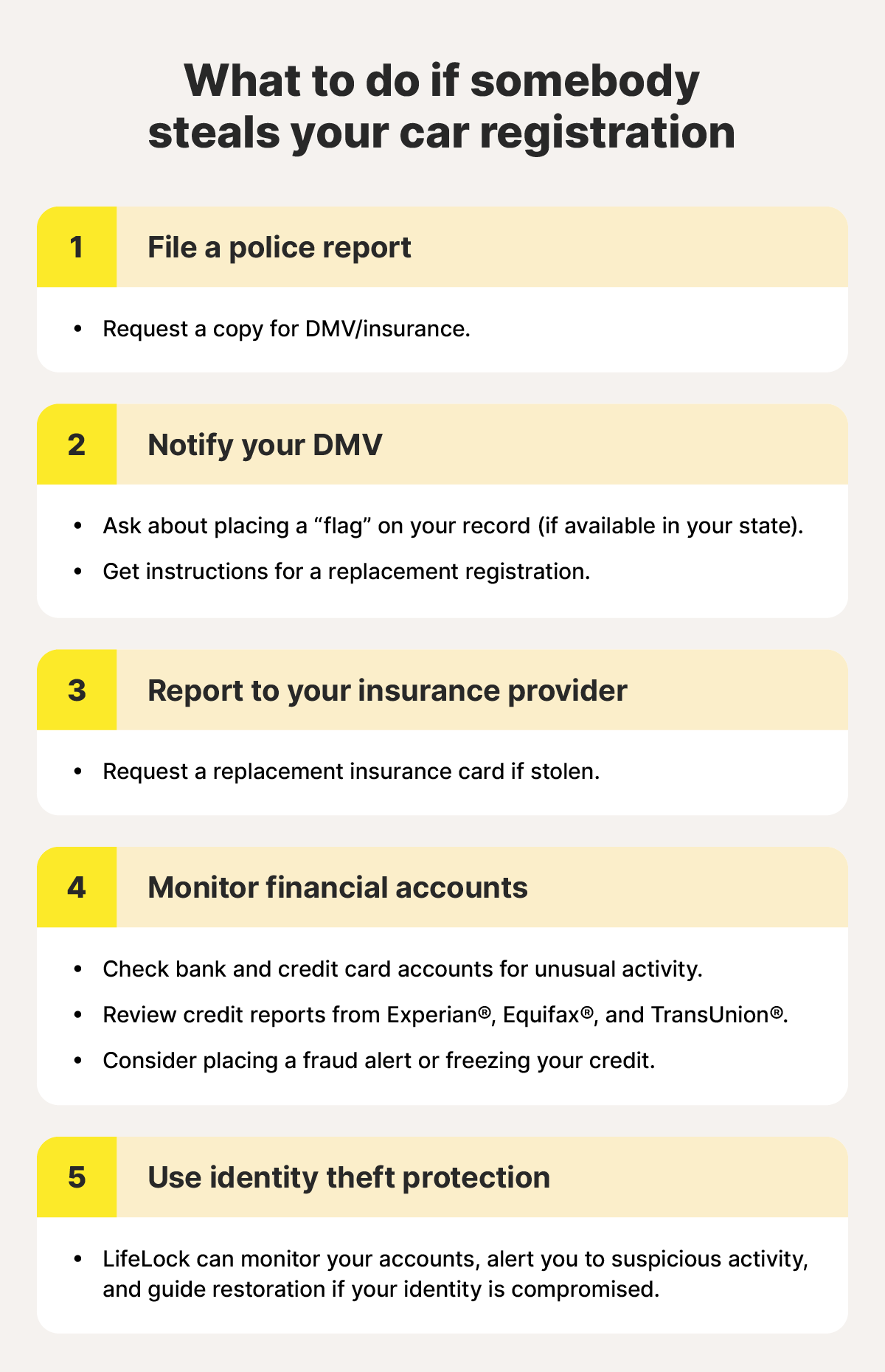
1. File a police report
Reporting a stolen car registration creates an official record that can help you provide evidence of the situation if the thief misuses your information. If someone tries to use your registration in a crime, fraud, or during a traffic stop, for example, having a police report can protect you from legal complications.
To file a report, reach out to your local police department, either in person, by calling the non-emergency number, or online. Make sure you file the report with the agency that covers the area where your registration was stolen. Here are some best practices to keep in mind when reporting:
- Include as much detail as possible: Key details include your license plate number, vehicle identification number (VIN), and when and where you first noticed the theft.
- Mention if the thief stole other important items: If your wallet was also stolen, or your passport, birth certificate, or other sensitive documents have gone missing, make sure to mention them.
- Ask for a copy of the report: You may be asked to provide the report to the DMV or your insurance company as proof. Having this documentation makes the following steps, like replacing your registration, much smoother.
2. Notify your local DMV
After filing a police report, contact your local DMV to report the stolen car registration. Some states, like New York and California, allow you to place a “flag” on your record, which alerts officials if anyone tries to use your stolen registration.
Ask about the process for getting a replacement registration. Requirements vary by state, but you may need the following items:
- A copy of your police report.
- Proof of identity.
- Payment for a replacement fee.
- Proof of insurance.
- Completed application form.
Check your state’s specific guidelines to make the process as smooth as possible.
3. Report the theft to your insurance provider
After filing a police report and notifying the DMV, let your auto insurance provider know your car registration was stolen. This helps protect your account and coverage against fraudulent activity, such as a thief making false claims or creating a duplicate of your plates and vehicle details (cloning).
Use the following best practices:
- Report the theft online, by phone, or through a mobile app, whichever is easiest.
- Have your police report and any other relevant documents ready, as some insurers may request it.
- Ask for replacement insurance documents if any of yours were stolen to ensure you remain covered.
- Confirm whether the theft affects your policy, and see if it’s possible to flag your account as potentially vulnerable to fraud.
- Ask if there are any additional steps you can take to help protect against fraud risks.
4. Monitor your financial accounts
A car registration gives thieves a useful bundle of personal details, including your name, address, vehicle make/model, license plate number, and the VIN. With this information, they may be able to register or finance new vehicles in your name, leading to missed payments or fraudulent activity that could damage your credit score.
But you can take some steps to protect yourself from the risk of fraud following registration theft, including:
- Monitoring your credit reports: Review your credit reports from Experian®, Equifax®, and TransUnion® to spot suspicious inquiries or new accounts. You can invest in credit monitoring to automate this process, providing alerts if changes are detected on your credit report.
- Taking protective action: Consider placing a fraud alert or freezing your credit to add a layer of defense against credit fraud. These protections will make it much more difficult for the thief to open new lines of credit in your name.
- Monitoring your accounts: While it’s unlikely that someone with your car registration will have the information they need to access your financial accounts, watch your bank and credit card statements for unusual activity and dispute any unfamiliar charges immediately.
5. Use identity theft protection
Identity theft protection monitors your personal information and alerts you to suspicious activity, like someone attempting to use sensitive details from your stolen car registration in applications for credit or services.
In situations like this, having an extra layer of protection can help you detect fraud that might otherwise be easy to miss, prompting you to take action that can help safeguard your finances.
LifeLock monitors for identity threats across the internet, dark web, and your credit file, helping you spot potential risks as they arise. And, if the worst should happen and your identity is stolen, you’ll get support from a U.S.-based identity theft restoration specialist who can help you recover.
What information is on your car registration?
Your car registration includes a range of personally identifiable information, covering both you and your vehicle, such as your name, address, and license plate number.
Below is a breakdown of all the sensitive information that may be included on a car registration:
- Vehicle Identification Number (VIN).
- License plate number.
- Vehicle make, model, and year.
- Vehicle color.
- Vehicle weight/class (for certain vehicles).
- Registration number.
- Name of the registered owner(s).
- Owner’s address.
- Registration expiration date.
What can thieves do with your car registration?
A stolen car registration contains both personal and vehicle information, which criminals can exploit to commit fraud, impersonate the owner, or make it harder for you to prove legitimate ownership.
Here’s a closer look at what criminals can do with access to your car registration:
- Commit vehicle-related fraud: Criminals can use your registration to create fake license plates or falsified ownership documents.
- Impersonate you: A thief may present your registration during a traffic stop to avoid detection, a form of criminal identity theft that could leave you dealing with fines or legal issues tied to their actions.
- Sell your vehicle illegally: Criminals can create counterfeit titles or paperwork using your VIN and ownership details, making it harder for you to prove legitimate ownership.
- Commit identity theft: By combining your personal details with other stolen information, criminals can open accounts or commit fraud in your name, potentially damaging your credit and draining your finances.
- File false claims: Scammers may use your details in fraudulent insurance claims, which can raise your premiums or cause disputes with your insurer.
- Clone your car: Criminals can duplicate your VIN and apply it to a stolen vehicle, making you a target for investigations if that vehicle is involved in a crime.
How to protect your car registration
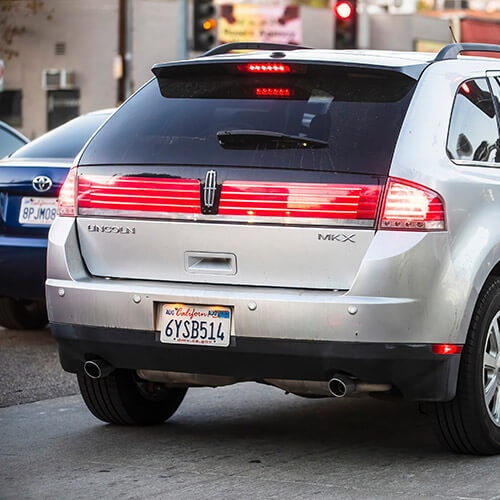
Many people keep their car registration in the glovebox for convenience, but that’s the first place a thief will think to look. Leaving it there gives criminals easy access to your personal details, making identity theft or fraud much more likely if your car is broken into.
One Nashville woman’s car was broken into while parked in a garage, and the only items stolen were a dagger she kept for protection and her car registration. Two other women in the same garage had their vehicle windows smashed and registrations taken as well. The woman said the experience was a wake-up call, reminding her and all drivers that personal information in your car can be more vulnerable than you realize.
To reduce the risk of your registration being stolen and, in turn, help prevent identity theft, follow these tips:
- Store your registration securely: While you may need it in your car while driving on public roads, consider storing your car registration like any other sensitive document when you’re parked at home, putting it in a secure location like a lockbox or safe.
- Get discreet car storage: If you’d rather keep it in your car to avoid forgetting to grab it before driving, consider installing a locked compartment in your vehicle to reduce the risk of a thief getting their hands on it if they break in.
- Avoid keeping other documents in your car: A thief who has access to both your car registration and another sensitive document, like your Social Security card or a bank statement, may be able to commit more serious fraud.
Protect your personal information with LifeLock
Following the steps above can help protect your identity and limit the damage if somebody steals your car registration. For added peace of mind, join LifeLock to monitor your information and receive alerts about potential identity theft or fraud risks. As a member, you’ll also get support from restoration specialists if the worst happens and your identity is stolen, helping you recover without the stress.
FAQs
What happens when someone steals your car registration sticker?
If someone steals your car registration sticker, they could use it to avoid tolls, commit traffic violations, or impersonate your vehicle. You may be held liable for any misuse. Report the theft to your DMV, insurance provider, and police, and get a replacement sticker to protect yourself from fraud or fines.
Where should I store my car registration?
Consider keeping your car registration at home in a secure spot, such as a safe, lockbox, or filing cabinet, whenever you’re not driving. You can also get a car safe or another secure storage spot for inside your car to reduce your risk.
Why would someone steal my car registration?
Someone might steal your car registration to access your personal information, like your name, address, and vehicle details. Criminals could use this information to commit identity theft, create fake documents, impersonate you, sell your vehicle illegally, file false insurance claims, or clone your car, putting your finances and personal safety at risk.
Editors’ note: Our articles provide educational information about identity theft, scams, financial fraud, and other topics that can put your identity or personal accounts at risk. LifeLock offerings may not cover or protect against every type of crime, fraud, scam, or threat we write about. For more details about how we write, review, and update our articles, see our Editorial Policy.
This article contains
- 1. File a police report
- 2. Notify your local DMV
- 3. Report the theft to your insurance provider
- 4. Monitor your financial accounts
- 5. Use identity theft protection
- What information is on your car registration?
- What can thieves do with your car registration?
- How to protect your car registration
- Protect your personal information with LifeLock
- FAQs
Related articles