





 Why do we ask?


1 Scam protection coverage as part of identity theft benefits is currently available to all customers residing in the United States, including U.S. territories and the District of Columbia, with the exception of New York. Gen Digital is not a licensed insurance producer. Benefits under the Master Policy are issued and covered by HSB Specialty Insurance Company. You can find further details and exclusions in the Summary of Benefits.
Has your personal data been recently exposed?
Check if information like your Social Security number, email, and passwords is exposed on the dark web.


You have reached the maximum number of scans allowed. Please come back after 24 hours.

Scanning the dark web...
Scanning public databases...
Scanning millions of records...
Narrowing down the search...
We need more information
Please enter a few more details to ensure we show you the right information.
Risk level:
High
You’re at high risk
We found your personal information on the dark web and on data broker sites.
Your personalized protection plan
Product Benefits:
 Up to $3M Reimbursement for identity theft, with up to $1M for Stolen Funds†††
$10K Scam Reimbursement7
Scam Support
Credit, Checking and Savings Activity Alerts: Unlimited Accounts
Credit & Payday Loan Lock2
Credit Monitoring:
3 Bureau1
Automatic Data Broker Removal8
Dark Web Monitoring
Priority 24/7 Customer Phone Support
Up to $3M Reimbursement for identity theft, with up to $1M for Stolen Funds†††
$10K Scam Reimbursement7
Scam Support
Credit, Checking and Savings Activity Alerts: Unlimited Accounts
Credit & Payday Loan Lock2
Credit Monitoring:
3 Bureau1
Automatic Data Broker Removal8
Dark Web Monitoring
Priority 24/7 Customer Phone Support
LifeLock Total
Your price:
$
349.99
Your price:
$
34.99
60-day money back guarantee with an annual plan
24/7 Live Member Support
No one can prevent all cybercrime or prevent all identity theft.
- Price valid for introductory term. After that, your price will renew at the standard price.
- Your subscription begins immediately after your transaction is complete. A payment method is required at sign-up for trials, and you will be charged at the end of your trial, unless canceled first.
- Prices are subject to change and may be charged up to 35 days prior to renewal. Cancel here or contact Member Services.
- Restrictions apply. Automatically renewing subscription required. If you're a victim of identity theft and not satisfied with our resolution, you may receive a refund for the current term of your subscription. See lifelock.norton.com/guarantee for complete details.
††† Up to $1 million coverage for Lawyers and Experts included with all plans. Reimbursement and expense compensation vary according to plan. Insurance benefits are issued by third parties. See lifelock.norton.com/legal for policy info.
1 Bureau Monitoring and Monthly Credit Report and Score / 3 Bureau Monitoring and Monthly Credit Report and Score.
2 Credit Lock cannot prevent all account takeovers, unauthorized account openings, or credit file inquiries. Deactivates if you downgrade or cancel your subscription.
7 Scam protection coverage as part of identity theft benefits is currently available to all customers residing in the United States, including U.S. territories and the District of Columbia, with the exception of residents of New York. Gen Digital is not a licensed insurance producer. Benefits under the Master Policy are issued and covered by HSB Specialty Insurance Company. You can find further details and exclusions in the summary of benefits.
8 After setup, automatic data broker removal service scans and requests removal every 90 days.
Risk level:
Medium
You’re at medium risk
We found your personal information on data broker sites.
Your personalized protection plan
Product Benefits:
Up to $1.2M Reimbursement for identity theft, with up to $100K for Stolen Funds†††
$5K Scam Reimbursement7
Scam Support
Credit, Checking and Savings Activity Alerts:
5 Accounts
Credit & Payday Loan Lock2
Credit Monitoring:
3 Bureau1
Automatic Data Broker Removal8
Dark Web Monitoring
Priority 24/7 Customer Phone Support
LifeLock Advanced
Your price:
$
199.99
Your price:
$
19.99
60-day money back guarantee with an annual plan
24/7 Live Member Support
No one can prevent all cybercrime or prevent all identity theft.
- Price valid for introductory term. After that, your price will renew at the standard price.
- Your subscription begins immediately after your transaction is complete. A payment method is required at sign-up for trials, and you will be charged at the end of your trial, unless canceled first.
- Prices are subject to change and may be charged up to 35 days prior to renewal. Cancel here or contact Member Services.
- Restrictions apply. Automatically renewing subscription required. If you're a victim of identity theft and not satisfied with our resolution, you may receive a refund for the current term of your subscription. See lifelock.norton.com/guarantee for complete details.
††† Up to $1 million coverage for Lawyers and Experts included with all plans. Reimbursement and expense compensation vary according to plan. Insurance benefits are issued by third parties. See lifelock.norton.com/legal for policy info.
1 Bureau Monitoring and Monthly Credit Report and Score / 3 Bureau Monitoring and Monthly Credit Report and Score.
2 Credit Lock cannot prevent all account takeovers, unauthorized account openings, or credit file inquiries. Deactivates if you downgrade or cancel your subscription.
7 Scam protection coverage as part of identity theft benefits is currently available to all customers residing in the United States, including U.S. territories and the District of Columbia, with the exception of residents of New York. Gen Digital is not a licensed insurance producer. Benefits under the Master Policy are issued and covered by HSB Specialty Insurance Company. You can find further details and exclusions in the summary of benefits.
8 After setup, automatic data broker removal service scans and requests removal every 90 days.
Risk level:
Low
Good news!
We didn’t find your personal information across millions of records or on public data sources.
Your personalized protection plan
Product Benefits:
Up to $1.05M Reimbursement for identity theft, with up to $25K for Stolen Funds†††
Identity Restoration Specialists
Credit, Checking and Savings Activity Alerts:
2 Accounts
Credit & Payday Loan Lock2
Credit Monitoring:
2 Bureau1
Automatic Data Broker Removal8
Dark Web Monitoring
Breach Alerts
24/7 Customer Phone Support
Lifelock Core
Your price:
$
124.99
Your price:
$
12.49
60-day money back guarantee with an annual plan
24/7 Live Member Support
No one can prevent all cybercrime or prevent all identity theft.
- Price valid for introductory term. After that, your price will renew at the standard price.
- Your subscription begins immediately after your transaction is complete. A payment method is required at sign-up for trials, and you will be charged at the end of your trial, unless canceled first.
- Prices are subject to change and may be charged up to 35 days prior to renewal. Cancel here or contact Member Services.
- Restrictions apply. Automatically renewing subscription required. If you're a victim of identity theft and not satisfied with our resolution, you may receive a refund for the current term of your subscription. See lifelock.norton.com/guarantee for complete details.
††† Up to $1 million coverage for Lawyers and Experts included with all plans. Reimbursement and expense compensation vary according to plan. Insurance benefits are issued by third parties. See lifelock.norton.com/legal for policy info.
1 Credit features require successful setup, identity verification, and sufficient credit history by the appropriate credit bureau. Credit monitoring features may take several days to activate after enrollment.
2 Identity Lock cannot prevent all account takeovers, unauthorized account openings, or credit file inquiries. Deactivates if you downgrade or cancel your subscription.
8 After setup, automatic data broker removal service scans and requests removal every 90 days.
1/2
Finding your match...

DID YOU KNOW?
10 cents
If your information is exposed or stolen in a data breach, it can end up on the dark web where it can be sold for as little as 10 cents.
100M+
LifeLock monitors hundreds of millions of data points a second.
Based on your concerns, the best plan for you is:
LifeLock Core
(Individual)
LifeLock Advanced
(Individual)
LifeLock Total
(Individual)
LifeLock Core
(2 adults)
LifeLock Advanced
(2 adults)
LifeLock Total
(2 adults)
LifeLock Core
(2 adults + up to 10 kids)
LifeLock Advanced
(2 adults + up to 10 kids)
LifeLock Total
(2 adults + up to 10 kids)
Pricing details below*
Pricing details below*
Pricing details below*
Pricing details below*
Pricing details below*
Pricing details below*
Pricing details below*
Pricing details below*
Pricing details below*
- Up to $1.05M Reimbursement for identity theft, with up to $25K for Stolen Funds†††
- Up to $1.2M Reimbursement for identity theft, with up to $100K for Stolen Funds†††
- Up to $3M Reimbursement for identity theft, with up to $1M for Stolen Funds†††
- Up to $1.05M Reimbursement for identity theft, with up to $25K for Stolen Funds††† for each adult
- Up to $1.2M Reimbursement for identity theft, with up to $100K for Stolen Funds††† for each adult
- Up to $3M Reimbursement for identity theft, with up to $1M for Stolen Funds††† for each adult
- Up to $1.05M Reimbursement for identity theft, with up to $25K for Stolen Funds††† for each adult
- Up to $1.2M Reimbursement for identity theft, with up to $100K for Stolen Funds††† for each adult
- Up to $3M Reimbursement for identity theft, with up to $1M for Stolen Funds††† for each adult
- Credit Monitoring Coverage1
- Credit Monitoring1 each adult
- Credit Monitoring1 for family
- Credit, Checking & Savings Account Activity Alerts
- Credit, Checking and Savings Activity Alerts for each adult
- Credit, Checking and Savings Activity Alerts for family
- 401K & Investment Account Activity Alerts
- 401K/Investment Account Alerts for each adult
- 401K/Investment Account Alerts for family
- Recurring and Unusual Charge Alerts
- Unexpected & Suspicious Charge Alerts for each adult
- Unexpected & Suspicious Charge Alerts for family
- Stolen Funds Reimbursement†††
- Stolen Funds Reimbursement††† for each adult
- Stolen Funds Reimbursement††† for family
- Lawyers and Experts†††
- Lawyers & Experts††† for each adult
- Lawyers & Experts††† for family
- Automatic Data Broker Removal8
- Automatic Data Broker Removal8 for each adult
- Automatic Data Broker Removal8 for family
- Scam Reimbursement7
- Scam Reimbursement7 for each adult
- Scam Reimbursement7 for family
- Credit Reports & Scores1
- Credit Report & Score for each adult
- Credit Report & Score for family
- Social Media Monitoring
- Social Media Monitoring for each adult
- Social Media Monitoring for family

We have more plans to choose from.
See all plans

Have questions?
Contact sales
*Your subscription begins immediately after payment and automatically renews unless cancelled. Discount for annual plans are compared to monthly billing. Prices subject to change and may be charged up to 35 days before current term ends. Cancel here or contact Member Services.
††† Up to $1 million coverage for Lawyers and Experts included with all plans. Reimbursement and expense compensation vary according to plan. Insurance benefits are issued by third parties. See LifeLock.Norton.com/legal for policy info.
1 Credit features require successful setup, identity verification and sufficient credit history by the appropriate credit bureau. Credit monitoring features may take several days to activate after enrollment.
7 Scam protection coverage as part of identity theft benefits is currently available to all customers residing in the United States, including U.S. territories and the District of Columbia, with the exception of residents of New York. Gen Digital is not a licensed insurance producer. Benefits under the Master Policy are issued and covered by HSB Specialty Insurance Company. You can find further details and exclusions in the Summary of Benefits.
8 After setup, automatic data broker removal service scans and requests removal every 90 days.
Why do we ask?
Identifying your concerns gives us the ability to recommend the right plan for your needs.
Return to quiz
Why do we ask?
Knowing this number helps us recommend coverage that fits your needs.
Return to quiz
Why do we ask?
Providing your email address makes you eligible for notifications of potential identity threats.
Return to quiz
6 Bumble scams to know before you get stung
Bumble built its brand around women initiating first contact (a feature now open to men as well), but scammers have never been shy about making moves. Emergency money requests, suspicious investments, and sextortion are some common Bumble scams to look out for. We’ll show you what to do if you encounter a scammer and teach you the most common red flags before you get stung by a Bumble scammer.


Whether you’re looking for love or a friend to hang out with while traveling, Bumble is a popular choice for meeting new people. But as with any online social platform, the risk of scams is prevalent, from classic phishing scams to blackmail and sextortion. In a recent 2025 Cybersecurity Insight Report run by Gen (the company behind LifeLock), it was reported that one in four online daters reported having experienced a romance scam. But do you know how to tell if a Bumble profile is fake?
Protect against scams
Join LifeLock to help reduce exposure of your information, get expert support spotting scams, and receive up to $10,000 in reimbursement for scam-related losses.
Keep reading to learn how to recognize some common Bumble scam red flags.
1. Fabricated emergencies
Creating a sense of urgency by pushing an “act now, think later” approach is a classic tactic for many social engineering scams, and those originating on dating apps like Bumble are no exception. Scammers create fake Bumble accounts and work to gain your trust before spinning a story of a sudden crisis and asking you for help, often in the form of an urgent wire transfer or a similar financial request.
Fake illness or medical scams are a common example of one of these fabricated emergencies (comprising 15% of dating scams according to the Gen survey). The person you’ve been falling for online has a sudden medical crisis and needs money to cover an ambulance, hospital stay, or emergency medication. But remember this: anyone asking for money, particularly someone you haven’t met in person, is almost certainly a scammer. The dramatic story (usually urging you to act right now) is an immediate red flag.
Fake Bumble profiles are also increasingly convincing — in our survey, fewer than 50% of people surveyed could tell a real profile from an AI one, and even legitimate profiles often use AI to craft messages. Even if the connection feels real, be on guard with someone you’ve only met online, and definitely don’t send them money.

An example of a fabricated emergency text, a common Bumble scam.
2. Long-distance scams
Long-distance romances make it easier for Bumble scammers to avoid meeting in real life, which enables them to catfish and lie about what they’re really after. Catfishing (alongside the more general approach of “romance scamming”) make up the overwhelming majority of dating scams according to the Gen Insights Report (74%). And a long-distance connection gives the perfect way to hide behind fake pictures or personas instead of video chatting or meeting in real life — a big red flag after a certain point.
Scammers build a connection, often using lovebombing tactics to gain the victim’s affection and trust, then ask for money or convince the victim to share personal details that could lead to further financial fraud or identity theft. Red flags to watch out for in long-distance scams are Bumble users who claim to be in the military, are oil and gas workers on location, or another profession that requires special permission from their employer to meet their Bumble match in person.
Ask yourself why someone abroad might be interested in chatting with someone in your location, and always be suspicious of anyone who keeps making excuses for why they can’t meet face to face (or at least on video at first). And never share intimate personal or financial information with someone you’ve only chatted with online.

An example of a long-distance scam, where a scammer is slowly phishing for personal information after meeting on Bumble.
3. Fake investments
Investment scams are a common way for Bumble scammers to launch their attacks to steal your money. The person you’ve been talking to seems genuinely wonderful — kind, funny, and always saying the right things. Then they slip in the fact that they’re a financial investor or simply, “in finance,” and ask if you’d be interested in a great investment opportunity they have the inside scoop on.
Because you may be excited to communicate and they seem professional and ambitious, investing can seem tempting. But take this Reddit user's story into account before you fall for something similar: The user narrowly escaped falling for a Bumble scam after she reached out to a guy who, by all accounts, seemed put together, gentlemanly, and sweet. Soon, he told her that he wanted all of her “goals and dreams to come true” and could help make it happen by teaching her about his job as a financial advisor.
She reports that she went along with it for a little while, helping him make a profit while she practiced trading with his money. But before long, he sent her the pitch to “invest in their future” by handing over 1k, 2k, or even 10k of her own money. For her, that was the last straw and she cut contact, reporting his Bumble profile on the way out.
The moral of the story? If something seems too good to be true, ask questions and find potential holes in the scammer’s story. And, at the risk of sounding like a broken record, never give your hard-earned cash to someone you’ve only met online.

A screenshot of a Bumble scam, wherein a scammer is trying to lure their date into falling for a fake investment.
4. Sugar baby scams
Whilst “sugar relationships” can be a real and functional arrangement between consenting partners, they are also a ruse in some Bumble scams. Here’s how they work: The scammer creates a fake profile with photos of an irresistibly attractive and seemingly-wealthy person (often AI-generated) and offers temptations such as luxury gifts, expensive vacations, and money. But the catch is that they need to test your loyalty before accepting you as their sugar baby, by asking you to share sensitive data or send them some money as a sign of trust. At the end of the day, the scammer will disappear with your money without providing any of the promised sugary benefits.
If you suspect you’re talking to a sugar daddy or sugar mommy, check the person’s profile in detail to spot AI-generated photos or inconsistent details. And never send a potential sugar partner money or financial details that they could use to commit fraud.
5. Blackmail and sextortion
Sextortion scams make up 17% of online dating scams according to the Gen Cybersecurity Insights Report from 2025. To get away with this, a scammer creates a fake profile and tricks you into sexually explicit conversations that they then use as material for blackmail. Even more daunting, sextortion scammers might ask to get spicy on a video call and record the interaction, threatening to send the recording to family members, your employer, or other people you don’t want seeing it, unless you send them money to stop them.
Whether threats of sextortion are bluffs or not, prevention is always better than being fearful that your private images or videos will be shared. Save the intimate stuff for real-life meetups until you really know and trust the other person, and never pay someone trying to extort you. Contact the police instead.
6. Tech support scams
Tech support scams happen in the dating world too, and Bumble is no exception. A representative claiming to be from Bumble says there’s a problem with your account and they need your login credentials or a 2FA code to help you recover access.
If you receive this type of SMS or email professing to be from Bumble, open your Bumble account directly to check for any notifications there, rather than clicking a “recovery” link in an SMS or email — it could be a phishing attempt. Never share a two-factor authentication (2FA) code or one-time password (OTP) with a third party, and don’t share passwords with anyone.
If you do end up sharing sensitive information and later suspect a scam, sign in to your account immediately if you can, then reset your password, remove linked devices that you don’t recognize, and report the scammer to Bumble.
Red flags to help you spot a Bumble scammer
These days, all AI-driven scams are tough to spot, and that goes for romance scammers and fake Bumble profiles too. But there are still plenty of red flags that can tip you off to a potential scam. While most of these red flags in isolation don’t necessarily scream “scammer,” if you see multiple of them while interacting with a singular person, it’s best to block the user and move on to greener pastures.
- Too-perfect profile: AI profiles often feature extremely attractive, modelesque individuals who seem like the total package. Although it can be hard to spot a fake, ensure you ask lots of questions and request recent photos to check that the profile is legitimate.
- Messages that sound like a chatbot: Again, spotting AI-generated messages can be tricky, especially with real people leaning on AI to make themselves sound suave and romantic. Watch out for matches who avoid direct answers to your questions, who seem inconsistent, or who don’t come off as authentic.
- Requests to move off the platform: While a natural relationship progression will eventually leave Bumble behind, beware of a match who seems over-eager to move to a different platform. Scammers often want to move to a different platform to prevent their Bumble account from being flagged as fake, or to remove the protections Bumble’s communication channels offer, like the ones outlined in the 2026 Bumble Transparency Report.
- Love bombing: Everyone dreams of being swept off their feet, but if your match is professing undying love before you’ve even met in person, they might be love bombing you. This is a classic social engineering tactic that can help you to identify a scammer that wants to hook you in fast.
- Refusal to meet in person: Persistently avoiding video calls and refusing or cancelling in-person meetups is a huge red flag. Although explanations like long distance or overseas jobs could be legitimate, they’re still a reason to be extra careful, as they are commonly used by scammers. It’s better to put the interaction on hold until the person is back in your location and you can meet in person.
- Urgent requests for money: Sudden medical expenses, unexpected illness, travel emergencies, and other dramatic stories that ultimately end in an urgent request for money are a huge red flag. It’s best not to send money to someone you’ve never met, even if they’re requesting the money to come see you.
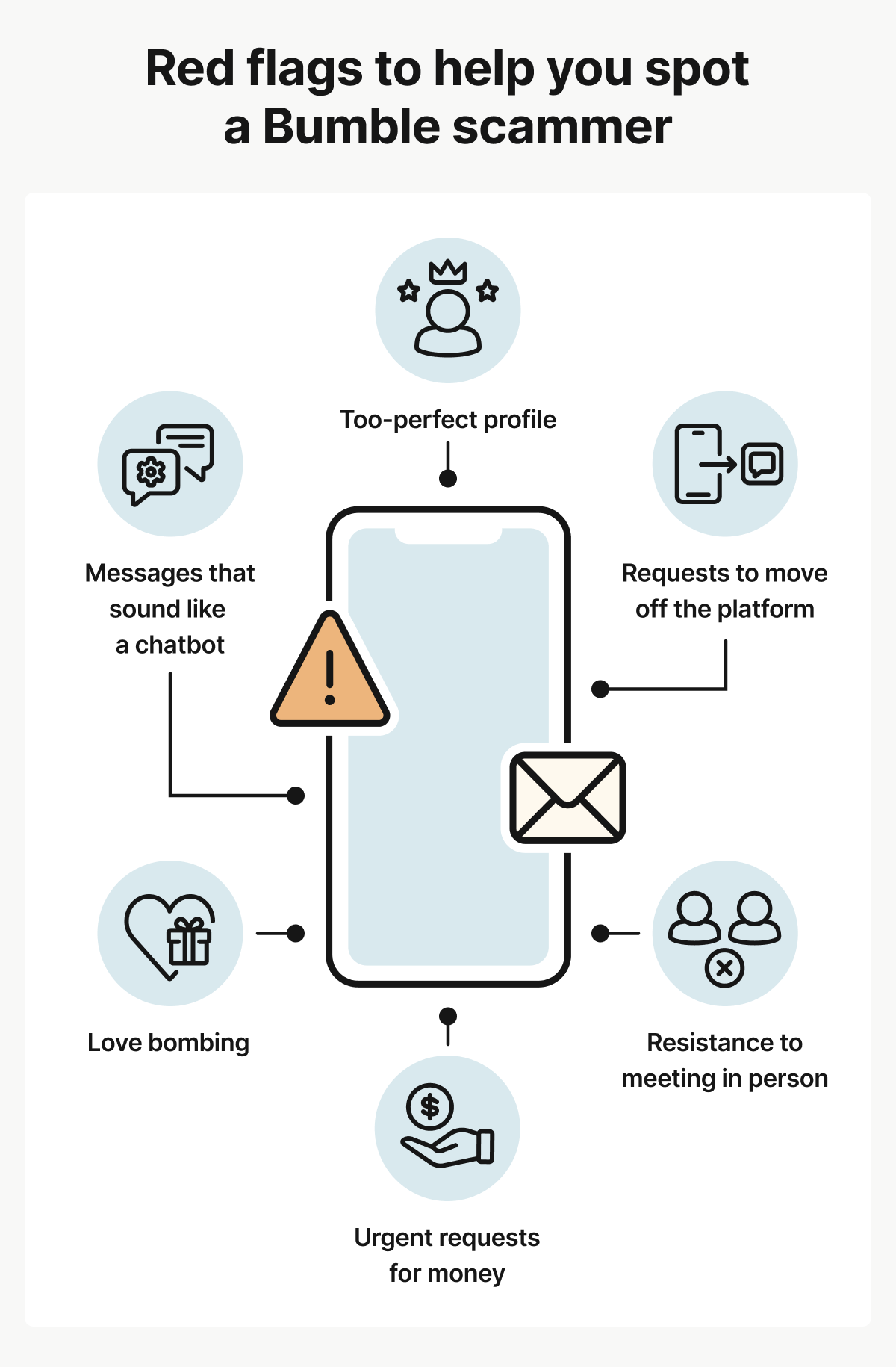
An infographic showing common Bumble scam red flags.
Already got scammed? Here’s your next move
If any of these scams sound painfully familiar, don’t despair. Being scammed, particularly by someone you’re emotionally attached to, is a devastating breach of trust. But you can still take action to protect yourself from further financial harm, and potentially protect would-be victims from the scammer. Here’s what to do:
- Report the scammer to Bumble: Bumble has a feature that allows you to anonymously report another account. They’ll review the account and take action if they find fraudulent or otherwise unacceptable account activity.
- Contact your financial institution: Monitor your accounts for unauthorized transactions. If you suspect the scammer has access to your financial details (or you gave them up outright) call your bank and credit card company as soon as possible. The sooner you alert them of fraud, the better chances you have of mitigating further financial fallout and potential identity theft.
- Change your passwords and enable 2FA: Create new, strong passwords for any accounts that might be compromised, and enable 2FA to help block unauthorized parties from accessing your account, even if they know your password.
- Report the scam to the authorities: Report a scam to the Federal Trade Commission to help protect future victims from the same fate. You can also file a police report, which may help you prove financial fraud or identity theft later on.
- Consider a fraud alert: If you’re concerned about identity theft, a fraud alert or credit freeze can help protect you from unauthorized people opening new credit lines in your name. With a police report, you can even request an extended fraud alert with the credit bureaus, which lasts up to seven years.
- Talk to someone you trust for support: Romantic scams take a heavy emotional toll. Don’t go through it alone. Get support from trusted friends and family members.
Is Bumble doing anything to protect users?
Bumble uses its AI-driven Deception Detector to identify behavioral patterns that may indicate fake profiles, as well as a dedicated moderation team that reviews suspicious accounts and reports to help weed out scammers. Bumble’s Block and Report feature allows users to easily block and report anyone who makes them feel unsafe, or who they suspect is trying to scam or harass them. And the Unmatch feature is designed to prevent blocked accounts from contacting you again on the app.
In addition, Bumble users can communicate in-app without giving out their email or phone number, which can help keep personal data more secure.
However, it’s still possible to get scammed on Bumble despite these safety features, so always use caution on Bumble and other dating apps, both when communicating online and in person. Don’t give out sensitive data or private information to anyone you meet online, conduct any in-person meetings in a safe public place, and always tell a trusted person who you’re meeting and where you’re going.
Swipe right on staying safe
Even if you’re cautious about giving out personal information and sharing sensitive data online, it’s still possible to fall victim to scams and fraud.
LifeLock’s Scam Support team can help you evaluate suspicious communication and identify scammers. And if you’ve already been scammed, you may be eligible for up to $10,000 in eligible losses,1 helping you recoup some of the finances that your bank may not cover
FAQs
Is Bumble safe?
Online dating on Bumble, or any other platform, comes with inherent risks of scammers, as well as people exhibiting violent or harassing behavior. Bumble has several features that protect users from these risks, but it’s up to every individual to spot and report unsafe users, and be careful about what information they share on the platform.
What does “moderated” mean on Bumble?
A profile or account on Bumble that has been “moderated” has been reviewed by the moderation team to ensure that it doesn’t violate the platform’s rules. It’s not necessarily indicative of any wrongdoing; it can be a result of accidentally breaking the rules, being unfairly reported by another user, or just a random spot check.
Are there bots on Bumble?
Bumble uses its Deception Detector to spot and remove fake, spam, and scam profiles. Despite this, there are almost certainly still some bots on Bumble that slip through the cracks.
How can I verify if a Bumble profile is real?
Bumble offers blue check photo verification and ID verification to confirm that a profile is real. But, users should always look out for inconsistencies between photographs, generic responses that avoid answering direct questions, and bios that seem generic or AI-generated.
Editors’ note: Our articles provide educational information about identity theft, scams, financial fraud, and other topics that can put your identity or personal accounts at risk. LifeLock offerings may not cover or protect against every type of crime, fraud, scam, or threat we write about. For more details about how we write, review, and update our articles, see our Editorial Policy.
This article contains
- 1. Fabricated emergencies
- 2. Long-distance scams
- 3. Fake investments
- 4. Sugar baby scams
- 5. Blackmail and sextortion
- 6. Tech support scams
- Red flags to help you spot a Bumble scammer
- Already got scammed? Here’s your next move
- Is Bumble doing anything to protect users?
- Swipe right on staying safe
- FAQs
Related articles





Internet Security
What is social engineering? Types of attacks & how to spot them
February 10, 2025
·
10 min read
Internet Security
What is social engineering? Types of attacks & how to spot them
February 10, 2025
·
10 min read
Internet Security
What is social engineering? Types of attacks & how to spot them
February 10, 2025
·
10 min read