

Has your personal data been recently exposed?
Check if information like your Social Security number, email, and passwords is exposed on the dark web.


You have reached the maximum number of scans allowed. Please come back after 24 hours.

Scanning the dark web...
Scanning public databases...
Scanning millions of records...
Narrowing down the search...
We need more information
Please enter a few more details to ensure we show you the right information.
You’re at high risk
We found your personal information on the dark web and on data broker sites.
 Up to $3M Reimbursement for identity theft, with up to $1M for Stolen Funds†††
$10K Scam Reimbursement7
Scam Support
Credit, Checking and Savings Activity Alerts: Unlimited Accounts
Credit & Payday Loan Lock2
Credit Monitoring:
3 Bureau1
Automatic Data Broker Removal8
Dark Web Monitoring
Priority 24/7 Customer Phone Support
Up to $3M Reimbursement for identity theft, with up to $1M for Stolen Funds†††
$10K Scam Reimbursement7
Scam Support
Credit, Checking and Savings Activity Alerts: Unlimited Accounts
Credit & Payday Loan Lock2
Credit Monitoring:
3 Bureau1
Automatic Data Broker Removal8
Dark Web Monitoring
Priority 24/7 Customer Phone Support
LifeLock Total

No one can prevent all cybercrime or prevent all identity theft.
- Price valid for introductory term. After that, your price will renew at the standard price.
- Your subscription begins immediately after your transaction is complete. A payment method is required at sign-up for trials, and you will be charged at the end of your trial, unless canceled first.
- Prices are subject to change and may be charged up to 35 days prior to renewal. Cancel here or contact Member Services.
- Restrictions apply. Automatically renewing subscription required. If you're a victim of identity theft and not satisfied with our resolution, you may receive a refund for the current term of your subscription. See lifelock.norton.com/guarantee for complete details.
††† Up to $1 million coverage for Lawyers and Experts included with all plans. Reimbursement and expense compensation vary according to plan. Insurance benefits are issued by third parties. See lifelock.norton.com/legal for policy info.
1 Bureau Monitoring and Monthly Credit Report and Score / 3 Bureau Monitoring and Monthly Credit Report and Score.
2 Credit Lock cannot prevent all account takeovers, unauthorized account openings, or credit file inquiries. Deactivates if you downgrade or cancel your subscription.
7 Scam protection coverage as part of identity theft benefits is currently available to all customers residing in the United States, including U.S. territories and the District of Columbia, with the exception of residents of New York. Gen Digital is not a licensed insurance producer. Benefits under the Master Policy are issued and covered by HSB Specialty Insurance Company. You can find further details and exclusions in the summary of benefits.
8 After setup, automatic data broker removal service scans and requests removal every 90 days.
You’re at medium risk
We found your personal information on data broker sites.
Up to $1.2M Reimbursement for identity theft, with up to $100K for Stolen Funds†††
$5K Scam Reimbursement7
Scam Support
Credit, Checking and Savings Activity Alerts:
5 Accounts
Credit & Payday Loan Lock2
Credit Monitoring:
3 Bureau1
Automatic Data Broker Removal8
Dark Web Monitoring
Priority 24/7 Customer Phone Support
LifeLock Advanced
No one can prevent all cybercrime or prevent all identity theft.
- Price valid for introductory term. After that, your price will renew at the standard price.
- Your subscription begins immediately after your transaction is complete. A payment method is required at sign-up for trials, and you will be charged at the end of your trial, unless canceled first.
- Prices are subject to change and may be charged up to 35 days prior to renewal. Cancel here or contact Member Services.
- Restrictions apply. Automatically renewing subscription required. If you're a victim of identity theft and not satisfied with our resolution, you may receive a refund for the current term of your subscription. See lifelock.norton.com/guarantee for complete details.
††† Up to $1 million coverage for Lawyers and Experts included with all plans. Reimbursement and expense compensation vary according to plan. Insurance benefits are issued by third parties. See lifelock.norton.com/legal for policy info.
1 Bureau Monitoring and Monthly Credit Report and Score / 3 Bureau Monitoring and Monthly Credit Report and Score.
2 Credit Lock cannot prevent all account takeovers, unauthorized account openings, or credit file inquiries. Deactivates if you downgrade or cancel your subscription.
7 Scam protection coverage as part of identity theft benefits is currently available to all customers residing in the United States, including U.S. territories and the District of Columbia, with the exception of residents of New York. Gen Digital is not a licensed insurance producer. Benefits under the Master Policy are issued and covered by HSB Specialty Insurance Company. You can find further details and exclusions in the summary of benefits.
8 After setup, automatic data broker removal service scans and requests removal every 90 days.
Good news!
We didn’t find your personal information across millions of records or on public data sources.
Up to $1.05M Reimbursement for identity theft, with up to $25K for Stolen Funds†††
Identity Restoration Specialists
Credit, Checking and Savings Activity Alerts:
2 Accounts
Credit & Payday Loan Lock2
Credit Monitoring:
2 Bureau1
Automatic Data Broker Removal8
Dark Web Monitoring
Breach Alerts
24/7 Customer Phone Support
Lifelock Core
No one can prevent all cybercrime or prevent all identity theft.
- Price valid for introductory term. After that, your price will renew at the standard price.
- Your subscription begins immediately after your transaction is complete. A payment method is required at sign-up for trials, and you will be charged at the end of your trial, unless canceled first.
- Prices are subject to change and may be charged up to 35 days prior to renewal. Cancel here or contact Member Services.
- Restrictions apply. Automatically renewing subscription required. If you're a victim of identity theft and not satisfied with our resolution, you may receive a refund for the current term of your subscription. See lifelock.norton.com/guarantee for complete details.
††† Up to $1 million coverage for Lawyers and Experts included with all plans. Reimbursement and expense compensation vary according to plan. Insurance benefits are issued by third parties. See lifelock.norton.com/legal for policy info.
1 Credit features require successful setup, identity verification, and sufficient credit history by the appropriate credit bureau. Credit monitoring features may take several days to activate after enrollment.
2 Identity Lock cannot prevent all account takeovers, unauthorized account openings, or credit file inquiries. Deactivates if you downgrade or cancel your subscription.
8 After setup, automatic data broker removal service scans and requests removal every 90 days.

 Why do we ask?
Finding your match...

10 cents
If your information is exposed or stolen in a data breach, it can end up on the dark web where it can be sold for as little as 10 cents.
100M+
LifeLock monitors hundreds of millions of data points a second.
- Up to $1.05M Reimbursement for identity theft, with up to $25K for Stolen Funds†††
- Up to $1.2M Reimbursement for identity theft, with up to $100K for Stolen Funds†††
- Up to $3M Reimbursement for identity theft, with up to $1M for Stolen Funds†††
- Up to $1.05M Reimbursement for identity theft, with up to $25K for Stolen Funds††† for each adult
- Up to $1.2M Reimbursement for identity theft, with up to $100K for Stolen Funds††† for each adult
- Up to $3M Reimbursement for identity theft, with up to $1M for Stolen Funds††† for each adult
- Up to $1.05M Reimbursement for identity theft, with up to $25K for Stolen Funds††† for each adult
- Up to $1.2M Reimbursement for identity theft, with up to $100K for Stolen Funds††† for each adult
- Up to $3M Reimbursement for identity theft, with up to $1M for Stolen Funds††† for each adult
- Credit Monitoring Coverage1
- Credit Monitoring1 each adult
- Credit Monitoring1 for family
- Credit, Checking & Savings Account Activity Alerts
- Credit, Checking and Savings Activity Alerts for each adult
- Credit, Checking and Savings Activity Alerts for family
- 401K & Investment Account Activity Alerts
- 401K/Investment Account Alerts for each adult
- 401K/Investment Account Alerts for family
- Recurring and Unusual Charge Alerts
- Unexpected & Suspicious Charge Alerts for each adult
- Unexpected & Suspicious Charge Alerts for family
- Stolen Funds Reimbursement†††
- Stolen Funds Reimbursement††† for each adult
- Stolen Funds Reimbursement††† for family
- Lawyers and Experts†††
- Lawyers & Experts††† for each adult
- Lawyers & Experts††† for family
- Automatic Data Broker Removal8
- Automatic Data Broker Removal8 for each adult
- Automatic Data Broker Removal8 for family
- Scam Reimbursement7
- Scam Reimbursement7 for each adult
- Scam Reimbursement7 for family
- Credit Reports & Scores1
- Credit Report & Score for each adult
- Credit Report & Score for family
- Social Media Monitoring
- Social Media Monitoring for each adult
- Social Media Monitoring for family


††† Up to $1 million coverage for Lawyers and Experts included with all plans. Reimbursement and expense compensation vary according to plan. Insurance benefits are issued by third parties. See LifeLock.Norton.com/legal for policy info.
1 Credit features require successful setup, identity verification and sufficient credit history by the appropriate credit bureau. Credit monitoring features may take several days to activate after enrollment.
7 Scam protection coverage as part of identity theft benefits is currently available to all customers residing in the United States, including U.S. territories and the District of Columbia, with the exception of residents of New York. Gen Digital is not a licensed insurance producer. Benefits under the Master Policy are issued and covered by HSB Specialty Insurance Company. You can find further details and exclusions in the Summary of Benefits.
8 After setup, automatic data broker removal service scans and requests removal every 90 days.
Why do we ask?
Identifying your concerns gives us the ability to recommend the right plan for your needs.
Why do we ask?
Knowing this number helps us recommend coverage that fits your needs.
Why do we ask?
Providing your email address makes you eligible for notifications of potential identity threats.
How to navigate car warranty calls without getting scammed
If you’ve ever answered a call only to hear a robotic voice saying, “We’re calling about your car’s extended warranty,” it was probably a scam. Learn how car warranty scam calls work and how to spot them. Then, join LifeLock to reduce public exposure of your personal information, including your phone number, and boost your privacy.





While some car warranty calls might just be spammy, low-effort sales pitches from legitimate companies, many are examples of one of the most notorious robocall scams.
Fake car warranty calls involve fraudsters pretending to be representatives from car dealerships or insurance companies, offering an extended car warranty in an effort to steal your money or sensitive information.
These calls seem to be everywhere. In fact, the FTC Consumer Sentinel Network received over 207,000 auto-related fraud reports in 2024, making it the seventh most common fraud category.
In this guide, we’ll break down how scam car warranty calls work, how to tell a real one from a fraudulent scheme, and how to stop them.
How auto warranty scams work
Auto warranty scams mimic legitimate service calls from your dealership, manufacturer, or insurer to discuss your car’s extended warranty. But instead of helping you extend your coverage, these scammers hope to get you to pay for a service you won’t receive or gain access to financial or personally identifiable information they can use in fraud or identity theft.
Auto warranty scams rely on social engineering tactics, with scammers manipulating you into sharing sensitive info by pretending to be someone trustworthy. Many spoof local numbers or recognizable area codes to increase the likelihood that you’ll answer, and may leverage information they have about you to convince you it’s a legitimate call.
Here’s how a typical car warranty robocall plays out:
- You receive a call from a number that looks familiar, posing as a vehicle service department.
- A prerecorded message claims your car’s warranty is about to expire. Some scammers use AI-generated voices to sound more convincing.
- You’re told to “Press 1” or a similar instruction to speak with a representative.
- The “rep” asks for vehicle details, like your Vehicle Identification Number (VIN), or other sensitive information, such as your Social Security number.
- If you bite, they may trick you into paying for a fake warranty or use your information to commit fraud.
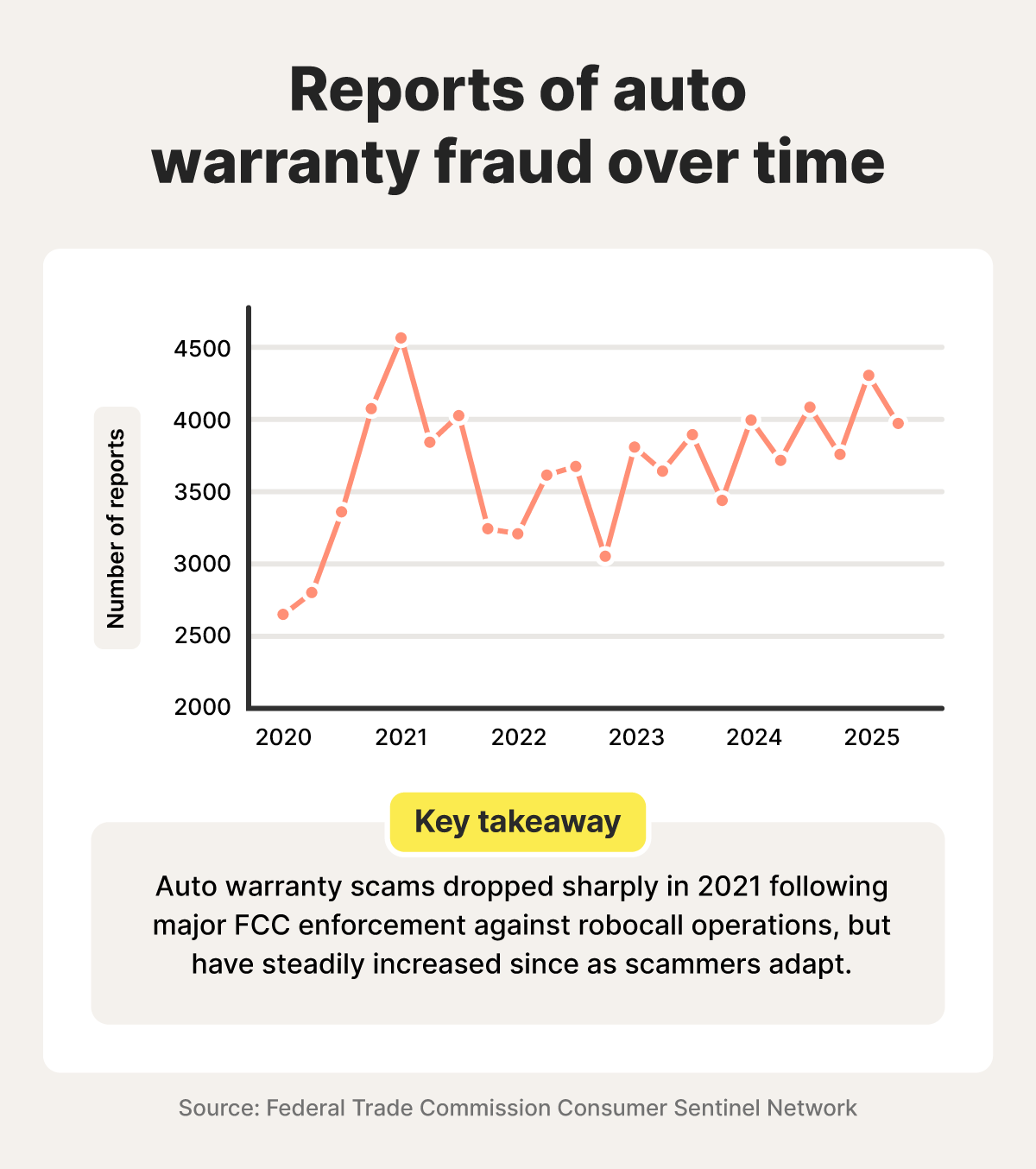
The Federal Communications Commission (FCC) recognizes these calls as a threat to look out for, and although phone companies have been instructed to root out and prevent them from being made, car warranty scams persist. In fact, according to FTC data, reports of this scam type have been growing steadily since 2022.
Signs you should hit the brakes
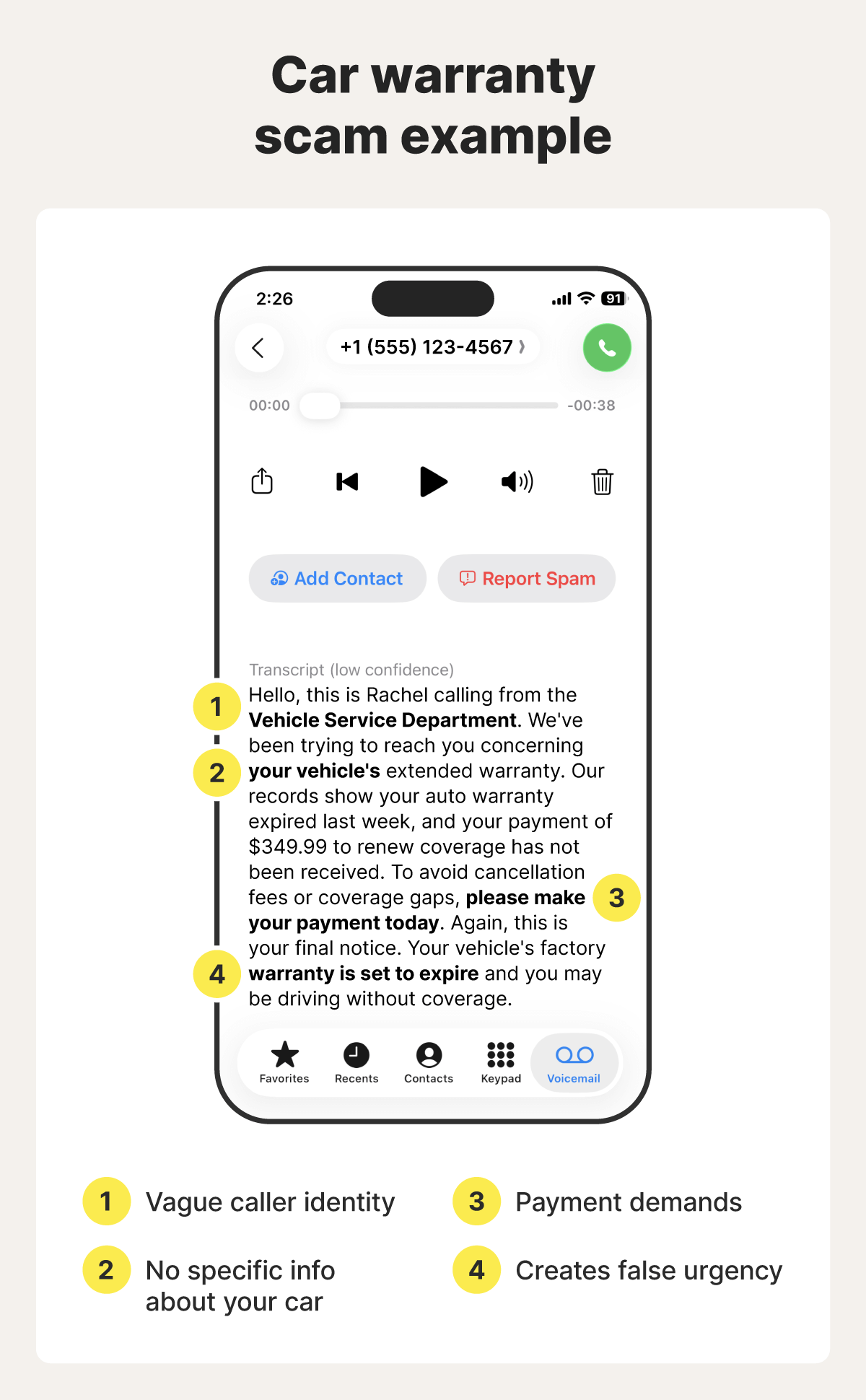
Knowing the warning signs that indicate an extended warranty scam call, as opposed to a legitimate call, can help you identify a potential scammer. Watch out for these red flags:
- Prerecorded voice: Most scam calls start as robocalls. Some may sound surprisingly convincing thanks to AI voice cloning technology, but if you suspect it’s not a real person on the other end of the line, be cautious.
- Pressure tactics: Phrases like “last chance,” “final notice,” or “urgent” are meant to cloud your judgment and rush you into a decision. Legitimate companies should give you time to review your options without fear tactics.
- Vague or generic info: Scammers often won’t mention your car’s make, model, or year, using terms like “your vehicle” instead. Even if they do have some accurate info, don’t immediately trust the call — they could have stolen it from another source.
- Requests for personal information: Never give out sensitive data like your VIN, SSN, or payment details before verifying the caller’s legitimacy. A trustworthy company won’t demand this upfront.
- Immediate payment demands: Legitimate warranty providers won’t pressure you to pay or commit immediately. They’ll gladly send a policy copy for review so you can make an informed decision.
Is a car warranty call ever legitimate?
Yes, there are legitimate extended warranty calls, but they’ll typically come from companies you’re already familiar with, like your car dealership, your vehicle’s manufacturer, or an extended warranty provider you’re already using.
If the call doesn’t come from one of these sources, it’s likely a scam or, at the very least, a spam sales call. Legitimate calls will also reference your actual car make and model and won’t ask for sensitive information right away. They also won’t use scare tactics to encourage you to make a quick decision.
If you’re unsure whether a call is legitimate, hang up and contact the company directly using a phone number from their official website or your purchase paperwork. You can also report suspicious calls to the FTC.
What should you do if the call is legitimate?
Even legitimate warranty providers can be persistent and annoying. If you realize that a car warranty call is legitimate but you’re unhappy with the service, you can:
- Call customer support to opt out or cancel your coverage.
- File a complaint with the Better Business Bureau, your state’s Attorney General, or your state’s Insurance Commissioner if you’re still being charged or feel harassed.
How to stop unwanted car warranty calls
To reduce the number of scam calls you receive, including car warranty calls, you should block spam numbers, register your number with the Do Not Call registry, and reduce exposure of your personal information. While no solution is 100% effective, these steps can dramatically reduce the noise.
Don’t answer and block the number
Any time you suspect an incoming call is from a scam call number, don’t answer it. Instead, let it ring out and then block the number immediately afterward. If you answer spam calls, your number may be flagged as “active,” prompting more scammers to get in touch. Plus, each time you block a number, it trains your phone or spam filter to better recognize scam calls.
- How to block numbers on iPhone: Open the Phone app, go to your recent call list, find the number you want to block, tap “i,” and then tap Block this Caller.
- How to block numbers on Android: Open the Phone app, go to your recent call list, tap the number you want to block, then tap Block/report spam.
Register with the National Do Not Call Registry
The National Do Not Call Registry is a database managed by the FTC, which is intended to prevent telemarketers from contacting you. It won’t necessarily stop criminal scammers from using your number, since they’re not concerned with abiding by the law in the first place, but it should reduce the number of legitimate telemarketing calls you receive.
- Visit donotcall.gov.
- Register your number and email.
- Confirm registration via email.
Use call-blocking features and apps
Your phone carrier or device likely offers spam protection settings, including a spam filter that you can configure to block or screen suspicious calls. You can also download third-party apps that block known robocall numbers. These apps can help spot car warranty robocalls and flag new potential spam numbers.
Reduce exposure of your phone number
Scammers may be able to find your phone number on public databases, like people search websites and online data brokers. Identity theft protection services like LifeLock can help find where your phone number is exposed online so you can take steps to remove your information, reducing your digital footprint and cutting scammers off before they even contact you.
How to get back on track after an auto warranty scam
If you’ve already answered a car warranty scam call and paid money under false pretenses or given away sensitive information, don’t panic, but act fast. Here’s how to reduce the risk of follow-up fraud or identity theft:
- Notify your bank: If you made a payment on the phone or shared financial details like your bank account number, contact your bank immediately. They can freeze compromised cards, potentially refund scammed money, and monitor your accounts for suspicious activity.
- Consider a credit freeze: If you provided your SSN or other sensitive info that the scammer could use in credit fraud, a credit freeze can help prevent new accounts from being opened in your name.
- Report the scam: File complaints with the FTC and FCC to alert the authorities about the scam. You’ll get guidance on how to protect yourself, and your report will help track scammers and protect others from falling victim.
- Stay alert for follow-ups: Once scammers know your number is active, you may get more suspicious calls, emails, or texts. Don’t answer unknown numbers or click unexpected links.
- Protect your identity: Consider investing in an identity theft protection service like LifeLock to reduce exposure of your phone number and other personal info on the internet, monitor for unusual activity, and get alerts of potential fraud.
Buckle up your identity and stay protected
If you’re constantly fielding spam calls or you think your data may already be out there, it’s time to take control. Every data broker listing that includes your phone number or personal details can be a doorway for scammers.
LifeLock’s Privacy Monitor feature scans popular data broker sites for your information and helps you submit opt-out requests. It puts you back in the driver’s seat of your digital privacy, making it harder for scammers to get a hold of your phone number or other personal data. Plus, as a member, you’ll also get dark web and credit monitoring tools to help identify and defend against other identity threats.
FAQs
Why do I keep getting car warranty calls?
If you keep getting car warranty calls, your phone number may be listed in public databases or sold by data brokers. Even if you never filled out a car-related form, your information could have been leaked, shared, or scraped from online sources.
Who is behind the car warranty calls?
Many car warranty call operations are run by shady telemarketing firms or scam rings — sometimes based overseas — that generate revenue by selling fake warranties or stealing personal information.
What should I do if I answered a car warranty call?
Hang up immediately. Don’t share any personal information. If you did, monitor your bank account and consider identity theft protection.
Editors’ note: Our articles provide educational information about identity theft, scams, financial fraud, and other topics that can put your identity or personal accounts at risk. LifeLock offerings may not cover or protect against every type of crime, fraud, scam, or threat we write about. For more details about how we write, review, and update our articles, see our Editorial Policy.
Related articles