

Tip: The free and easy availability of generative AI tools means that looking out for spelling or grammar errors is now less useful when trying to spot a scam. AI scams can use perfectly natural-sounding language that’s free from mistakes.

Call us:
1-800-416-0599

 Call us

How to know if a job is a scam (9 common signs)
Job scams aim to trick job hunters into giving up sensitive information or paying for fake employment expenses, preying on intense emotions like ambition or desperation. Learn how to tell if a job opening is actually a scam so you can focus on real opportunities. Then, join LifeLock to help reduce online exposure of your personal information and protect against fraud.


Landing a new job should be cause for celebration. But what happens when the job you thought you had turns out to be fake? Fake job scams are a real threat, with over 127,000 reports concerning business and job opportunities made to the FTC in 2024 and a median loss per victim of over $2,000. But how are you supposed to know if a job is a scam?
Let’s explore nine ways to spot fake job postings, steps you can take to report fake jobs, and what you can do if you’ve been the target of a job application scam.
1. Unsolicited contact from recruiters
Receiving a job offer out of the blue can be suspicious, but it's not an immediate red flag. Legitimate recruiters may extend an unsolicited invitation to apply if they have a position to fill and your experience is a good fit.
To identify a scammer, consider whether the timing and the method by which they contacted you make sense. A legitimate recruiter or headhunter will often reach out by phone, email (with an official company email address), or LinkedIn. If someone reaches out via another social media platform (like Facebook) or sends you spam texts, it’s more likely to be part of a scam.
The time and day a recruiter contacts you are important as well. A professional recruiter will usually get in touch during normal business hours, but a fake recruiter may contact you in the middle of the night or on a Sunday.
And if the recruiter is offering you a job that is far outside your field (e.g., you’re a copywriter and the position is for a CFO), you should treat it as a clear red flag of a scam.
2. Unrealistically high pay
Unfortunately, if a job offer looks too good to be true, it probably is. Many scammers prey on inexperienced job seekers by promising high pay for low-effort or entry-level work.
For instance, a fake posting may say something like “earn $700 a day working part-time with 30 days of paid vacation” or “work 1 hour a day and receive $9,000 a month guaranteed.”
These promises of lucrative pay are often offered alongside jobs like:
- Social media posting.
- Re-shipping packages.
- Customer service.
- Data entry jobs.
- Remote work.
- Envelope stuffing.
- Mystery shopping.
- AI training.
- Administrative assistant work.
A good way to check if a wage is realistic is to check online sources like Glassdoor and Indeed. If the pay being advertised is well above the average for similar roles at similar companies, treat it as a warning sign that the job may not be legitimate.
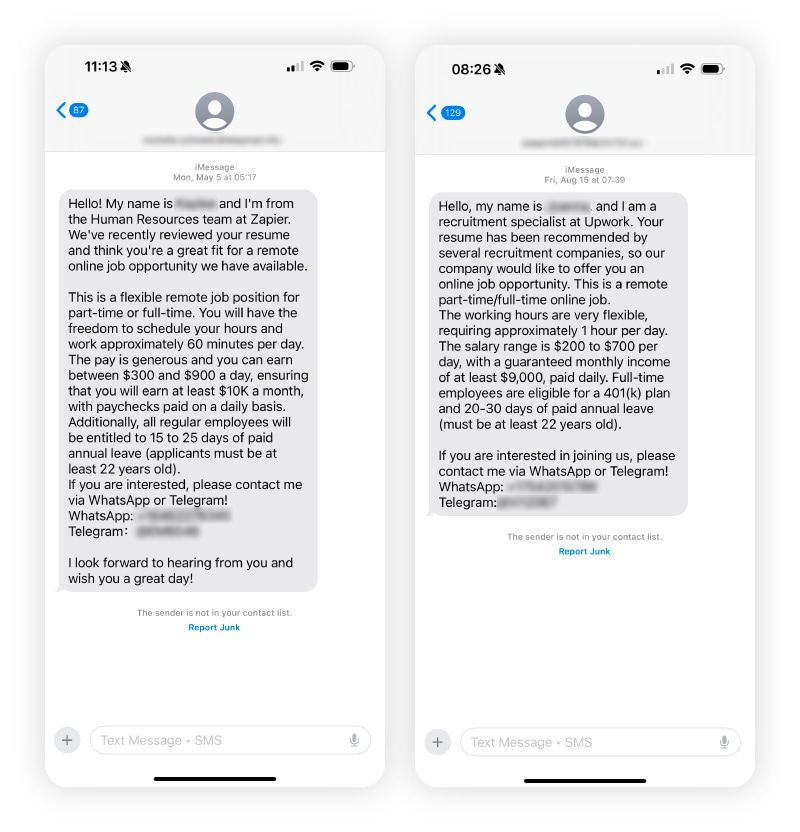
Screenshots showing job application scam text messages.
3. Immediate job offers
Getting an offer letter is the ultimate job-hunt goal, but when it comes too soon, it’s a red flag. Usually, the hiring process starts with an application, then a screening, and often one or more interviews. If you’re a good fit, the company will then reach out to make you an offer.
If you’ve just submitted your application and you immediately get a job offer, without even completing an interview, it’s highly likely that you’re being scammed.
Job scammers may also use urgency tactics, claiming they need to fill the position immediately or that “the first candidate to reply gets the job.” This is just a strategy to get you to act without thinking, with the scammer hoping you don’t take the time to verify that the job is real.
4. Requests for payment
A recruiter or company asking you to pay money up front, before you start the job, is a classic sign of a scam. Scammers can make these payment requests seem legitimate by presenting them as necessary fees for training, equipment, or certification.
Even more suspicious is when a scammer asks for money in the form of gift cards, fraudulent Zelle payments, or cryptocurrency. A legitimate company will never ask you to send payments like this as part of your hiring process.
5. Vague job descriptions and requirements
A solid job opportunity should have a descriptive title and a list of duties. However, with a fake job posting, you may come across vague position titles like “data entry assistant” or “warehouse coordinator” followed by an equally lacking job description. Sometimes the title and description just don’t make sense, like “remote cashier” or “perform online optimization.”
For instance, this Reddit user shared a scam job experience in which the recruiter outright refused to provide details about what the “data entry assistant” role entailed.
Working from home is another phrase commonly used in fake job descriptions. According to the BBB, job scams, particularly those advertised as remote, were the number one scam targeting young adults (18-34) in 2024.
One final phrase to watch for in fake job postings is “no experience necessary.” If the job has a flashy title, high pay, and no experience required, it is too good to be true.
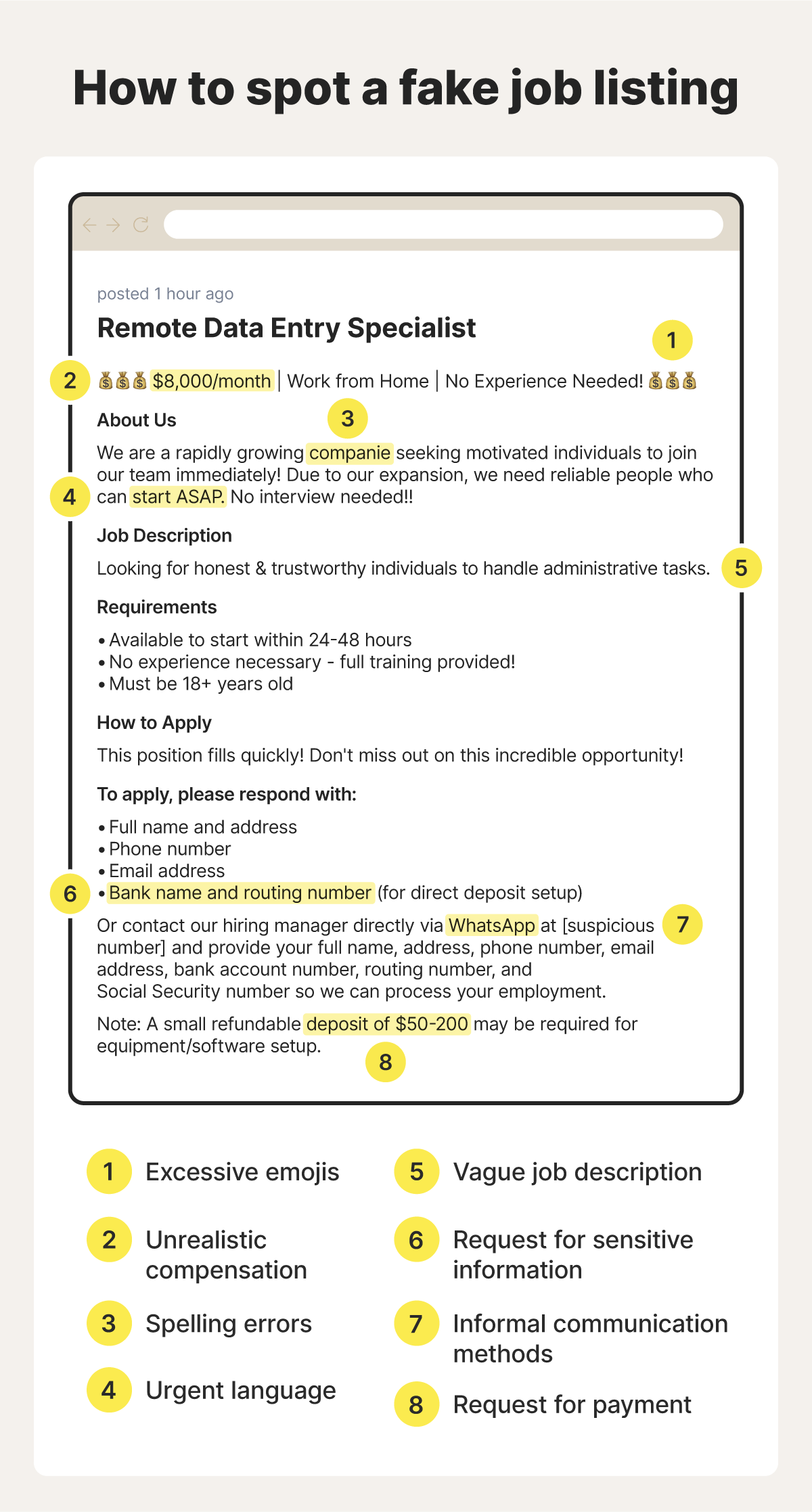
A diagram showing ways to spot a fake job listing.
6. Unprofessional communications
Take a close look at the email or message you received — are there numerous grammatical or spelling mistakes, an overly casual tone, or a missing signature? If so, you could be dealing with a scam.
Another way to spot fake emails is by closely inspecting the sender’s address. Legitimate emails from recruiters should be sent from an address that includes the company’s domain name (e.g., @lifelock.com). Check the website of the company supposedly offering the job to verify how a real email address should look.
Emails from private email addresses like recruiter8643@live.com or best.job.opportunities@gmail.com are more likely to be from scammers.
7. No verifiable company information
If you get a job offer from a company you don’t recognize, doing a little internet research can be a good way to find out how likely it is that the offer is legit. Check if the company has a website, a BBB listing, or a social media presence. If not, consider it a warning sign — almost all legitimate companies will have some kind of internet presence.
A word of caution here: even if the company is legitimate, that doesn’t mean the person contacting you is. If you’re suspicious that somebody might be posing as a legitimate employee, check the company’s website or look them up on LinkedIn. If you can’t verify that the person you’re speaking with even works for the company, treat it as a red flag and act cautiously.
8. Unusual interview process
Was your interview for the job short, overly casual, or nonexistent? If so, be wary of a scam. Job interviews are normally a very professional, structured process.
Another strong sign of a fake interview is the method used to communicate. If the interviewer wants to chat over text message or a private messaging app like Telegram, this is a red flag.
To protect yourself from fake interviews, or just avoid confusion during the recruitment process, ask upfront what the interview process looks like. And if you’re actively chatting with a recruiter or hiring manager and something doesn’t feel right, ask if you can hop on a quick phone call or video chat.
9. Premature requests for sensitive information
If you’re asked for detailed personal information too early in the recruitment process, such as before an interview even takes place, be wary. A legitimate recruiter may ask for basic information, such as a phone number and location, but that’s it.
Giving up more sensitive personally identifiable information could leave you vulnerable to fraud. For example, a scammer could use your address in mail fraud or use your SSN to steal your identity.
At some point during the hiring process, you will be asked to provide personal information, including your address, Social Security number (SSN), and banking details. However, this is generally only used to check your credit report or as part of the onboarding process once you have the job.
What to do if you suspect a job scam
If you think you’ve been targeted by a job scam, don’t panic. Here are six steps you can take to protect yourself and sound the alarm on the scammer.
- Do not interact: If a job opportunity appears suspicious, cease communication with the “recruiter” immediately. Certainly don’t send money or click any links sent to you regarding the job.
- Verify the job posting: A job posting you discover via email, text, or even a job board won’t always be real. Check to see if details about the position appear elsewhere online, and visit the company’s website for confirmation about whether it actually exists.
- Block communications: Once the scammer sees that you are wary, they may grow more aggressive in communications. Blocking their phone number and email address can give you peace of mind.
- Collect evidence: Gathering information like emails, voicemails, and the job posting can prove you were scammed and may be useful for reporting the scam, filing a lawsuit, or navigating subsequent identity theft issues.
- Report the fake job listing: If you found the listing on a job board like Indeed, report the job as fake on that website. You can also report a job scam to the Federal Trade Commission (FTC) and the Internet Crime Complaint Center (IC3) to help the authorities root out the scammer.
- Contact the company directly: If a scammer fraudulently poses as a legitimate company, notify that business. They can then launch an investigation and alert the public to the scam so others don’t fall victim.
If you didn’t discover the job was a scam until after you provided the scammer with sensitive information, it’s important to protect against the risk of identity theft. Depending on what information you shared, that may involve notifying your bank or credit card company and placing a fraud alert or credit freeze with the credit bureaus, which can help prevent scammers from accessing your credit.
For extra protection, consider investing in an identity theft protection service. This can help you detect online exposure of your sensitive information, navigate the recovery process if your identity is stolen, and provide protection against future identity theft.
What to do if you fall for a job application scam
Are you already in the middle of the hiring process and suspect you’re being scammed? Here are six steps you can take to protect yourself and report fake job applications.
- Stop all contact: Don’t reply to any further texts, emails, or calls regarding the job. Block all email addresses and phone numbers associated with the scammer.
- Inform your bank (if needed): If you’ve given out banking information after being asked to pay a “required fee,” notify your bank immediately. They can put a freeze on your account to protect your funds.
- Protect your credit: Contact the credit bureaus to place a fraud alert on your credit reports or freeze your credit. This is especially important if you have given out sensitive information, such as your birthdate or Social Security number.
- Report to the police: Reach out to your local police department to file a report. If the scam results in identity theft, a police report will help you recover.
- Report to the FTC/IC3: You may also want to file a report with the FTC and IC3. These agencies may launch an official investigation and be able to stop the scammer once and for all.
- Stay vigilant: Monitor your credit, financial accounts, and online accounts closely over the next few weeks or months. Scammers with access to sensitive information may try to commit fraud or launch account takeover attacks, but spotting the warning signs early can help you defend against them.
How to protect yourself from fake job scams
Whether you’re on the hunt for a new job or get contacted out of the blue, there are a few key tips you can use to help protect yourself against fake jobs, and the fraud or identity theft risks they might be linked to.
From researching the company and recruiter to spotting red flags early, here are some ways to reduce your risk of being scammed:
- Look for red flags: Offers of high pay, no experience required, and a hiring process that feels too quick are just a few of the red flags to be aware of. The sooner you can spot red flags and avoid the scam attempt, the better.
- Research the company and recruiter: Run a quick online search to verify the business is legit. Even if the company is real, that doesn’t mean the recruiter is. Check whether the recruiter is associated with the company they claim to represent.
- Know your career’s salary range: Research the salary range for your job position in your location. This way, you’ll know if the pay offered is too good to be true.
- Ignore unsolicited offers: While legitimate headhunters can contact you out of the blue, many unsolicited offers are scams. Ignoring unsolicited offers that don’t seem legitimate can save you from being scammed.
- Confirm contact information: If the email or phone number used to contact you seems suspicious, you can verify it against the information on the company’s website. If it doesn’t match, protect yourself from follow-up attempts by blocking the number or email address.
- Don’t share sensitive information: When you’re approached about a job offer, only share basic information like the city you live in and potential start date. Keep sensitive or personally identifiable information to yourself, at least until later in the application process when you’re more confident the opportunity is legitimate.
Help defend yourself from job scams
Job scams aren’t just a nuisance that take up valuable time you could spend on applying for real jobs. They’re a real threat that can lead to financial losses or even worse consequences, like identity theft. Learning how to tell if a job is a scam is a good start, but an identity theft protection service can give you even more robust defenses against online scams.
Join LifeLock to monitor exposure of your information online, detect if sensitive data has been compromised, monitor your credit for signs of fraud, and get critical recovery support from experts if your identity is stolen after you fall for a job scam.
FAQs
How common are job scams?
Job application scams are very common. According to the BBB, job scams were the second most common type of scam in 2024, accounting for 14% of all scam attempts. In the same year, scams relating to business and job opportunities were also the third most-reported category to the FTC.
Are all work from home jobs scams?
Work from home jobs are constantly used in scams as criminals prey upon job seekers' desire for flexibility and financial freedom. But that doesn’t mean all remote jobs are scams. Many companies offer legitimate work-from-home jobs or jobs with hybrid working practices.
Do job recruiters ask for a Social Security number?
A legitimate job recruiter should never ask for your full Social Security number before you’ve interviewed or been offered the role. They may request the last four digits of your SSN, but this is usually only for internal record-keeping purposes. If you’re asked for sensitive information, it’s always a good idea to act cautiously and verify how the recruiting agency will protect it.
Are pyramid schemes considered job scams?
Generally speaking, a pyramid scheme is a type of illegal multi-level marketing program (MLM). These MLMs are their own type of scam and are considered a type of investment fraud by the IC3.
How quickly should a legitimate hiring process move?
This can vary from company to company. A legitimate process can last anywhere from a few days to a few months. However, if things appear to be moving too fast and important steps are skipped, such as no official application or interview, this is a red flag for a job scam.
Editor’s note: Our articles provide educational information. LifeLock offerings may not cover or protect against every type of crime, fraud, or threat we write about.
This article contains
- 1. Unsolicited contact from recruiters
- 2. Unrealistically high pay
- 3. Immediate job offers
- 4. Requests for payment
- 5. Vague job descriptions and requirements
- 6. Unprofessional communications
- 7. No verifiable company information
- 8. Unusual interview process
- 9. Premature requests for sensitive information
- What to do if you suspect a job scam
- What to do if you fall for a job application scam
- How to protect yourself from fake job scams
- Help defend yourself from job scams
- FAQs
Related articles



Credit & Finance
Credit check for employment: What do employers look for?
July 10, 2025
·
10 min read



Start your protection,
enroll in minutes.


LifeLock is part of Gen – a global company with a family of trusted brands.
Copyright © 2025 Gen Digital Inc. All rights reserved. Gen trademarks or registered trademarks are property of Gen Digital Inc. or its affiliates. Firefox is a trademark of Mozilla Foundation. Android, Google Chrome, Google Play and the Google Play logo are trademarks of Google, LLC. Mac, iPhone, iPad, Apple and the Apple logo are trademarks of Apple Inc., registered in the U.S. and other countries. App Store is a service mark of Apple Inc. Alexa and all related logos are trademarks of Amazon.com, Inc. or its affiliates. Microsoft and the Window logo are trademarks of Microsoft Corporation in the U.S. and other countries. The Android robot is reproduced or modified from work created and shared by Google and used according to terms described in the Creative Commons 3.0 Attribution License. Other names may be trademarks of their respective owners.