


Has your personal data been recently exposed?
Check if information like your Social Security number, email, and passwords is exposed on the dark web.


You have reached the maximum number of scans allowed. Please come back after 24 hours.

Scanning the dark web...
Scanning public databases...
Scanning millions of records...
Narrowing down the search...
We need more information
Please enter a few more details to ensure we show you the right information.
You’re at high risk
We found your personal information on the dark web and on data broker sites.
 Up to $3M Reimbursement for identity theft, with up to $1M for Stolen Funds†††
$10K Scam Reimbursement7
Scam Support
Credit, Checking and Savings Activity Alerts: Unlimited Accounts
Credit & Payday Loan Lock2
Credit Monitoring:
3 Bureau1
Automatic Data Broker Removal8
Dark Web Monitoring
Priority 24/7 Customer Phone Support
LifeLock Total

No one can prevent all cybercrime or prevent all identity theft.
- Price valid for introductory term. After that, your price will renew at the standard price.
- Your subscription begins immediately after your transaction is complete. A payment method is required at sign-up for trials, and you will be charged at the end of your trial, unless canceled first.
- Prices are subject to change and may be charged up to 35 days prior to renewal. Cancel here or contact Member Services.
- Restrictions apply. Automatically renewing subscription required. If you're a victim of identity theft and not satisfied with our resolution, you may receive a refund for the current term of your subscription. See lifelock.norton.com/guarantee for complete details.
††† Up to $1 million coverage for Lawyers and Experts included with all plans. Reimbursement and expense compensation vary according to plan. Insurance benefits are issued by third parties. See lifelock.norton.com/legal for policy info.
1 Bureau Monitoring and Monthly Credit Report and Score / 3 Bureau Monitoring and Monthly Credit Report and Score.
2 Credit Lock cannot prevent all account takeovers, unauthorized account openings, or credit file inquiries. Deactivates if you downgrade or cancel your subscription.
7 Scam protection coverage as part of identity theft benefits is currently available to all customers residing in the United States, including U.S. territories and the District of Columbia, with the exception of residents of New York. Gen Digital is not a licensed insurance producer. Benefits under the Master Policy are issued and covered by HSB Specialty Insurance Company. You can find further details and exclusions in the summary of benefits.
8 After setup, automatic data broker removal service scans and requests removal every 90 days.
You’re at medium risk
We found your personal information on data broker sites.
Up to $1.2M Reimbursement for identity theft, with up to $100K for Stolen Funds†††
$5K Scam Reimbursement7
Scam Support
Credit, Checking and Savings Activity Alerts:
5 Accounts
Credit & Payday Loan Lock2
Credit Monitoring:
3 Bureau1
Automatic Data Broker Removal8
Dark Web Monitoring
Priority 24/7 Customer Phone Support
LifeLock Advanced
No one can prevent all cybercrime or prevent all identity theft.
- Price valid for introductory term. After that, your price will renew at the standard price.
- Your subscription begins immediately after your transaction is complete. A payment method is required at sign-up for trials, and you will be charged at the end of your trial, unless canceled first.
- Prices are subject to change and may be charged up to 35 days prior to renewal. Cancel here or contact Member Services.
- Restrictions apply. Automatically renewing subscription required. If you're a victim of identity theft and not satisfied with our resolution, you may receive a refund for the current term of your subscription. See lifelock.norton.com/guarantee for complete details.
††† Up to $1 million coverage for Lawyers and Experts included with all plans. Reimbursement and expense compensation vary according to plan. Insurance benefits are issued by third parties. See lifelock.norton.com/legal for policy info.
1 Bureau Monitoring and Monthly Credit Report and Score / 3 Bureau Monitoring and Monthly Credit Report and Score.
2 Credit Lock cannot prevent all account takeovers, unauthorized account openings, or credit file inquiries. Deactivates if you downgrade or cancel your subscription.
7 Scam protection coverage as part of identity theft benefits is currently available to all customers residing in the United States, including U.S. territories and the District of Columbia, with the exception of residents of New York. Gen Digital is not a licensed insurance producer. Benefits under the Master Policy are issued and covered by HSB Specialty Insurance Company. You can find further details and exclusions in the summary of benefits.
8 After setup, automatic data broker removal service scans and requests removal every 90 days.
Good news!
We didn’t find your personal information across millions of records or on public data sources.
Up to $1.05M Reimbursement for identity theft, with up to $25K for Stolen Funds†††
Identity Restoration Specialists
Credit, Checking and Savings Activity Alerts:
2 Accounts
Credit & Payday Loan Lock2
Credit Monitoring:
2 Bureau1
Automatic Data Broker Removal8
Dark Web Monitoring
Breach Alerts
24/7 Customer Phone Support
Lifelock Core
No one can prevent all cybercrime or prevent all identity theft.
- Price valid for introductory term. After that, your price will renew at the standard price.
- Your subscription begins immediately after your transaction is complete. A payment method is required at sign-up for trials, and you will be charged at the end of your trial, unless canceled first.
- Prices are subject to change and may be charged up to 35 days prior to renewal. Cancel here or contact Member Services.
- Restrictions apply. Automatically renewing subscription required. If you're a victim of identity theft and not satisfied with our resolution, you may receive a refund for the current term of your subscription. See lifelock.norton.com/guarantee for complete details.
††† Up to $1 million coverage for Lawyers and Experts included with all plans. Reimbursement and expense compensation vary according to plan. Insurance benefits are issued by third parties. See lifelock.norton.com/legal for policy info.
1 Credit features require successful setup, identity verification, and sufficient credit history by the appropriate credit bureau. Credit monitoring features may take several days to activate after enrollment.
2 Identity Lock cannot prevent all account takeovers, unauthorized account openings, or credit file inquiries. Deactivates if you downgrade or cancel your subscription.
8 After setup, automatic data broker removal service scans and requests removal every 90 days.

 Why do we ask?
Finding your match...

10 cents
If your information is exposed or stolen in a data breach, it can end up on the dark web where it can be sold for as little as 10 cents.
100M+
LifeLock monitors hundreds of millions of data points a second.
- Up to $1.05M Reimbursement for identity theft, with up to $25K for Stolen Funds†††
- Up to $1.2M Reimbursement for identity theft, with up to $100K for Stolen Funds†††
- Up to $3M Reimbursement for identity theft, with up to $1M for Stolen Funds†††
- Up to $1.05M Reimbursement for identity theft, with up to $25K for Stolen Funds††† for each adult
- Up to $1.2M Reimbursement for identity theft, with up to $100K for Stolen Funds††† for each adult
- Up to $3M Reimbursement for identity theft, with up to $1M for Stolen Funds††† for each adult
- Up to $1.05M Reimbursement for identity theft, with up to $25K for Stolen Funds††† for each adult
- Up to $1.2M Reimbursement for identity theft, with up to $100K for Stolen Funds††† for each adult
- Up to $3M Reimbursement for identity theft, with up to $1M for Stolen Funds††† for each adult
- Credit Monitoring Coverage1
- Credit Monitoring1 each adult
- Credit Monitoring1 for family
- Credit, Checking & Savings Account Activity Alerts
- Credit, Checking and Savings Activity Alerts for each adult
- Credit, Checking and Savings Activity Alerts for family
- 401K & Investment Account Activity Alerts
- 401K/Investment Account Alerts for each adult
- 401K/Investment Account Alerts for family
- Recurring and Unusual Charge Alerts
- Unexpected & Suspicious Charge Alerts for each adult
- Unexpected & Suspicious Charge Alerts for family
- Stolen Funds Reimbursement†††
- Stolen Funds Reimbursement††† for each adult
- Stolen Funds Reimbursement††† for family
- Lawyers and Experts†††
- Lawyers & Experts††† for each adult
- Lawyers & Experts††† for family
- Automatic Data Broker Removal8
- Automatic Data Broker Removal8 for each adult
- Automatic Data Broker Removal8 for family
- Scam Reimbursement7
- Scam Reimbursement7 for each adult
- Scam Reimbursement7 for family
- Credit Reports & Scores1
- Credit Report & Score for each adult
- Credit Report & Score for family
- Social Media Monitoring
- Social Media Monitoring for each adult
- Social Media Monitoring for family


††† Up to $1 million coverage for Lawyers and Experts included with all plans. Reimbursement and expense compensation vary according to plan. Insurance benefits are issued by third parties. See LifeLock.Norton.com/legal for policy info.
1 Credit features require successful setup, identity verification and sufficient credit history by the appropriate credit bureau. Credit monitoring features may take several days to activate after enrollment.
7 Scam protection coverage as part of identity theft benefits is currently available to all customers residing in the United States, including U.S. territories and the District of Columbia, with the exception of residents of New York. Gen Digital is not a licensed insurance producer. Benefits under the Master Policy are issued and covered by HSB Specialty Insurance Company. You can find further details and exclusions in the Summary of Benefits.
8 After setup, automatic data broker removal service scans and requests removal every 90 days.
Why do we ask?
Identifying your concerns gives us the ability to recommend the right plan for your needs.
Why do we ask?
Knowing this number helps us recommend coverage that fits your needs.
Why do we ask?
Providing your email address makes you eligible for notifications of potential identity threats.
How much does a will cost?
Knowing how much it costs to make a will can help make estate planning feel more manageable. The final figure can range widely depending on your estate, your needs, and whether you choose an online service, a DIY kit, or an estate planning attorney. This guide compares the costs of each option, explains the factors that can affect what you pay, and explores when professional legal help may be worth the added expense.


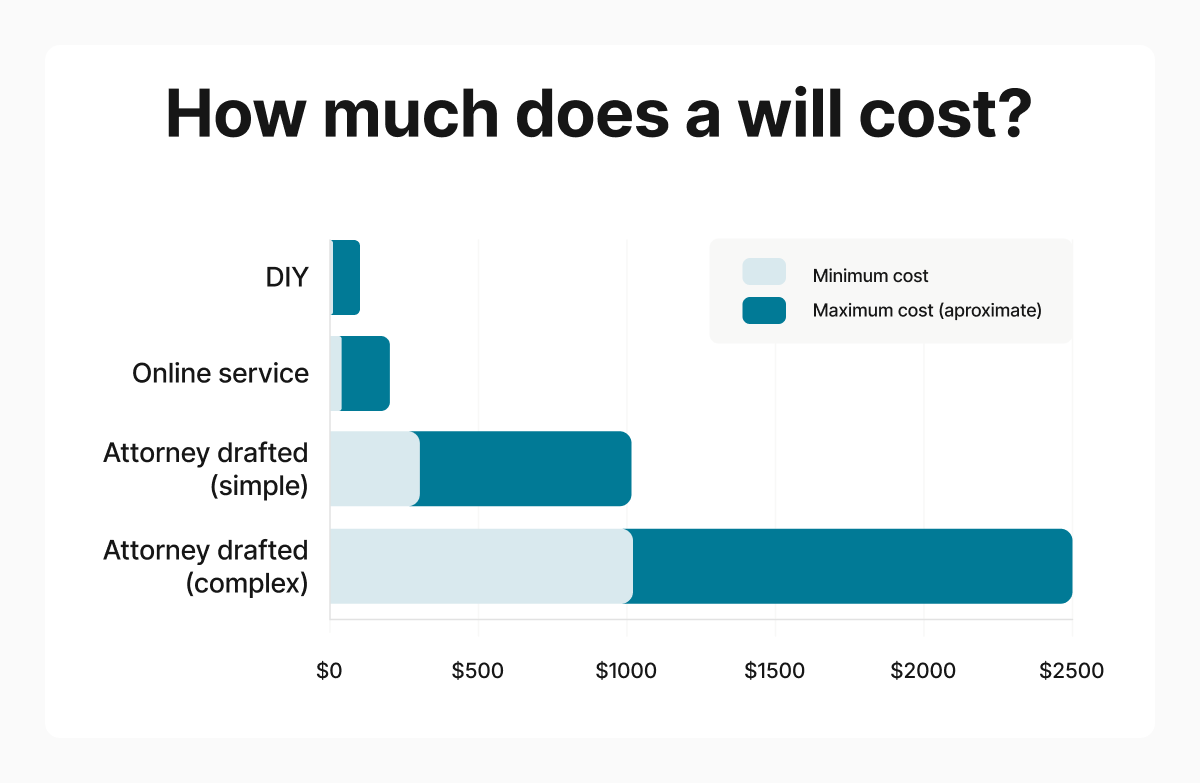
It can cost anywhere from $10 to over $1,000 to make a will, depending on how you choose to create it. DIY forms and online services are typically the most affordable options, while attorney-drafted wills tend to cost significantly more. The right choice depends on the complexity of your estate, how much support you want, and how confident you are handling the process yourself.
How much do different will options cost?
DIY will kits are usually the cheapest option but offer the least guidance, typically only providing you with a basic template that you complete yourself. Online will services cost more but offer a more guided experience, using your answers to generate a customized document and sometimes providing support, storage, or state-specific documents.
Hiring an attorney is generally the most expensive option, but includes bespoke legal guidance. A lawyer can tailor your will to your circumstances, explain relevant state laws, and help address complex issues such as blended families, business interests, trusts, or significant assets.
Method |
Typical Cost |
Best For |
Main-Trade-Off |
|---|---|---|---|
Handwritten will |
Free |
Emergencies when no other option is available. |
May not be legally recognized in some states and can be challenged or lost if not properly stored. |
DIY will |
$10 to $100 |
People with very simple estates seeking a low-cost method. |
Greater risk of omissions, unclear language, or failing to meet state-specific legal requirements. |
Online will service |
$39 to $200+ |
Most individuals with uncomplicated estates, hoping to balance cost and personalization. |
Can struggle to address very complex family dynamics or unusual wishes. |
Attorney-drafted (simple) |
$300 to $1,000 |
Individuals or married couples seeking personalized legal guidance for complex estates. |
Higher upfront cost, but offers professional review and customization. |
Attorney-drafted (complex) |
$1,000 to $2,500+ |
Blended families, business owners, high-value estates, or multi-state property. |
Costs can rise significantly when extensive planning or hourly legal work is required. |
Here’s a closer look at the three most common options for making a will, their pros and cons, and their typical price points:
Cost of a DIY will
Cost: $10 to $100
DIY will kits are typically pre-printed forms or downloadable templates that you complete yourself. They are among the lowest-cost ways to make a will, but they offer the least amount of professional guidance and protection. These kits are best suited for young, healthy people with simple estates and straightforward wishes who are confident they can meet their state’s legal requirements.
While the upfront cost is low, DIY kits may not account for every state-specific requirement or individual circumstance, and errors in drafting, signing, or witnessing could affect the will’s validity or create problems during probate. Additionally, ongoing professional services are typically not included. So, if you need to change your will, you may need to complete a new document, purchase an updated kit, or seek legal help, depending on the changes required.
Cost of online will services
Cost: $39 to $200+
Online will services guide you through an estate planning checklist and help you generate a will based on your answers about your assets, beneficiaries, and guardians. You must then execute the will according to your state’s signing and witnessing requirements. These services are best suited for individuals with straightforward estates who want a convenient and affordable alternative to hiring an attorney.
While DIY kits are static, many online will services let you return to your account and update your documents as your circumstances change. Pricing varies, but most services charge a one-time fee with a lower-cost subscription for ongoing access, updates, or additional services. For many people, this can provide a relatively affordable balance of guidance, convenience, and flexibility.
LifeLock Estate Planning can help you create a ready-to-sign will in a few simple steps, using the accounts and assets LifeLock already monitors and protects. Sign up to learn when it’s available where you live.

Cost of an estate planning attorney
Cost: $300 to $2,500+
An estate planning attorney is a licensed legal professional who can draft your will and provide advice tailored to your circumstances. This option may be particularly useful if you have complex assets, business interests, a blended family, or other complicated estate planning needs. An attorney can review your assets, discuss your goals, and help ensure your will meets your state’s legal requirements.
The cost of hiring an attorney depends on factors such as the complexity of your estate, your location, and the attorney’s fee structure. Some attorneys charge a flat rate for drafting a will or estate plan, while others bill by the hour. Additional services, such as document storage, future amendments, trusts, or other estate planning documents, may cost extra.
Whether hiring a lawyer is worthwhile depends largely on your specific situation. A reputable online will service may be sufficient for a straightforward estate, while an attorney may be needed to provide personalized guidance for more complex situations. Professional legal advice may also help reduce ambiguities or errors that could lead to disputes or make it harder to carry out your wishes.
What can affect the cost of a will?
Several factors can affect the cost of a will, including where you live, the type of service you use, and the complexity and size of your estate. Understanding these variables can help you budget accurately and choose the right service for your needs.
The cost of making a will varies due to factors such as local attorney rates, the cost of living, and market demand. In states with higher living costs, legal services generally tend to be more expensive.
For example, a simple attorney-drafted will in New York and California may cost $500 to $1,500. Fees may be lower in states with a lower cost of living, such as Indiana and West Virginia, although an attorney-drafted will can still cost several hundred dollars or more depending on the lawyer, fee structure, and complexity of the estate.
Online will services can reduce some of these geographic price differences because many use standardized or flat-rate pricing. However, costs and included services vary by provider.
Whether you have an individual or a joint will
The cost of creating a will can vary depending on whether you need a will for one person or estate planning documents for a couple. Individual wills are more common and offer greater flexibility. Joint wills — where two people, typically spouses, share a single document — are less common and can be harder to change after one person dies.
Attorney fees may be higher when planning for two people because additional assets, beneficiaries, and wishes may need to be addressed. Many online will services offer discounted packages for couples, which can cost less than purchasing two plans separately. DIY kits are typically priced per person or document, although pricing varies by provider.
The complexity of your estate can affect the type of will you need and, therefore, how much it costs to create. A simple will, the most common type, generally outlines how your assets should be distributed, names an executor, and can designate guardians for minor children and other dependents. It may be suitable for straightforward estates and can often be created using an online service or template.
More complex circumstances involving multiple properties, business interests, numerous beneficiaries, or special conditions may require a different type of will or additional estate planning documents, which generally increases the overall cost. For example, a testamentary trust will can place assets in a trust for beneficiaries, while a pour-over will directs certain assets into an existing trust.
A living will, meanwhile, covers your medical care preferences rather than the distribution of your estate and may add to your total estate planning costs if created alongside your last will and testament.
Online services and DIY kits may not accommodate more complicated needs, so you’ll likely need an attorney to draft your will or to help set up a trust, which can further increase the overall cost.

Attorneys use different fee structures, which can affect the total cost of creating your will. Some charge an hourly rate, often ranging from $150 to $500+ per hour. This structure is more common for complex estates that require extensive consultation. Others charge a flat fee, which sets a fixed price for drafting a standard will and can make costs more predictable.
An attorney’s experience, location, and specialization can also play a part. A seasoned estate planning attorney may charge more, particularly for complex estates. In return, specialized legal guidance can help ensure your will complies with state law, clearly reflects your wishes, and reduces ambiguities that could contribute to disputes (and delays) during probate.
Can you make a will for free?
Yes, it is possible to make a will for free. Free templates and online forms can help you document your wishes without paying for a lawyer or online service, and some states may recognize handwritten wills. However, validity requirements vary by state, and free options are generally not advisable unless you have no other choice.
If your estate is relatively straightforward, consider using an online will service for an affordable and more reliable alternative to writing a free, DIY will. These services typically provide a guided process and state-specific documents much more cheaply than a lawyer, although you are still responsible for properly signing and executing your will.
The cost of a trust vs a will
A trust is generally more expensive than a will because it involves more legal work to create and fund, and may involve ongoing administration as your situation changes. A trust is a legal entity that holds assets for the benefit of designated beneficiaries. Certain trusts, including properly funded revocable living trusts, can help assets avoid probate.
The cost of a trust depends heavily on how you create it. Online revocable living trust services typically cost a few hundred dollars, with major providers currently charging around $399 to $599 for basic plans. Attorney-drafted revocable living trusts commonly cost $1,500 to $4,000 or more, depending on the complexity of the estate. In comparison, a will usually costs between $200 and $1,500, depending on how it was drafted.
Factors that affect the cost of a trust include:
- The type of trust: Revocable living trusts tend to be less expensive to establish than more complex irrevocable trusts.
- The complexity and size of your estate: More assets and types of property (real estate, businesses, investments) can increase the cost of both wills and trusts.
- Specialized legal provisions: You may need additional planning, such as special needs trusts or spendthrift clauses, to control how and when beneficiaries receive assets.
- State laws: Probate and trust laws vary by state, affecting legal fees.
- Your attorney’s experience: Specialized attorneys may charge more for both services.
- The funding process: A trust requires you to transfer or retitle applicable assets, which may involve additional legal or administrative fees not required for a will.
How do I know if I need a trust?
You should consider a trust if you want to avoid probate, maintain privacy, or plan for how your assets will be managed if you become incapacitated. Trusts may also be beneficial if you have a large estate, own property in multiple states, or have beneficiaries with special needs. If your estate is simple and you live in a state with a streamlined probate process, a will may be sufficient and more cost-effective.
A trust can also provide safeguards for people who may become vulnerable to financial exploitation because of age or incapacity. For example, a properly structured trust can authorize a trustee or successor trustee to manage assets if the grantor becomes incapacitated, potentially limiting a scammer’s direct access to those assets. However, a trust does not itself prevent scams, identity theft, or home title theft, so broader fraud and identity-protection measures remain important.
Plan ahead with confidence
Making a will is an important step toward protecting your assets and the people who depend on you. As you put your estate plan in place, sign up to get more practical tips about how to safeguard your assets now, and into the future, sent straight to your inbox. Plus, you’ll get notified when LifeLock Estate Planning is available where you live.
Disclaimer: This article provides general educational information and should not be construed as legal, tax, or financial advice. Estate planning requirements vary by state; consult a qualified attorney or financial advisor regarding your specific situation.
Editors’ note: Our articles provide educational information about identity theft, scams, financial fraud, and other topics that can put your identity or personal accounts at risk. LifeLock offerings may not cover or protect against every type of crime, fraud, scam, or threat we write about. For more details about how we write, review, and update our articles, see our Editorial Policy.
Related articles