

Has your personal data been recently exposed?
Check if information like your Social Security number, email, and passwords is exposed on the dark web.


You have reached the maximum number of scans allowed. Please come back after 24 hours.

Scanning the dark web...
Scanning public databases...
Scanning millions of records...
Narrowing down the search...
We need more information
Please enter a few more details to ensure we show you the right information.
You’re at high risk
We found your personal information on the dark web and on data broker sites.
 Up to $3M Reimbursement for identity theft, with up to $1M for Stolen Funds†††
$10K Scam Reimbursement7
Scam Support
Credit, Checking and Savings Activity Alerts: Unlimited Accounts
Credit & Payday Loan Lock2
Credit Monitoring:
3 Bureau1
Automatic Data Broker Removal8
Dark Web Monitoring
Priority 24/7 Customer Phone Support
Up to $3M Reimbursement for identity theft, with up to $1M for Stolen Funds†††
$10K Scam Reimbursement7
Scam Support
Credit, Checking and Savings Activity Alerts: Unlimited Accounts
Credit & Payday Loan Lock2
Credit Monitoring:
3 Bureau1
Automatic Data Broker Removal8
Dark Web Monitoring
Priority 24/7 Customer Phone Support
LifeLock Total

No one can prevent all cybercrime or prevent all identity theft.
- Price valid for introductory term. After that, your price will renew at the standard price.
- Your subscription begins immediately after your transaction is complete. A payment method is required at sign-up for trials, and you will be charged at the end of your trial, unless canceled first.
- Prices are subject to change and may be charged up to 35 days prior to renewal. Cancel here or contact Member Services.
- Restrictions apply. Automatically renewing subscription required. If you're a victim of identity theft and not satisfied with our resolution, you may receive a refund for the current term of your subscription. See lifelock.norton.com/guarantee for complete details.
††† Up to $1 million coverage for Lawyers and Experts included with all plans. Reimbursement and expense compensation vary according to plan. Insurance benefits are issued by third parties. See lifelock.norton.com/legal for policy info.
1 Bureau Monitoring and Monthly Credit Report and Score / 3 Bureau Monitoring and Monthly Credit Report and Score.
2 Credit Lock cannot prevent all account takeovers, unauthorized account openings, or credit file inquiries. Deactivates if you downgrade or cancel your subscription.
7 Scam protection coverage as part of identity theft benefits is currently available to all customers residing in the United States, including U.S. territories and the District of Columbia, with the exception of residents of New York. Gen Digital is not a licensed insurance producer. Benefits under the Master Policy are issued and covered by HSB Specialty Insurance Company. You can find further details and exclusions in the summary of benefits.
8 After setup, automatic data broker removal service scans and requests removal every 90 days.
You’re at medium risk
We found your personal information on data broker sites.
Up to $1.2M Reimbursement for identity theft, with up to $100K for Stolen Funds†††
$5K Scam Reimbursement7
Scam Support
Credit, Checking and Savings Activity Alerts:
5 Accounts
Credit & Payday Loan Lock2
Credit Monitoring:
3 Bureau1
Automatic Data Broker Removal8
Dark Web Monitoring
Priority 24/7 Customer Phone Support
LifeLock Advanced
No one can prevent all cybercrime or prevent all identity theft.
- Price valid for introductory term. After that, your price will renew at the standard price.
- Your subscription begins immediately after your transaction is complete. A payment method is required at sign-up for trials, and you will be charged at the end of your trial, unless canceled first.
- Prices are subject to change and may be charged up to 35 days prior to renewal. Cancel here or contact Member Services.
- Restrictions apply. Automatically renewing subscription required. If you're a victim of identity theft and not satisfied with our resolution, you may receive a refund for the current term of your subscription. See lifelock.norton.com/guarantee for complete details.
††† Up to $1 million coverage for Lawyers and Experts included with all plans. Reimbursement and expense compensation vary according to plan. Insurance benefits are issued by third parties. See lifelock.norton.com/legal for policy info.
1 Bureau Monitoring and Monthly Credit Report and Score / 3 Bureau Monitoring and Monthly Credit Report and Score.
2 Credit Lock cannot prevent all account takeovers, unauthorized account openings, or credit file inquiries. Deactivates if you downgrade or cancel your subscription.
7 Scam protection coverage as part of identity theft benefits is currently available to all customers residing in the United States, including U.S. territories and the District of Columbia, with the exception of residents of New York. Gen Digital is not a licensed insurance producer. Benefits under the Master Policy are issued and covered by HSB Specialty Insurance Company. You can find further details and exclusions in the summary of benefits.
8 After setup, automatic data broker removal service scans and requests removal every 90 days.
Good news!
We didn’t find your personal information across millions of records or on public data sources.
Up to $1.05M Reimbursement for identity theft, with up to $25K for Stolen Funds†††
Identity Restoration Specialists
Credit, Checking and Savings Activity Alerts:
2 Accounts
Credit & Payday Loan Lock2
Credit Monitoring:
2 Bureau1
Automatic Data Broker Removal8
Dark Web Monitoring
Breach Alerts
24/7 Customer Phone Support
Lifelock Core
No one can prevent all cybercrime or prevent all identity theft.
- Price valid for introductory term. After that, your price will renew at the standard price.
- Your subscription begins immediately after your transaction is complete. A payment method is required at sign-up for trials, and you will be charged at the end of your trial, unless canceled first.
- Prices are subject to change and may be charged up to 35 days prior to renewal. Cancel here or contact Member Services.
- Restrictions apply. Automatically renewing subscription required. If you're a victim of identity theft and not satisfied with our resolution, you may receive a refund for the current term of your subscription. See lifelock.norton.com/guarantee for complete details.
††† Up to $1 million coverage for Lawyers and Experts included with all plans. Reimbursement and expense compensation vary according to plan. Insurance benefits are issued by third parties. See lifelock.norton.com/legal for policy info.
1 Credit features require successful setup, identity verification, and sufficient credit history by the appropriate credit bureau. Credit monitoring features may take several days to activate after enrollment.
2 Identity Lock cannot prevent all account takeovers, unauthorized account openings, or credit file inquiries. Deactivates if you downgrade or cancel your subscription.
8 After setup, automatic data broker removal service scans and requests removal every 90 days.

 Why do we ask?
Finding your match...

10 cents
If your information is exposed or stolen in a data breach, it can end up on the dark web where it can be sold for as little as 10 cents.
100M+
LifeLock monitors hundreds of millions of data points a second.
- Up to $1.05M Reimbursement for identity theft, with up to $25K for Stolen Funds†††
- Up to $1.2M Reimbursement for identity theft, with up to $100K for Stolen Funds†††
- Up to $3M Reimbursement for identity theft, with up to $1M for Stolen Funds†††
- Up to $1.05M Reimbursement for identity theft, with up to $25K for Stolen Funds††† for each adult
- Up to $1.2M Reimbursement for identity theft, with up to $100K for Stolen Funds††† for each adult
- Up to $3M Reimbursement for identity theft, with up to $1M for Stolen Funds††† for each adult
- Up to $1.05M Reimbursement for identity theft, with up to $25K for Stolen Funds††† for each adult
- Up to $1.2M Reimbursement for identity theft, with up to $100K for Stolen Funds††† for each adult
- Up to $3M Reimbursement for identity theft, with up to $1M for Stolen Funds††† for each adult
- Credit Monitoring Coverage1
- Credit Monitoring1 each adult
- Credit Monitoring1 for family
- Credit, Checking & Savings Account Activity Alerts
- Credit, Checking and Savings Activity Alerts for each adult
- Credit, Checking and Savings Activity Alerts for family
- 401K & Investment Account Activity Alerts
- 401K/Investment Account Alerts for each adult
- 401K/Investment Account Alerts for family
- Recurring and Unusual Charge Alerts
- Unexpected & Suspicious Charge Alerts for each adult
- Unexpected & Suspicious Charge Alerts for family
- Stolen Funds Reimbursement†††
- Stolen Funds Reimbursement††† for each adult
- Stolen Funds Reimbursement††† for family
- Lawyers and Experts†††
- Lawyers & Experts††† for each adult
- Lawyers & Experts††† for family
- Automatic Data Broker Removal8
- Automatic Data Broker Removal8 for each adult
- Automatic Data Broker Removal8 for family
- Scam Reimbursement7
- Scam Reimbursement7 for each adult
- Scam Reimbursement7 for family
- Credit Reports & Scores1
- Credit Report & Score for each adult
- Credit Report & Score for family
- Social Media Monitoring
- Social Media Monitoring for each adult
- Social Media Monitoring for family


††† Up to $1 million coverage for Lawyers and Experts included with all plans. Reimbursement and expense compensation vary according to plan. Insurance benefits are issued by third parties. See LifeLock.Norton.com/legal for policy info.
1 Credit features require successful setup, identity verification and sufficient credit history by the appropriate credit bureau. Credit monitoring features may take several days to activate after enrollment.
7 Scam protection coverage as part of identity theft benefits is currently available to all customers residing in the United States, including U.S. territories and the District of Columbia, with the exception of residents of New York. Gen Digital is not a licensed insurance producer. Benefits under the Master Policy are issued and covered by HSB Specialty Insurance Company. You can find further details and exclusions in the Summary of Benefits.
8 After setup, automatic data broker removal service scans and requests removal every 90 days.
Why do we ask?
Identifying your concerns gives us the ability to recommend the right plan for your needs.
Why do we ask?
Knowing this number helps us recommend coverage that fits your needs.
Why do we ask?
Providing your email address makes you eligible for notifications of potential identity threats.
What happens if you lose your Social Security card ?
Losing your Social Security card might not affect your day-to-day life, but it can expose your SSN to fraud and identity theft in the longer term. Learn what to do if you lose your Social Security card, including using LifeLock to monitor for fraudulent SSN activity.





Losing your Social Security card can range from a minor hassle to a serious problem if it falls into the wrong hands. On the minor end, you may need to order a replacement before certain jobs, benefits, or paperwork can move forward. At the more severe end, a lost card exposes your Social Security number (SSN), which can be misused to open accounts, accumulate debt, or file fraudulent tax returns.
But you don't have to wait for the worst to happen to take action. Keep reading to learn which steps to take immediately and a few thoughtful follow-ups that can help minimize damage if you lose your Social Security card.
What can someone do with your Social Security number (SSN)?
Thieves who steal your Social Security card can use your SSN to carry out identity theft, including financial, tax, employment, or government benefits fraud. These can be especially damaging if a thief has other personal information, such as your name or address, because it can also allow thieves to apply for loans or credit cards in your name.
Here’s a detailed look at what someone can do with your lost Social Security card, and the SSN printed on it:
- Commit financial fraud: They can access your bank accounts, open credit cards or loans in your name, and run up balances you didn’t approve. Credit card scams often go unnoticed until bills or collections show up.
- File fraudulent tax returns: A scammer may file a tax return before you do and steal your refund. This, like other tax scams, will likely delay your real refund.
- Cause employment fraud: Someone can use your SSN to get a job, which can throw off your income records and taxes. This often ties into LinkedIn scams, where fake recruiters or job posts collect personal details and pass them along for misuse.
- Enable government benefits fraud: Criminals can apply for unemployment or other government benefits using your identity, creating roadblocks when you try to claim benefits yourself.
- Result in a damaged credit score: All of this activity can negatively impact your credit score, making it more challenging to secure loans, housing, or even certain job opportunities in the future.
Losing a Social Security card can become a long-term inconvenience, as suggested by a victim of identity theft who posted recently on Reddit. The victim shared that somebody used their SSN (and their husband's) to file a fake tax return. The IRS caught it quickly, but six years later, they still receive a special code every tax season to prove their identity.
Steps to take after losing your Social Security card
Losing your card doesn’t guarantee you’ll be a victim of fraud. That said, you should take these quick actions to help prevent identity theft anyway: flag your information, replace the card, and check for early signs of misuse. Follow these three steps if you aren't sure what to do if you lose your Social Security card.
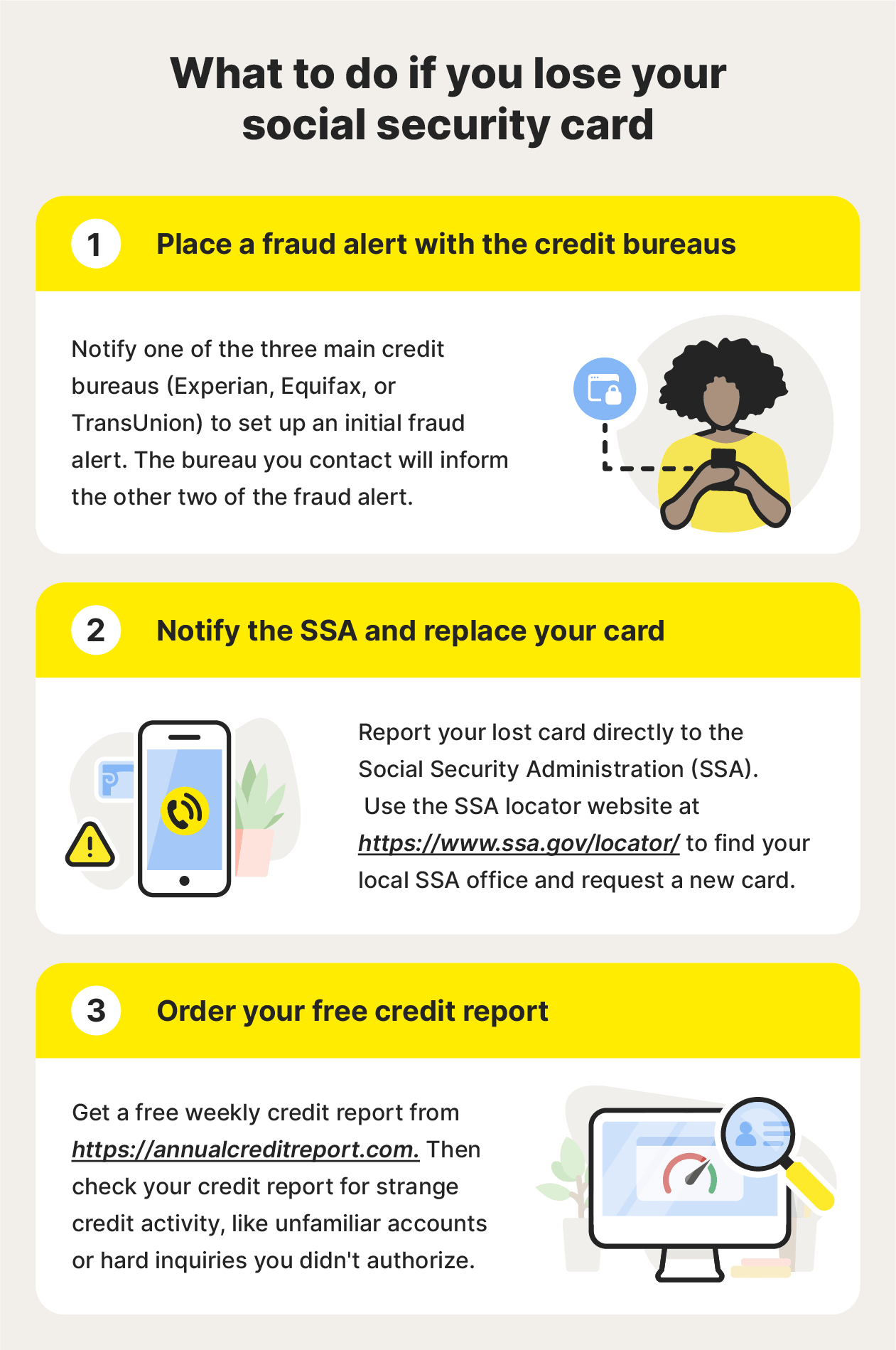
1. Place a fraud alert with the credit bureaus
Placing a fraud alert helps reduce the risk that your SSN can be misused in new credit applications. It tells lenders to double-check your identity before approving new credit lines. A fraud alert won’t shut down all opportunities for fraud, but it can slow or block many attempts before they go further in a credit application.
How to place a fraud alert:
- Contact one of the three major credit bureaus: Equifax®, Experian®, and TransUnion®.
- Request a free, one-year fraud alert to be added to your credit file. If you’ve already been a victim of identity theft and reported it to the FTC, you’re eligible for an extended fraud alert, which lasts for seven years.
- The bureau you contact is required to notify the other two.
You can request a fraud alert online, by phone, or by mail through the credit bureaus.
2. Notify the Social Security Administration and order a new card
To replace your Social Security card, you’ll need to notify the Social Security Administration (SSA). Ordering a replacement also alerts them that the original card is lost.
Here’s how to get a new Social Security card from SSA:
- Create or sign in to your Social Security account on the SSA website.
- Choose the option to request a replacement card.
- Confirm your identity and mailing address.
- Submit the request.
If you can’t use the online system, you can apply by mail or in person at an SSA office. The SSA locator website helps you find your nearest location and provides printable forms for requesting a new card. Most replacement cards arrive within 7 to 14 business days.
Non-U.S. citizens or naturalized citizens may need to apply in person and bring documents that show their immigration status, work authorization, and identity. Check out this list of eligible documents for more details.
What documents do you need to replace a Social Security card?
If you’re replacing a lost Social Security card and not requesting changes to your name, birthdate, citizenship, or immigration status, you typically only need to show proof of identity (such as your passport or driver’s license).
If you need to change your name on your replacement Social Security card, you’ll need to provide an original name-change document (such as a marriage certificate) alongside proof of identity.
If proof of citizenship or immigration status is missing from your Social Security file, the SSA will also ask you for this information before issuing a replacement Social Security card. To prove citizenship, show an original U.S. birth certificate or passport, Certificate of Naturalization, or Certificate of Citizenship. To prove non-citizen immigration status, showing your original Permanent Resident Card (also known as a “green card”) or an Employment Authorization Document usually works best.
3. Order free credit reports to check for fraud
If somebody stole your Social Security card, you can regularly check your credit report and score with a LifeLock subscription to catch early signs of identity theft. LifeLock tools even send you alerts if it’s detected that your personal information is being used fraudulently. You can also check your credit report without extra alerts at annualcreditreport.com.
To get your free weekly credit report:
- Visit AnnualCreditReport.com.
- Request reports from Equifax, Experian, and TransUnion.
- Verify your identity using personal and financial details.
Review each report for unfamiliar accounts, strange balances, or hard inquiries you don’t recognize. While credit reports won’t directly confirm if your SSN is on the dark web, for example, they often reveal the first visible damage when your stolen information is being used fraudulently.
What should I do if I find fraud on my credit report?
If you spot fraud on your credit report, report it, lock your credit, and start disputing any fraudulent charges. Acting fast helps limit the damage. This matters even more if the issue began with a lost wallet containing your Social Security card, as your number may already be circulating.
Here's what to do if your Social Security card is stolen and you notice any fraudulent activity:
- File an identity theft report with the FTC: Visit IdentityTheft.gov to report what happened. This creates an official recovery plan and paperwork you can use with banks, credit bureaus, and lenders.
- File a police report: Some creditors and agencies require a police report to remove fraudulent accounts. Bring your FTC report, ID, and any proof of the fraud.
- Contact the affected companies: Call the bank, lender, or service tied to the fraudulent account. Ask them to close or freeze the account and flag it as identity theft.
- Dispute the fraud with the credit bureaus: Submit disputes to Equifax, Experian, and TransUnion to dispute credit report errors. Include copies of your FTC and police reports.
- Place a credit freeze: A credit freeze blocks access to your credit report, which effectively prevents new credit from being opened in your name. It’s free, reversible, and one of the strongest ways to temporarily block your credit after fraud.
- Alert your banks and card issuers: Inform your financial institutions about the situation so they can monitor for unusual activity and issue new account numbers if necessary. In some situations, your bank might be required to refund you in the case of unauthorized transactions.
- Report tax fraud to the IRS, if applicable: If fake tax filings are involved, submit IRS Form 14039 (Identity Theft Affidavit). The IRS may add extra verification steps to future returns.
Cleaning up fraud takes time, but you don’t have to do it blind. LifeLock credit monitoring helps you track changes to your credit report, flags sketchy activity when detected, and alerts you if fraudulent activity involving your SSN shows up. That extra visibility can make recovery feel far more manageable.
How to protect yourself from the risks of lost Social Security cards
An ounce of prevention is worth a pound of cure, as they say — lower the risk of losing your Social Security card by keeping it out of your wallet and protected in a safe spot at home.
Here’s a more detailed breakdown of how to lower the risk of losing your Social Security card:
- Don’t carry your Social Security card: Keep it stored securely at home in a locked drawer or safe, the same way you would other important documents.
- Create a my Social Security account: A my Social Security account lets you track activity tied to your number and manage benefits securely through the SSA’s official portal.
- Set up credit and identity monitoring: Credit and identity monitoring both help alert you to new accounts, hard inquiries, or changes that may signal fraud, giving you a chance to act early.
- Use Self Lock through E-Verify: E-Verify’s Self Lock feature lets you block employers from electronically verifying your SSN for new jobs unless you unlock it, helping prevent employment-related misuse.
- Limit when and where you share your SSN: Ask why it’s needed and whether another form of ID will work. Many requests are optional, even if they sound official.
These steps won’t make your social security number invisible, but they do make misuse harder.
Catch SSN misuse with LifeLock
A stolen Social Security number doesn’t always cause instant damage, but limiting exposure of your personal information is always a good idea. LifeLock helps you by monitoring for unusual use of your personal information across credit files, public records, and other data sources, then alerts you if fraudulent activity is detected.
And if identity theft does lead to losses, LifeLock also offers up to $1.05 million in coverage and reimbursements, helping offset costs tied to recovery and restoration of your identity.
FAQs
Can you change your Social Security number?
You can't change your SSN in most cases. The SSA only allows it in exceptional circumstances, like severe and ongoing identity misuse. Most people are better off monitoring accounts and fixing fraud as it appears. You also don’t need a replacement physical card unless a job, benefits office, or official form specifically asks for it (as long as you have your number memorized).
Can someone steal your identity if you lose your Social Security card?
Yes, someone can steal your identity if you lose your Social Security card, but the more personal info a thief has, the more successful their attempts to steal your identity are. A lost card gives direct access to your Social Security number, which criminals can use with your other data to open accounts, file tax returns, or apply for benefits.
How can you lock your Social Security number if it's lost?
You can’t fully lock your SSN, but you can limit some high-risk ways it’s used. Start by contacting the SSA to block electronic access to your record. Then set up Self Lock through E-Verify, which prevents employers from verifying your SSN for new jobs without your approval. For extra protection, consider freezing your credit, too.
Should you report a lost Social Security card to the FTC?
You should report a lost Social Security card to the FTC only if there’s evidence of identity theft. If your card is simply missing, replacing it through the SSA is enough. If fraud is detected, filing an FTC report creates an official record and a recovery plan that you can use with banks and credit bureaus.
Editors’ note: Our articles provide educational information about identity theft, scams, financial fraud, and other topics that can put your identity or personal accounts at risk. LifeLock offerings may not cover or protect against every type of crime, fraud, scam, or threat we write about. For more details about how we write, review, and update our articles, see our Editorial Policy.
Related articles